Updated 2026 · Onshore Partner Visa Guide
A practical explanation of Schedule 3 for subclass 820 applicants who do not hold a substantive visa, including criteria 3001–3004, compelling reasons, evidence and refusal options.
A Schedule 3 Partner visa case commonly arises when a person applies for an onshore Partner visa subclass 820 while holding a Bridging Visa, holding certain other non-substantive visas, or being unlawful in Australia. The relationship may be genuine, but the applicant must still address the additional Schedule 3 requirements in the Migration Regulations 1994.
Quick answer: Schedule 3 can affect an onshore 820 applicant who had no substantive visa when the Partner visa application was made. The applicant may try to satisfy the applicable criteria or ask Home Affairs not to apply them because compelling reasons exist. A marriage, de facto relationship or ordinary distress from separation does not by itself guarantee success; the request must be tailored and supported by evidence.
What is Schedule 3 for a Partner visa?
Schedule 3 is a set of additional criteria for unlawful non-citizens and certain Bridging Visa holders. Its policy purpose is broadly to encourage people with a basis to remain in Australia to apply for a further substantive visa before their existing substantive visa ends, and to discourage people from improving their eligibility simply by remaining without lawful status.
A substantive visa is generally any visa other than a Bridging Visa, Criminal Justice Visa or Enforcement Visa. A person can therefore be lawfully present on a Bridging Visa but still be a non-substantive visa holder for the purpose of clause 820.211. “Lawful” and “holding a substantive visa” are not the same question.
Schedule 3 is most closely associated with the onshore Partner visa 820/801 pathway. It is not the standard test for an offshore subclass 309 application, because that pathway is lodged outside Australia. For a broader comparison of relationship visa options, see VEM’s Partner Visa Australia guide.
When does Schedule 3 apply to a Partner visa?
The critical status check is normally made at the time the Partner visa application is lodged. Schedule 3 may be relevant when the primary applicant:
Held a Bridging Visa
A Bridging Visa keeps a person lawful subject to its terms, but it is not a substantive visa.
Had no visa
A person whose visa expired without another visa taking effect may be an unlawful non-citizen.
Held another non-substantive visa
Schedule 3 also covers the categories specified by the Regulations, including certain Criminal Justice or Enforcement Visa circumstances.
Applied after a refusal or cancellation
Section 48, bridging status, application validity, Schedule 3 and any No Further Stay condition are separate issues that all require checking.

Schedule 3 is not the same as section 48 or condition 8503
Section 48 can restrict which visas a person may apply for onshore after a refusal or cancellation. Condition 8503/8534/8535 can prevent a valid further visa application unless waived, or an exception applies. Passing one issue does not resolve the others.
Schedule 3 criteria for a Partner visa explained
The current Regulations refer to criteria 3001, 3003 and 3004 for most non-substantive subclass 820 applicants, with a separate 3002 route for a narrow diplomatic or special-purpose group. The criteria should not be reduced to one generic “28-day rule.”
| Criterion |
Core rule |
Who it concerns |
Practical point |
| 3001 |
A valid application is made within 28 days after the “relevant day” defined in 3001(2). |
Commonly a person whose substantive or Criminal Justice Visa ceased, or who entered unlawfully, subject to the detailed definition. |
Calculate from the legislation and records. Do not assume the relevant day from memory or a VEVO screenshot alone. |
| 3002 |
A valid application is made within 12 months after the relevant day. |
For subclass 820, this is an alternative route tied mainly to qualifying subclass 995 Diplomatic or special-purpose entrants. |
It is not the ordinary 12-month extension for all Partner visa applicants. |
| 3003 |
Contains beyond-control, compelling-reasons, compliance, past eligibility and future-compliance requirements. |
A narrow historical group who had no substantive visa on or after 1 September 1994 and were illegal entrants or held certain entry permits on 31 August 1994. |
It appears in clause 820.211, but its pre-1994 factual trigger means it is not the main live test for most modern applicants. |
| 3004 |
Requires, among other matters, factors beyond control, compelling reasons, substantial visa-condition compliance, past eligibility and intention to comply. |
People whose substantive or Criminal Justice Visa ceased on or after 1 September 1994, or who entered unlawfully on or after that date and meet its scope. |
This is usually the detailed substantive criterion at the centre of a modern Schedule 3 case. |
What is a Schedule 3 waiver for a Partner visa?
A Schedule 3 waiver allows a Partner visa applicant who does not meet certain Schedule 3 requirements to still be considered for the visa if there are compelling reasons to waive those criteria.
It is not automatic and does not remove the other Partner visa requirements. There is also no separate “waiver application”. Applicants usually make their case through written submissions and supporting evidence as part of the Partner visa application.
“Waiver” means discretion, not entitlement
The decision-maker asks whether the circumstances, considered together, are sufficiently compelling to justify not applying Schedule 3. There is no checklist that guarantees approval and no single fact—marriage, pregnancy, an Australian child, employment or hardship – that automatically wins every case.
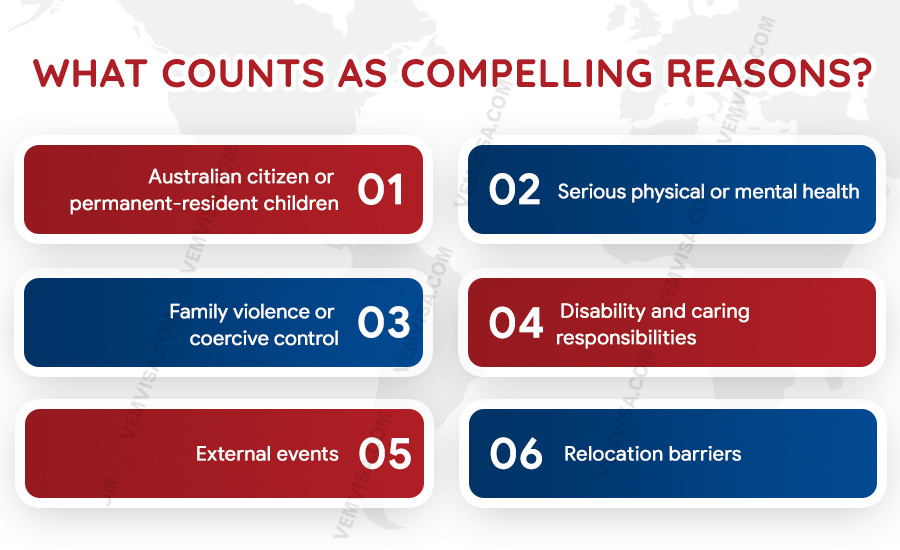
What counts as compelling reasons?
“Compelling reasons” is not exhaustively defined in the Regulations. The assessment is individual and evaluative. The decision-maker considers the circumstances affecting the applicant, Australian partner, children and sometimes other people, as well as the visa history and reasons the applicant did not regularise status earlier.
Potentially relevant circumstances can include:
- Australian citizen or permanent-resident children: the child’s best interests, care arrangements, education, health, attachment and practical effect of separation or relocation.
- Serious physical or mental health: diagnosis, treatment, prognosis and the concrete support the applicant provides to the sponsor or family.
- Family violence or coercive control: how abuse affected visa status, decision-making, access to documents, finances or ability to seek help.
- Disability and caring responsibilities: the needs of an Australian partner, child or dependent relative and the availability of realistic alternative care.
- External events: serious accident, incapacity, official or representative error, conflict, disaster or another event causally connected to the visa problem.
- Relocation barriers: safety, healthcare, legal recognition of the relationship, custody, language and the sponsor’s inability to relocate – supported by country and personal evidence.
Evidence for a Schedule 3 waiver Partner visa request
A strong request normally contains a dated chronology, a legal framework, statements from the applicant and sponsor, independent evidence, and a clear explanation of why offshore lodgement is not a realistic answer in the particular circumstances. Relationship evidence remains necessary, but it is not a substitute for Schedule 3 evidence.
| Issue |
Possible evidence |
Question to answer |
| Visa history and delay |
Grant notices, VEVO, ImmiAccount records, cancellation/refusal letters, travel records, advice file, emails and a day-by-day chronology. |
How did the applicant lose substantive status, what was within or beyond their control, and what did they do to regularise it? |
| Australian partner hardship |
Medical reports, psychologist evidence, carer assessments, finances, employment evidence and detailed statement. |
What concrete harm would occur, why is it more than ordinary separation hardship, and what alternatives were considered? |
| Children’s best interests |
Birth/citizenship records, school and childcare reports, medical evidence, parenting schedule, expert assessment and custody documents. |
How would separation, relocation or uncertainty affect each child’s stability, care, education, health and relationships? |
| Family violence |
Police or court documents where available, family-violence service records, medical evidence, counsellor reports, financial records and witness statements. |
How did the conduct affect the applicant’s status, choices, safety or capacity to lodge earlier? |
| Country and relocation barriers |
Authoritative country material, healthcare access evidence, legal restrictions, employment evidence and family-specific risk material. |
Why can the Australian family not reasonably relocate or maintain family life through an offshore process? |
| Compliance and character |
Visa conditions, work records, tax records, police checks, explanations of breaches and evidence of corrective steps. |
Has the applicant substantially complied, and why should the decision-maker trust future compliance? |
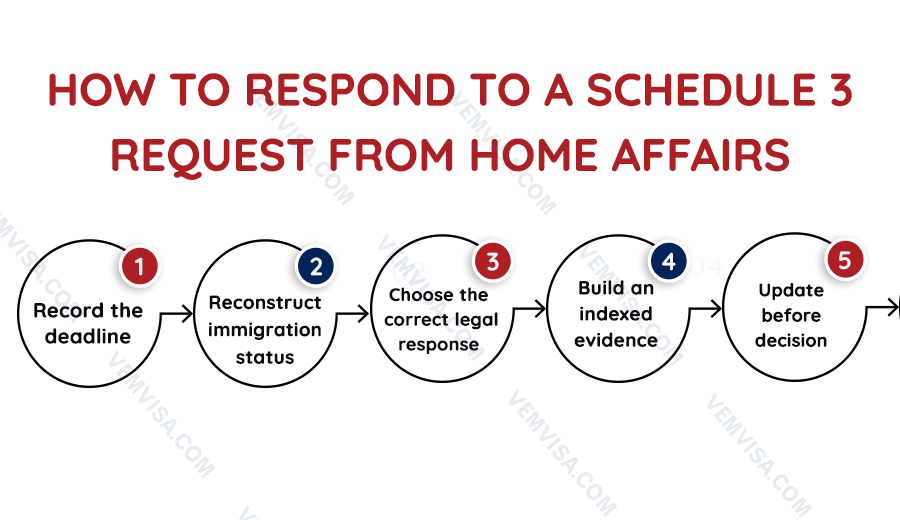
How to respond to a Schedule 3 request from Home Affairs
1. Record the deadline
Read the request or procedural-fairness letter in full, identify every issue and confirm the response deadline. Ask for extra time only through the proper channel and never assume it has been granted.
2. Reconstruct immigration status
Verify the last substantive visa, cessation date, all Bridging Visas, refusals, cancellations, review history, travel and any No Further Stay condition.
3. Choose the correct legal response
Address whether the applicant meets the applicable Schedule 3 criteria, requests the compelling-reasons discretion, or relies on both arguments in the alternative.
4. Build an indexed evidence package
Link every factual claim to a document. Separate relationship evidence, visa history, medical material, child evidence, country information and compliance records.
5. Update before decision
Because relevant compelling circumstances can arise after lodgement, provide material changes through ImmiAccount before the case is decided rather than assuming old evidence remains sufficient.
Onshore waiver, offshore visa or review after refusal?
The right strategy depends on status, application validity, relationship facts, Schedule 3 evidence, review rights and the consequences of leaving Australia. No applicant should withdraw, depart or lodge another visa merely because an offshore case sounds simpler.
| Path |
When it may be considered |
Main risk or limitation |
| Continue subclass 820 with Schedule 3 request |
The onshore application is valid and the applicant has a properly evidenced basis to meet the criteria or seek the compelling-reasons discretion. |
High evidentiary threshold; relationship eligibility alone does not overcome Schedule 3, and refusal can affect status and future options. |
| Offshore subclass 309/100 |
An offshore pathway is legally and practically available after advice on departure, bars, debts, status and re-entry. |
Departure may end a Bridging Visa and affect review or onshore rights. Offshore processing may create a lengthy separation and visitor entry is not guaranteed. |
| ART merits review |
A subclass 820 refusal is reviewable and a valid application can be lodged by the eligible person within the decision-letter deadline. |
Strict deadline, fee and potentially long processing. A review does not guarantee unrestricted work or travel rights. |
| Judicial review |
There is an arguable legal or jurisdictional error in an ART or Department decision. |
A court does not simply reconsider compelling circumstances on the merits; deadlines, costs and litigation risk apply. |
VEM’s subclass 309/100 guide explains the offshore pathway, while its Partner visa processing-time guide provides current planning context. Government charges are generally not refunded merely because an application is refused or withdrawn; check VEM’s Partner visa fee guide before comparing strategies.
Do you hold a Bridging Visa or have an unlawful-status history?
VEM can review your visa chronology, identify Schedule 3, section 48 and No Further Stay issues, assess the onshore and offshore Partner visa pathways, and prepare an evidence plan tailored to your circumstances.
Discuss your Partner visa with VEM
FAQs
Does Schedule 3 apply if I hold a Bridging Visa?
It can. A Bridging Visa is not a substantive visa, even though it may keep you lawful. The decisive analysis includes the visa held when the Partner visa was lodged, your full status history and any special pathway under clause 820.211.
What is the 28-day rule for Schedule 3?
Criterion 3001 generally requires the valid visa application to be made within 28 days after the statutory “relevant day.” The relevant day is defined in 3001(2) and depends on the person’s visa and entry history. It should be calculated from official records, not assumed.
Is there a Schedule 3 waiver form?
There is generally no separate waiver visa or standalone approval form. The applicant provides a written request and evidence within the subclass 820 application, responding to clause 820.211 and the relevant Schedule 3 criteria.
Is having an Australian child enough for a Schedule 3 waiver?
Not automatically. A child’s interests can carry substantial weight, but the decision is case-specific. Evidence should show how separation, relocation or instability would affect that child’s care, health, education, relationships and development.
Can compelling reasons arise after the Partner visa application?
Yes. Waensila confirms that the assessment is not confined to reasons existing at lodgement. Relevant circumstances up to the decision can be considered, so important changes should be documented and provided before Home Affairs finalises the application.
Can I apply offshore instead of requesting a Schedule 3 waiver?
An offshore subclass 309/100 pathway may be available, but departure can affect a Bridging Visa, lawful status, review rights and return options. Compare the consequences before withdrawing an onshore application or leaving Australia.
Can a refused Schedule 3 Partner visa be appealed?
Some subclass 820 refusals can be reviewed by the Administrative Review Tribunal. Review availability, the eligible applicant and deadline are stated in the decision letter. The statutory time limit is strict, so obtain advice immediately rather than relying on a generic number of days.

 VN
VN
 Người
đăng
Người
đăng Ngày
cập nhật:
Ngày
cập nhật:



