Updated No Further Stay guide
A practical explanation of condition 8503, waiver tests, evidence, skilled-visa provisions and the steps needed to protect lawful status.
Visa condition 8503, or “No Further Stay”, prevents a holder from being granted most substantive visas while they remain in Australia. If it applies, lodging an onshore partner, student, visitor or work visa may be invalid unless the condition is first waived or a specific legal exception applies.
An 8503 waiver is deliberately difficult. The usual test requires compelling and compassionate circumstances that developed after the relevant visa was granted, were beyond the person’s control and caused a major change in circumstances. A waiver removes the condition; it does not extend the existing visa, grant a new visa or automatically create a Bridging Visa.
Quick answer: Check the grant letter and VEVO for “8503 – No Further Stay”. If present, do not lodge another onshore substantive visa based only on a pending waiver request. Obtain written waiver approval first and separately confirm the intended visa can be validly lodged.
What does visa condition 8503 mean?
Condition 8503 restricts a person who has entered Australia on the conditioned visa from being granted another substantive visa while remaining in Australia, other than a Protection visa. A substantive visa is generally any visa other than a bridging, criminal justice or enforcement visa.
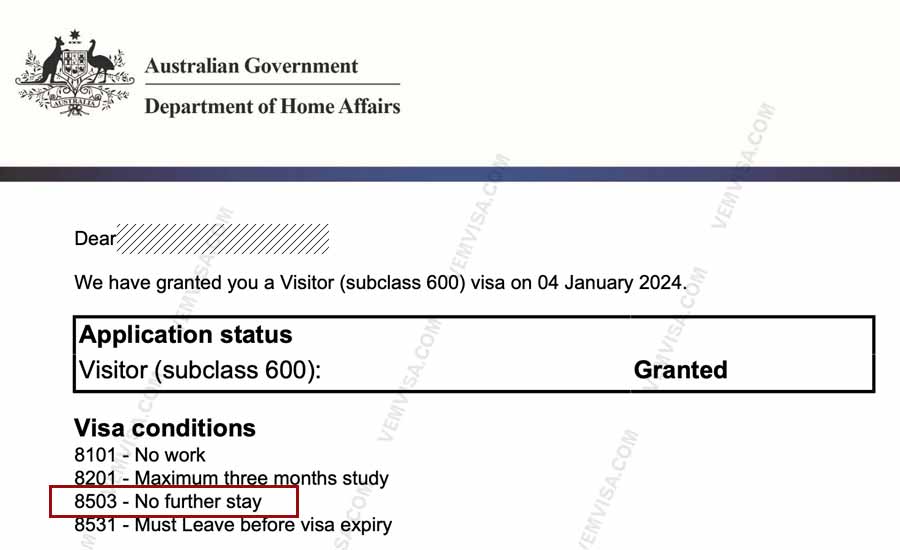
The restriction can continue to affect onshore application validity even after the conditioned visa has ceased, until the person leaves Australia or Home Affairs waives the condition. Waiting until the expiry date therefore does not make the problem disappear.
You may stay until expiry
Condition 8503 does not shorten the current visa’s authorised stay by itself. All other conditions still apply.
Onshore applications restricted
Most further substantive-visa applications cannot validly be made while the person remains in Australia.
Offshore applications different
After departure, condition 8503 does not itself bar a valid offshore application, although all criteria and other restrictions still apply.
Protection visa applications are treated differently under the legislation, but protection should be considered only where genuine protection claims exist. It is not a device for avoiding condition 8503.
Which visas can carry condition 8503?
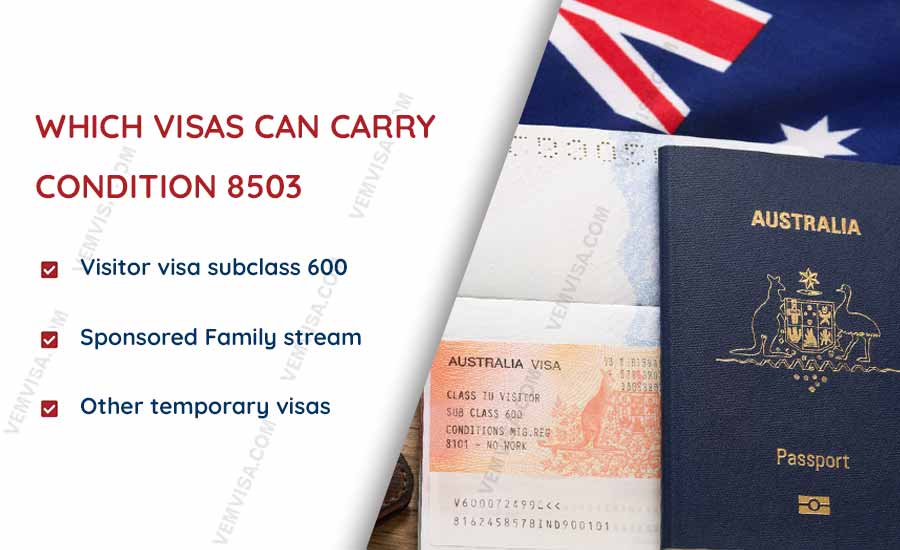
The condition is most frequently seen on Visitor visas, particularly where sponsorship arrangements apply. For some visa circumstances it is mandatory; in others Home Affairs may impose it at discretion.
| Situation |
Practical check |
Do not assume |
| Visitor visa subclass 600 |
Read every condition on the individual grant. |
Not every Tourist stream grant has 8503. |
| Sponsored Family stream |
Expect strict onshore limitations and verify VEVO. |
Australian family ties do not remove the condition. |
| Other temporary visas |
Check the grant notice and current legislation. |
Do not confuse 8503 with conditions 8534, 8535 or 8540. |
The quickest reliable check is VEVO and the visa grant notification. If “No Further Stay – 8503” is shown, resolve its effect before paying another application charge.
For related planning, read VEM’s Visitor visa guide and Bridging Visa A guide.
The usual condition 8503 waiver test
Under the ordinary compelling-and-compassionate pathway, the circumstances relied on must satisfy all parts of the legal test:
1. They developed after visa grant
The relevant change must arise after the visa carrying condition 8503 was granted. A long-standing situation normally cannot be reframed as new without evidence of material deterioration.
2. They are compelling and compassionate
The circumstances must create a strong humanitarian or practical reason for allowing an onshore application; preference or convenience is insufficient.
3. They were beyond the person’s control
The person must not have created, chosen or reasonably controlled the event relied upon.
4. They caused a major change
Show how the post-grant event materially changed the person’s actual situation and why departure is now unreasonable or impracticable.
If a previous waiver request was refused, a new request generally needs circumstances substantially different from those already considered. Rewriting the same claim or adding weak documents is unlikely to meet that threshold.

Circumstances that may or may not support a waiver
May be relevant
- Serious new illness or injury making travel medically unreasonable
- Death or serious deterioration of a close family member in Australia requiring support
- Natural disaster materially preventing return
- War or severe civil unrest arising after grant
Generally insufficient alone
- Marriage or beginning a de facto relationship in Australia
- Pregnancy without serious unforeseen complications
- A desire to remain with family or continue employment
- Failed subjects or choosing another course
Examples are not automatic approvals or refusals. A pregnancy complication may support a waiver where independent medical evidence shows unfitness to travel; ordinary pregnancy by itself is commonly treated differently. The facts, timing and causal link matter.
A separate 8503 waiver pathway for certain skilled visas
Regulation 2.05(4AA) provides a separate discretionary circumstance where a current holder of the conditioned visa has a genuine intention to apply for a visa in specified skilled or employer-sponsored categories. The listed framework includes General Skilled Migration visas and particular subclasses such as 186 visa, 191 visa, the current 482 Skills in Demand visa, and 494 visa.
This is not a general-purpose waiver
A waiver under the skilled-visa provision can restrict the valid next application to the prescribed visa categories. It should not be treated as permission to switch later to a partner, student or visitor visa.
This route is technical and date-sensitive. It is framed for a person who still holds the visa carrying condition 8503; allowing that visa to expire may close this particular pathway while the general onshore bar continues. Nomination, invitation and separate Schedule 1 lodgement criteria must also be satisfied.
Home Affairs’ public online form is primarily framed around No Further Stay waivers generally and does not replace an analysis of the current Regulations. Obtain advice before relying on a skilled waiver or lodging the intended visa.

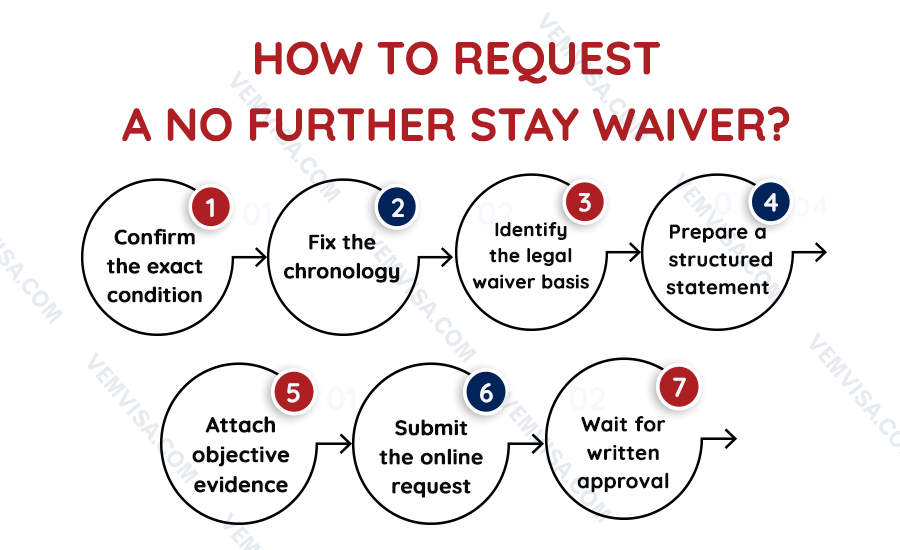
How to request a No Further Stay waiver
- Confirm the exact condition: check whether it is 8503, 8534, 8535 or another condition because the rules differ.
- Fix the chronology: record visa grant, entry, event, medical or family developments, current stay expiry and intended application dates.
- Identify the legal waiver basis: ordinary compelling circumstances and prescribed skilled intentions are not interchangeable.
- Prepare a structured statement: address every element of the applicable test with dates and cross-references to evidence.
- Attach objective evidence: medical reports, hospital documents, death certificates, official disaster or security information, relationship and care evidence, or skilled-pathway documents.
- Submit the online request: each affected visa holder must lodge their own Home Affairs waiver request.
- Wait for written approval: do not assume submission suspends the condition or validates another application.
A persuasive medical letter should address diagnosis, onset, change since visa grant, treatment, ability to fly, the risk of travel and expected timeframe. General statements such as “the patient should stay with family” may not establish the legal test.
Timing, visa expiry and Bridging Visas
A waiver request does not extend the visitor’s authorised stay and does not itself make the person eligible for a Bridging Visa. If the current stay expires while the request remains undecided, the person can become unlawful unless another valid lawful-status arrangement applies.
Home Affairs does not promise one processing time for every waiver. Lodge as early as the relevant circumstances and evidence allow, but do not submit a speculative request before the waiver test is met.
A pending waiver is not lawful status
Track the visa’s period of stay, not only its travel-validity date. Obtain urgent advice if expiry is near or has passed.
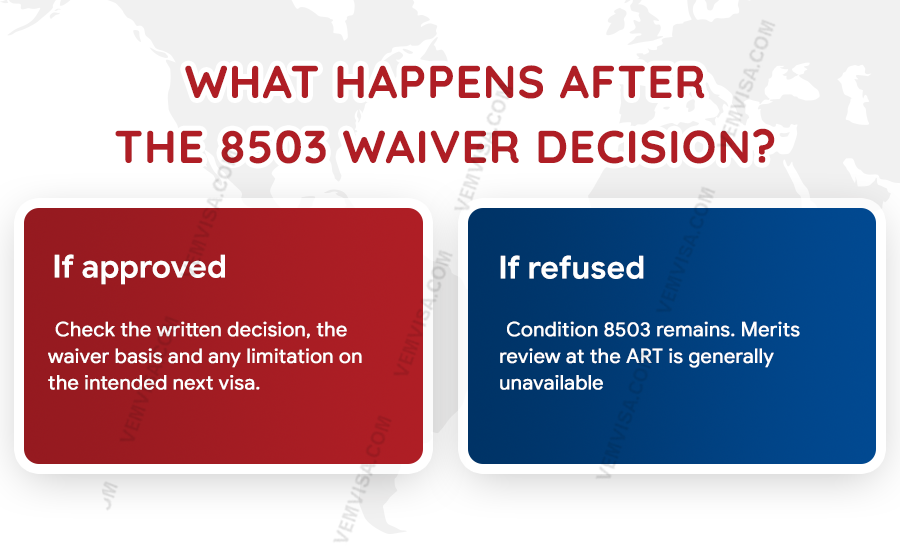
What happens after the waiver decision?
If approved
Check the written decision, the waiver basis, and any limitation on the intended next visa. Confirm every other eligibility and lodgement requirement, then apply before the current lawful stay ends.
If refused
Condition 8503 remains. Merits review at the ART is generally unavailable. Judicial review concerns legal error, not a fresh merits decision, and strict deadlines apply.
Approval does not guarantee the next visa and does not waive unrelated barriers such as eligibility, onshore-location rules, another No Further Stay condition, health, character or Schedule 3 requirements.
If departure is feasible, an offshore application may be the simpler lawful route. Compare processing, travel, family separation and grant-location requirements rather than treating a waiver as the only option.
Common condition 8503 waiver mistakes
- Lodging the next visa while the waiver is merely pending.
- Relying on marriage, pregnancy or employment without a qualifying post-grant event.
- Failing to explain how the event was beyond control and caused a major change.
- Submitting screenshots or personal claims without independent evidence.
- Assuming approval extends the current visa or creates a Bridging Visa.
- Using a skilled-visa waiver as if it allowed any later onshore visa.
- Making the same request again without substantially different circumstances.
If you need further assistance, please contact VEM. Our consultant, Mr. Peter Cao, a registered migration agent (MARN: 1577877), with more than 10 years of experience in the migration field, will help you.
Does your visa show condition 8503?
Assess the waiver test, evidence, expiry date and intended visa before lodging anything onshore.
Contact VEM Visa
FAQs
Can condition 8503 be waived?
Yes, in limited circumstances. The usual pathway requires compelling and compassionate post-grant events beyond the person’s control that caused a major change. A separate provision covers genuine intentions for specified skilled visas.
Does marrying an Australian remove condition 8503?
No. Marriage does not automatically waive the condition and generally does not by itself satisfy the beyond-control test. Without a waiver, an onshore partner application may be invalid.
Does requesting a waiver extend my visa?
No. The existing visa and authorised stay retain their original dates. A pending request does not grant a Bridging Visa or protect against becoming unlawful.
Can I lodge another visa while the waiver is pending?
Do not assume so. For most intended onshore substantive visas, written waiver approval must exist before a valid application can be made.
Can condition 8503 be waived for a 482 or 186 visa?
Current regulations provide a separate discretionary waiver pathway for genuine intentions to apply for specified skilled and employer-sponsored visas, including listed 482 and 186 categories. It is technical and does not waive other lodgement criteria.
Can I appeal an 8503 waiver refusal at the ART?
Merits review is generally unavailable. Judicial review may be possible only for legal error and is not a reconsideration of whether the waiver should be granted.

 VN
VN

 Người
đăng
Người
đăng Ngày
cập nhật:
Ngày
cập nhật:



