Updated 7 September 2026 · Working Holiday Health Cover Guide
Current guidance for subclass 417 and 462 holders, including condition 8501, OVHC, travel insurance, Medicare and work-related cover considerations.
A Working Holiday in Australia can include farm work, hospitality shifts, construction, road trips and long distances from major hospitals. A minor injury or unexpected admission can therefore become much more than a travel inconvenience. Most temporary visitors are personally responsible for their healthcare costs, and access to Medicare depends on separate eligibility rules.
Quick answer: Health insurance is strongly recommended for both the Working Holiday visa 417 and Work and Holiday visa 462. It is not a universal upfront requirement for every applicant, but condition 8501 can be attached and then adequate cover must be maintained while in Australia. Even without condition 8501, uninsured travellers may have to pay the full cost of treatment.
Is health insurance mandatory for a Working Holiday visa?
Home Affairs’ subclass 417 and 462 pages say that health insurance is strongly recommended because the visa holder is personally liable for healthcare costs in Australia. The Department’s condition 8501 instrument lists both subclasses as visas on which that condition may be imposed. In other words, the correct answer depends on the conditions attached to the individual visa.
When condition 8501 appears on the grant
Condition 8501 means the holder must maintain adequate arrangements for health insurance while in Australia. Check the visa grant notice and Visa Entitlement Verification Online (VEVO). If the condition appears, keep appropriate cover active without gaps and retain the policy certificate and payment records. A traveller should not cancel merely because immigration clearance is complete.
When condition 8501 is not attached
Insurance remains a practical safeguard rather than a visa condition. An uninsured overseas visitor can be treated as a private patient in either a public or private hospital and may need to pay at the time of treatment. Home Affairs also cautions that even adequate insurance may not pay the whole bill, so limits, gaps, excesses and co-payments matter.
Do not confuse the visa health examination with insurance
An applicant may still be asked to complete medical checks. Passing the immigration health requirement does not pay future treatment costs, and buying a policy does not replace a requested examination.

Health cover for visa 417 versus visa 462
Both subclasses sit within the Working Holiday Maker program and normally permit a 12-month stay, short-term work and up to four months of study. Eligibility depends primarily on the passport used. VEM has separate guides for the Working Holiday visa subclass 417 and the Work and Holiday visa subclass 462.
| Point |
Subclass 417 |
Subclass 462 |
| Official name |
Working Holiday visa |
Work and Holiday visa |
| Main distinction |
Available to specified 417 passport countries or jurisdictions. |
Different partner-country list; extra education, English, support-letter, cap or ballot rules may apply. |
| Health insurance |
Strongly recommended; maintain adequate cover if condition 8501 is attached. |
Strongly recommended; maintain adequate cover if condition 8501 is attached. |
| Family cover |
Family members are not included in the application; each traveller needs their own visa and insurance plan. |
Family members are not included in the application; dependent children cannot accompany the holder. |
| Later visas |
Eligible holders may obtain second and third visas under the relevant rules. |
Eligible holders may obtain second and third visas under the relevant rules. |
The insurance analysis is therefore broadly similar, but nationality affects possible Medicare access under a Reciprocal Health Care Agreement. A traveller should not copy a friend’s insurance decision simply because both people are on a “working holiday”.
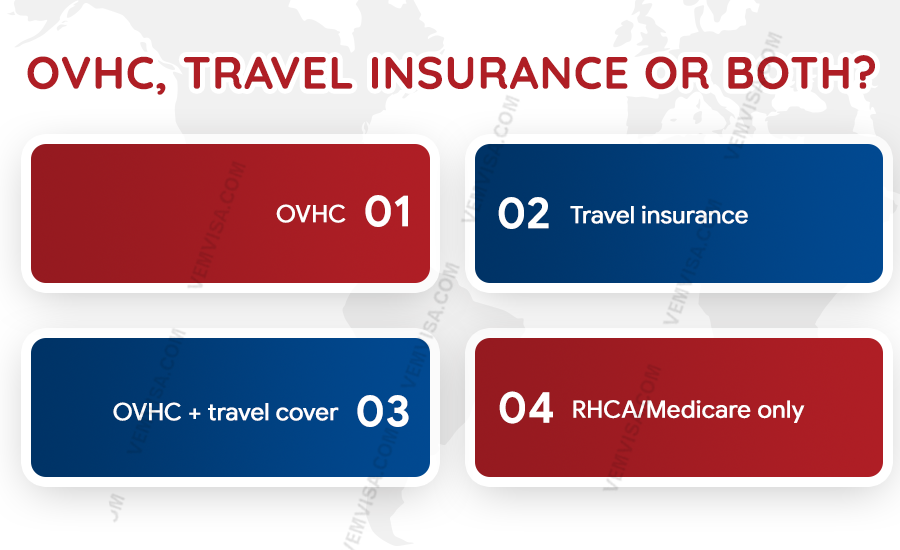
OVHC, travel insurance or both?
Overseas Visitors Health Cover (OVHC) is designed around medical and hospital treatment for temporary visitors. Travel insurance commonly adds trip cancellation, luggage, personal liability and repatriation benefits, but its medical cover may have shorter limits, activity exclusions or a requirement to hold coverage from the home country. Some travellers combine the two.
| Option |
Usually designed to cover |
What to verify |
| OVHC |
Hospital and eligible medical treatment in Australia. |
Visa suitability, inpatient and outpatient benefits, ambulance, medicines, excess and waiting periods. |
| Travel insurance |
Emergency medical care plus travel events such as cancellation, luggage and repatriation. |
Maximum trip length, working activities, motorcycles, sports, pre-existing conditions and whether it meets condition 8501. |
| OVHC + travel cover |
Broader medical protection and non-medical travel risks. |
Overlaps, duplicate benefits, claim priority and total cost. |
| RHCA/Medicare only |
Limited medically necessary public care for eligible visitors from agreement countries. |
Country-specific entitlement, enrolment, exclusions and whether private cover is still required by the grant. |
What “adequate” health insurance should address
Home Affairs publishes a benefit-level guide covering hospital admission, surgery, implanted prostheses, eligible medicines, admitted medical services and ambulance transport. It is a minimum risk guide, not a promise that every charge will be reimbursed. Before non-emergency treatment, request informed financial consent from the provider and confirm benefits with the insurer.
Can Working Holiday visa holders use Medicare?
A temporary Working Holiday visa does not automatically provide Medicare. Visitors from a country with an Australian Reciprocal Health Care Agreement may be eligible for specified medically necessary care. The agreement countries and exact benefits are set by Services Australia, and eligibility may depend on where the traveller lived immediately before arriving.
RHCA cover is not equivalent to comprehensive private insurance. It may not cover ambulance, dental care, private hospital treatment, all medicines, elective procedures or repatriation. Ireland and New Zealand also have distinct administrative arrangements. Check the correct Services Australia country page and bring the documents needed for enrolment or treatment.
How to choose medical insurance for a working holiday
The best policy is the one that matches the holder’s visa condition, health profile, work, travel plans and realistic risk tolerance. Product marketing aimed at backpackers is not enough; read the policy wording and ask the insurer questions in writing.
| Feature |
Questions to ask |
Why it matters |
| Work activities |
Are farm work, construction, hospitality, machinery and manual labour covered? |
A general leisure policy may exclude paid or hazardous work. |
| Motorcycles and driving |
Are scooters, motorcycles and road trips covered, and what licence/helmet rules apply? |
Non-compliance can invalidate a claim. |
| Hospital and outpatient care |
Does cover include public/private admission, GP, specialist, imaging and pathology? |
Treatment often begins outside hospital. |
| Ambulance |
Emergency-only or broader transport, and does it operate nationwide? |
State arrangements differ and ambulance bills can be high. |
| Pre-existing conditions |
What definition, assessment, waiting period or exclusion applies? |
A stable condition may still be treated as pre-existing. |
| Sports and remote travel |
Are surfing, diving, hiking, skiing and remote-area evacuation included? |
Adventure activities may require an add-on or remain excluded. |
| Excess and limits |
How much per claim/admission, what annual caps apply, and are provider gaps payable? |
A cheap premium can shift more cost to the traveller. |
| Repatriation |
Does it cover medical evacuation or return home when medically necessary? |
OVHC and travel policies often differ in this area. |
Working in regional and remote Australia
Specified work for a later visa may take a traveller far from major services. Check emergency transport, retrieval, telehealth and the nearest network hospitals. Insurance does not override workplace protections: employers must still comply with Australian work health and safety and workers’ compensation laws. However, workers’ compensation generally relates to work injuries, not illness, leisure accidents or every healthcare cost.
Travellers planning another year should also review VEM’s second Working Holiday visa guide and preserve employment evidence separately from insurance documents.

When should working holiday health insurance start and end?
Arrange cover before travel so the start date aligns with arrival and any visa condition. A first 417 or 462 stay normally begins on first entry after grant, while the commencement of a second or third visa depends on the person’s location and current visa. Use the actual dates in the grant notice rather than buying a generic twelve-month period.
Avoid gaps between first, second and third visas
A later Working Holiday visa is a separate grant, not an automatic extension. If staying in Australia while another application is processed, check the substantive visa, any bridging visa, its conditions and the insurance certificate. Extend or replace the policy before it expires. When changing insurers, activate the new cover before cancelling the old and ask how served waiting periods are treated.
Time spent outside Australia generally does not extend the 12-month stay after it starts. Ask the insurer whether cover can be suspended during overseas travel and how this affects condition 8501, waiting periods and claims. Do not suspend a policy if that would breach an attached visa condition.

How much does Working Holiday visa health insurance cost?
Australia does not set one government premium. Price depends on age, duration, benefit level, excess, extras, pre-existing-condition treatment and whether travel benefits are included. Insurers may quote weekly or monthly amounts, but compare the same coverage period and benefits before deciding.
Budget beyond the premium
Total exposure = premiums + excesses + co-payments + provider gaps + excluded treatment + costs above benefit limits. Also allow for dental, optical, prescriptions, ambulance and repatriation where these are not included. A policy that costs less can still produce a larger bill after a claim.
Common insurance mistakes to avoid
- Assuming every 417 or 462 visa has condition 8501 without checking VEVO—or assuming no insurance is needed because a friend’s visa did not have it.
- Buying a leisure travel policy that excludes paid manual work, farm tasks, construction, motorcycles or adventure activities.
- Assuming RHCA eligibility covers every medical, ambulance and repatriation cost.
- Ignoring waiting periods and the policy definition of a pre-existing condition.
- Cancelling cover after visa grant or allowing a direct debit to fail.
- Failing to update cover when obtaining a second or third Working Holiday Maker visa.
- Choosing on premium alone without checking excess, benefit caps and hospital networks.
How VEM can help with a Working Holiday visa
An insurer can explain its policy; a registered migration professional can help interpret the visa pathway, evidence and conditions. VEM can assist with subclass selection, first or subsequent visa eligibility, specified-work records and the application process. For a broader overview, see VEM’s Working Holiday Maker guidance.
Check the visa before choosing the policy
Confirm whether you need subclass 417 or 462, review the grant conditions and plan any second-year specified work. Ask the insurer separately to confirm product eligibility and benefits in writing.
Contact VEM Visa
FAQs
Do I need health insurance for an Australian Working Holiday visa?
Home Affairs strongly recommends it. Condition 8501 may be attached to a subclass 417 or 462 visa; if attached, adequate insurance must be maintained while in Australia. Check the grant letter and VEVO.
Is insurance required before applying for visa 417 or 462?
It is not a universal upfront document for every applicant. The Department can request information and may impose condition 8501. Arrange suitable cover before travelling and follow any specific request or grant condition.
Can I use travel insurance instead of OVHC?
Possibly, but only if the policy meets your needs and any attached visa condition. Confirm this in writing. Travel cover and OVHC are designed differently, so compare hospital, outpatient, work-activity and repatriation benefits.
Does Medicare cover Working Holiday visa holders?
Not automatically. Some visitors qualify for limited benefits under a Reciprocal Health Care Agreement. Check the country-specific Services Australia rules and do not assume this replaces an insurance obligation.
Does working holiday insurance cover farm work?
It depends on the policy. Confirm paid manual work, machinery, livestock, remote work and any height or hazardous-duty exclusions. An ordinary leisure policy may not cover every specified-work activity.
Do I need new insurance for a second Working Holiday visa?
Ensure the cover continues through the new visa period and any bridging period. You may extend or replace a policy, but avoid gaps and check the conditions attached to each visa.
Are pre-existing conditions covered?
Coverage varies. Waiting periods, exclusions and clinical assessments may apply. Disclose health information accurately and obtain written advice from the insurer before purchase.
How much is health insurance for a Working Holiday visa in Australia?
There is no fixed government price. The premium depends on age, duration, benefits, excess and add-ons. Compare total possible out-of-pocket costs, not only the advertised weekly or monthly rate.

 VN
VN

 Người
đăng
Người
đăng Ngày
cập nhật:
Ngày
cập nhật: