
 VN
VN
Skilled Worker Visa Australia: Requirements and Pathways
VEMVisa | Skilled Migration Australia
A practical guide to skilled worker visa pathways, from employer sponsorship to points-tested General Skilled Migration.
A skilled worker visa Australia pathway may suit qualified professionals and trades workers who want to work, live or build a longer-term future in Australia. The correct route depends on your occupation, skills assessment, English ability, work history, age, sponsorship and location.
Australia does not use one universal “skilled work visa”. It offers several employer-sponsored, points-tested and regional pathways. Start with the official criteria, then compare the visa route that fits your circumstances.
Important: Eligible occupations, nomination settings, invitation rounds, income thresholds and visa rules can change. This guide was reviewed on 30 June 2026. Confirm the current position using the Department of Home Affairs skilled migration program before acting.
On this page
What it means · Visa types · Requirements · Occupation list · How to apply · Timing & cost · FAQ

What is a Skilled Worker Visa Australia?
“Skilled worker visa Australia” is a broad search term, not one visa subclass. It usually refers to visas that allow a suitably skilled person to work in Australia through an employer nomination, a points-tested invitation, or a regional pathway.
The first decision is whether you have an eligible employer ready to sponsor you, or whether you may compete through the General Skilled Migration system. The answer affects the evidence, application sequence and visa options.
Employer-sponsored pathways
An eligible Australian employer nominates a role. Common pathways include the temporary Skills in Demand visa, Employer Nomination Scheme and regional employer-sponsored options.
General Skilled Migration
Points-tested visa routes use SkillSelect. Subclass 189, 190 and 491 each have different invitation, nomination or regional requirements.
Regional pathways
Regional options can involve a state or territory nomination, an eligible family sponsor, or a regional employer. They carry route-specific conditions.
Skilled visa types: employer-sponsored and General Skilled Migration
The table below is a pathway map, not a personal eligibility decision. Visa streams and occupation settings vary, so use it to identify what to investigate next.
| Visa pathway | Route | High-level purpose |
|---|---|---|
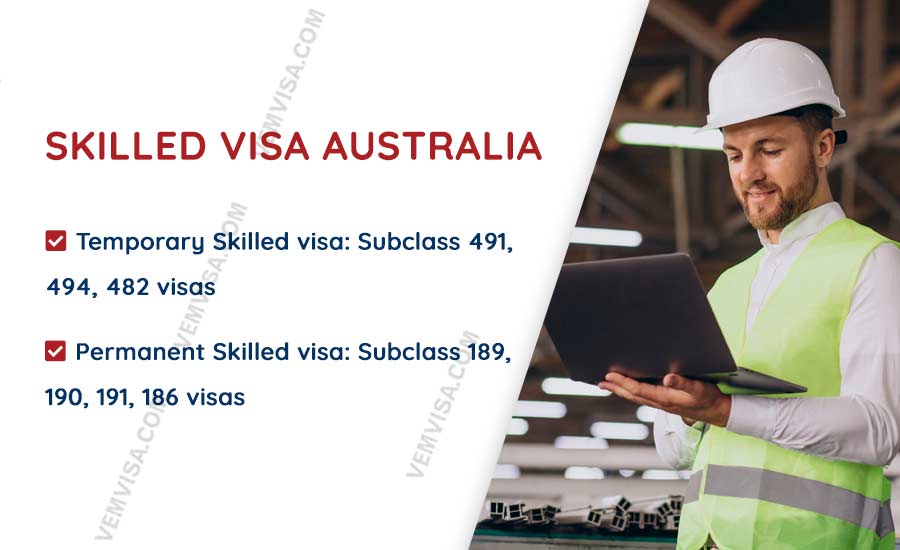
| 482 Skills in Demand | Employer-sponsored | Temporary work pathway for a suitably skilled worker nominated by an employer, subject to the relevant stream requirements. |
| 186 Employer Nomination Scheme | Employer-sponsored | Permanent employer-nominated pathway, with eligibility depending on its stream and personal circumstances. |
| 494 Skilled Employer Sponsored Regional | Regional employer-sponsored | Regional pathway for a skilled worker nominated by an eligible regional employer. |
| 189 Skilled Independent | Points-tested | Invitation-based route for eligible skilled workers without employer, state or family sponsorship. |
| 190 Skilled Nominated | Points-tested + state nomination | Invitation-based pathway for eligible workers nominated by a state or territory. |
| 491 Skilled Work Regional | Points-tested + regional support | Provisional regional pathway via eligible state or territory nomination or eligible family sponsorship. |
| 191 Permanent Residence (Skilled Regional) | Regional permanent pathway | Permanent pathway for eligible regional provisional visa holders who meet the relevant criteria. |
Employer-sponsored visas and points-tested visas have different evidence rules. Do not assume that eligibility for one route means you qualify for another.

Skilled Visa Australia requirements: how eligibility varies
There is no single checklist for every skilled work visa in Australia. However, the following areas are commonly assessed and should be reviewed before you choose a route.
| Eligibility area | Points-tested routes | Employer-sponsored routes |
|---|---|---|
| Occupation | Your nominated occupation must be eligible for the relevant visa route and invitation settings. | The employer must nominate an eligible role under the relevant stream and occupation settings. |
| Skills assessment | A positive skills assessment is generally needed before submitting an EOI for the nominated occupation. | It may be required depending on the visa stream, occupation and applicant circumstances. |
| English | English results can determine eligibility and contribute to points. | English requirements depend on the visa stream and any applicable exemptions. |
| Points and invitation | For 189, 190 and 491, you must meet at least the 65-point threshold to be considered for invitation. Meeting it does not guarantee an invitation. | A points test is not the core mechanism. The employer nomination and visa-stream criteria are central. |
| Support or nomination | 190 needs state or territory nomination. 491 needs eligible regional support under its rules. 189 does not use employer sponsorship. | An eligible employer sponsors and nominates the position. Regional pathways have additional regional requirements. |
| Health and character | Relevant health and character requirements apply. | Relevant health and character requirements apply. |
Practical point: The 65-point threshold is a minimum for the relevant points-tested visas. It is not a promise of an invitation, selection or visa grant. Invitation rankings and state nomination settings can change.
Skilled visa Australia occupation list and skills assessment
People often search for one “skilled worker visa Australia list”, but Australia uses different occupation lists and legislative settings across visa programs. An occupation that is available for one pathway may not be available for another.
Use the official Skilled occupation list and the relevant visa page. For EOI-based routes, Home Affairs says a skills assessment in your nominated occupation is needed before you submit the EOI.
1. Match your occupation
Identify the correct occupation code and determine which skilled visa pathway currently accepts it.
2. Confirm the assessor
The relevant assessing authority decides how qualifications and work experience must be evidenced.
3. Keep evidence aligned
Your employment references, payslips, qualifications, English evidence and EOI claims must be consistent.
For a detailed preparation guide, see VEM’s skills assessment information and Australian skilled occupations list.
How to apply for a skilled worker visa to Australia
The application sequence depends on the pathway. Points-tested General Skilled Migration and employer-sponsored visas should not be prepared in the same way.
Points-tested General Skilled Migration
1. Identify your nominated occupation and skills assessor.
2. Prepare English and evidence needed to support your claimed points.
3. Create an EOI in SkillSelect, and seek state or territory nomination where relevant.
4. If invited, lodge a visa application within the timeframe stated in the invitation and provide accurate supporting documents.
Employer-sponsored skilled visa
1. Confirm the role, employer eligibility and suitable visa stream.
2. Align your skills, experience, English and occupation evidence with the nominated position.
3. The employer completes sponsorship and nomination actions required for the route.
4. Lodge your visa application through ImmiAccount and respond promptly to Department requests.
A SkillSelect EOI is not a visa application and it does not guarantee an invitation. Home Affairs publishes invitation-round information and states that higher-ranked EOIs are invited before lower-ranked EOIs in the relevant process.
What skilled visa holders can do, and the limits to check
The rights attached to a skilled visa depend on the visa subclass, stream and conditions shown in the grant notice or VEVO. Temporary, regional and permanent visas should not be treated as interchangeable.
- Temporary employer-sponsored visas are linked to the approved visa route, nominated role and relevant conditions.
- Regional visas can include regional living, working or compliance requirements.
- Permanent visa pathways can allow an eligible person to live and work in Australia permanently, but citizenship requires separate eligibility.
- Always check the actual conditions on the grant notice or in VEVO rather than relying on a general article.

Skilled visa processing times, fees and planning
Processing times and government charges vary by visa subclass, stream, applicant location, case complexity and Department workload. A single “skilled visa processing time” or “skilled worker visa cost” would be misleading.
Use the official visa processing time guide for recently decided applications and the Visa Pricing Estimator before lodging. Both tools are guides, not a guarantee for a particular case.
Build a practical skilled migration plan
Start with your occupation, skills assessment pathway, English evidence, employer or state support, and realistic timing. Then review current policy changes through our Australian migration policy updates.

Discuss your skilled visa pathway
Bring your CV, qualifications, work history, occupation, English results, current visa status and any employer or state nomination details. These facts determine which pathway should be assessed first.
Frequently asked questions
What is the General Skilled Migration visa Australia system?
General Skilled Migration commonly refers to points-tested pathways such as Subclass 189, 190 and 491. These routes use SkillSelect and have different invitation or nomination settings.
Can I apply for a skilled worker visa to Australia without an employer?
Potentially. Subclass 189 is not employer-sponsored. Subclass 190 requires state or territory nomination, while Subclass 491 uses eligible regional support. Each route has separate eligibility rules.
Does 65 points guarantee a skilled visa invitation?
No. The 65-point threshold is the minimum to be considered for the relevant points-tested visas. Invitations depend on the process, occupation demand, ranking and, where relevant, state or territory criteria.
Do I need a skills assessment?
For points-tested EOI routes, Home Affairs says you need a skills assessment in the occupation you nominate before submitting the EOI. Employer-sponsored requirements vary by stream, occupation and circumstances.
Is an occupation on the skilled worker visa Australia list enough by itself?
No. An eligible occupation does not by itself establish visa eligibility. You may still need a suitable skills assessment, English evidence, points, nomination, sponsorship, work history and health or character documents.
Where can I check the current status of my Australian visa?
Use VEVO and your ImmiAccount messages. VEM’s guide to checking visa status in Australia explains the practical steps.
Official skilled migration references