820 Visa Australia: Temporary Partner Visa Requirements, Checklist and 801 Stage
VEMVisa | Australian Partner Visa Guidance
A practical guide to the onshore 820/801 pathway, relationship evidence, temporary stay and the later permanent stage.
The 820 visa is the temporary stage of Australia’s onshore Partner visa pathway. It is for an eligible spouse or de facto partner of an Australian citizen, Australian permanent resident or eligible New Zealand citizen.
Applicants must be in Australia when lodging a valid application. The pathway can later lead to the permanent Partner visa subclass 801. For a broader overview, start with our Partner Visa Australia guide.
Updated 1 July 2026: Visa rules, charges and processing-time estimates can change. This page explains the general 820/801 pathway. Check official Home Affairs tools before lodging, paying a fee or making travel plans.
The 820/801 pathway begins with a temporary onshore Partner visa and may later progress to permanent residence.
What is a Partner Visa 820/801?
The Partner Visa Australia 820 is not permanent residency. It is a temporary visa stage for a person applying from inside Australia. The related subclass 801 is the permanent stage.
Home Affairs describes the 820 as the first step toward the 801 visa. The Department currently states that an applicant must be in Australia when applying for the 820. Since 25 November 2023, the 820 can be granted while the applicant is in or outside Australia. [Home Affairs: partner visa pathways]
Subclass 820: temporary stage
The 820 lets an eligible partner remain in Australia temporarily while the permanent Partner visa stage is pending. Your grant notice and VEVO confirm your actual visa conditions.
Subclass 801: permanent stage
The 801 is the permanent stage of the onshore pathway. In most cases, Home Affairs assesses permanent eligibility after two years have passed from the original temporary Partner visa application date.
The temporary 820 stage and the later 801 stage serve different roles in the onshore Partner visa pathway.
820 visa requirements: are you eligible to apply onshore?
The core question is whether your relationship, sponsor and visa situation meet the rules at the time of lodgement. The Department assesses the facts of each case. A general checklist is not a substitute for an individual assessment.
Applicant and relationship
You are in Australia when you lodge the Partner visa 820 application.
You are the spouse or de facto partner of an Australian citizen, permanent resident or eligible New Zealand citizen.
Your relationship is genuine and continuing, with a mutual commitment to a shared life.
You live together, or are not permanently separated.
You meet relevant health, character and public-interest requirements.
Important visa-history checks
Review your current visa conditions before lodging.
A No Further Stay condition can prevent many onshore applications unless it is waived.
Outstanding debts to the Australian Government should be addressed.
Past visa refusals, cancellations or unlawful-status issues can require careful assessment.
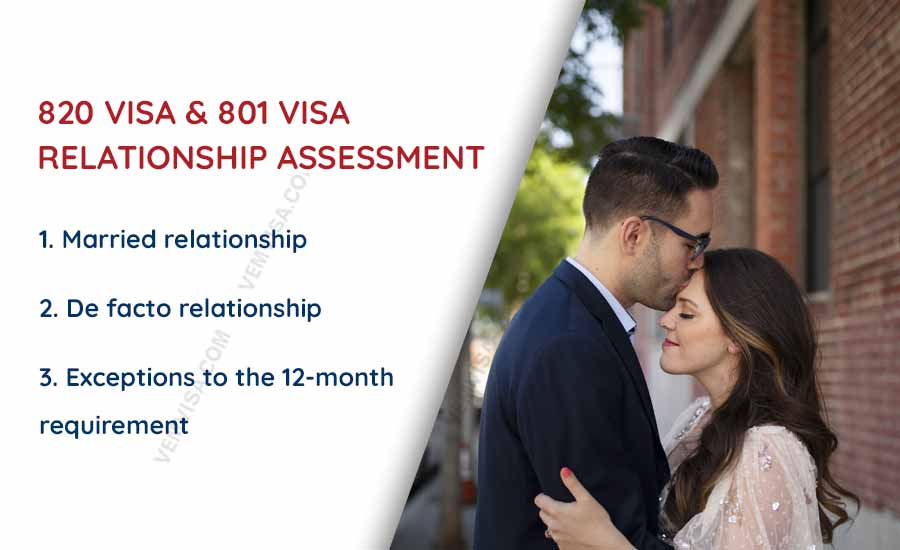
De facto applicants commonly need at least 12 months in the relationship, unless an exemption applies.
Do not assume a visitor visa automatically permits an 820 application. Check your grant letter and conditions first. Home Affairs explains that a No Further Stay condition limits applications for many visas while you are in Australia. [No Further Stay waiver guidance]
Eligibility depends on the applicant’s onshore status, an eligible sponsor and evidence of a genuine relationship.Relationship evidence should show a genuine and continuing partnership across financial, household, social and commitment aspects.
Partner Visa 820 checklist: what evidence should you organise?
A strong partner visa 820 checklist does not mean uploading the largest possible number of documents. It means presenting reliable evidence that shows how the relationship has developed and continues over time.
Home Affairs considers the relationship as a whole. The evidence should make sense across the financial, household, social and commitment aspects of your life together.
Evidence group
Examples to organise
What it should help show
Identity and status
Passports, birth records, marriage certificate where relevant, name-change or divorce documents, sponsor’s citizenship or permanent-residence evidence.
Who the applicant and sponsor are, and their legal relationship status.
Financial aspects
Joint accounts, shared bills, leases, mortgages, insurance, transfers, major purchases and evidence of financial support.
How you manage money and financial responsibilities as a couple.
Household aspects
Lease or property records, mail to a shared address, utility accounts, household arrangements and evidence of shared daily responsibilities.
How you live together in practice.
Social aspects
Photos with friends and family, travel records, invitations, shared memberships and relevant statutory declarations.
How your relationship is known and recognised by others.
Commitment
Relationship statements, communication during time apart, future plans, wills or beneficiary records where relevant and evidence of ongoing support.
Your shared future intentions and the continuing nature of the relationship.
Where children are included, you may need further identity, health, character or custody documents. The Department can request further material at any stage. For guidance on the complete partner pathway, see how to apply for a Partner Visa Australia.
Looking for a Partner Visa 820 form PDF? Avoid relying on downloaded forms from unrelated websites. The Department uses its online process through ImmiAccount and may require information or documents that vary by circumstances. Use the official application flow and your document-request list as the source of truth.
Evidence should tell one coherent story across the financial, household, social and commitment aspects of the relationship.
How to apply for a Partner Visa 820 and manage your bridging visa
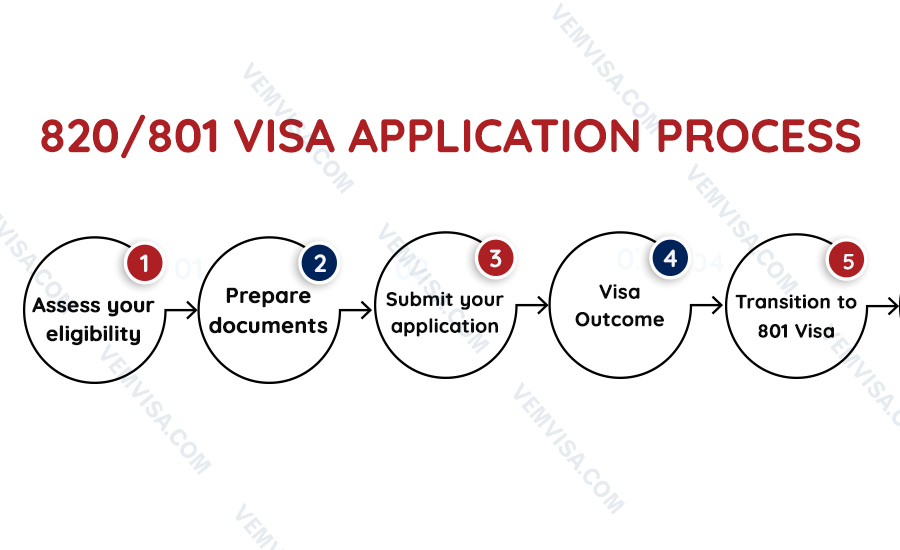
A valid onshore application is made through ImmiAccount. The order of preparation matters because the application, payment, identity records and relationship evidence need to align from the start.
Step 1. Check the pathway and your current visa
Confirm that the 820/801 pathway matches your location and relationship status. Check VEVO, your grant notice and any visa conditions before lodging.
Step 2. Build a dated evidence plan
Sort documents by the four relationship aspects. Use a relationship timeline and concise personal statements to make the evidence easier to understand.
Step 3. Create or use your ImmiAccount
Complete the correct Family visa application online. Upload the required information, pay the visa application charge and retain submission records. [ImmiAccount guidance]
Step 4. Respond to Home Affairs requests
Home Affairs may ask for health examinations, police certificates, biometrics or more relationship evidence. Respond within the stated timeframe and keep copies of every upload.
Step 5. Manage lawful stay and travel
If your substantive visa ends after a valid onshore application, a bridging visa may become relevant. Do not assume it gives travel rights. Only a Bridging Visa B allows travel and re-entry while a substantive visa is being processed. [Home Affairs travel guidance]
Read our Bridging Visa Australia guide for a clearer explanation of bridging visa timing and travel. It should not replace checking the conditions attached to your own visa.
A structured application plan reduces avoidable gaps between relationship evidence, forms and supporting documents.
What happens after 820 visa is granted?
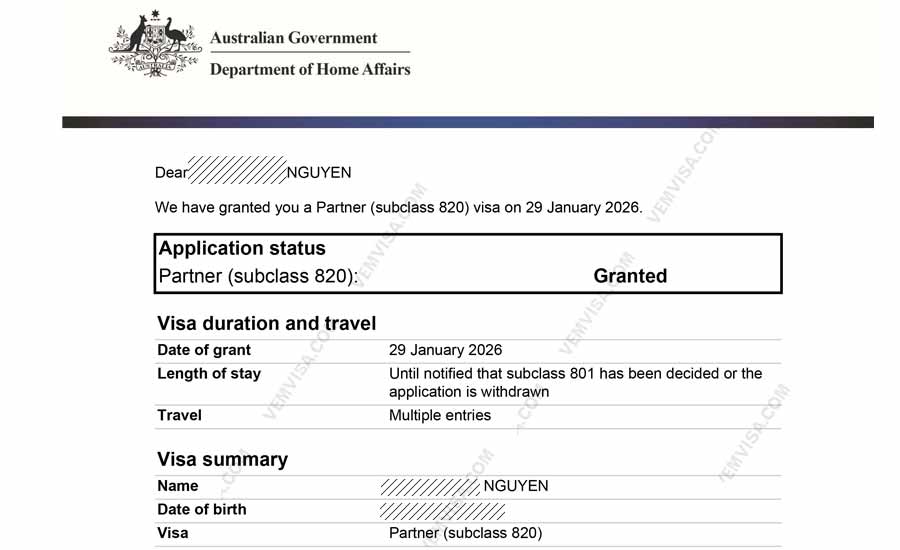
After a temporary Partner Visa Australia grant, you become a temporary Partner visa holder. The 820 is not permanent residency. The next permanent stage is the subclass 801 assessment.
Home Affairs states that two years must have passed since the original temporary Partner visa application before you can be eligible for assessment of the permanent stage. The Department will contact you if it needs updated documents. [Home Affairs Partner visa FAQ]
Keep relationship records current
Continue keeping documents that show your relationship remains genuine and ongoing. Updated evidence may be useful when the 801 stage is considered.
Report major changes promptly
Changes to address, contact details, family circumstances or relationship circumstances may need to be reported to Home Affairs.
Some long-term relationships may be considered for the temporary and permanent stages together. Do not assume a double grant applies. If the relationship ends because of death, family violence or circumstances involving a child, special provisions may be relevant. [Family violence provisions]
820 visa fee, processing time and 820 vs 309 comparison
As checked on 30 June 2026, Home Affairs lists the 820 visa fee as from AUD 11,710 for most applicants. For eligible applicants who already hold a subclass 300 visa, the page lists from AUD 2,475. Fees can change, including around 1 July, so use the official estimator immediately before lodging. [Visa Pricing Estimator]
The partner visa 820 processing time is not fixed. Home Affairs updates its processing-time guide monthly based on recently decided cases. It is indicative only and cannot predict an individual application. [Global visa processing times]
Additional costs can include health examinations, police certificates, biometrics, translations and professional services. Their amount depends on your personal circumstances and service providers. Home Affairs lists these as possible related costs rather than one standard package. [Related visa costs]
Need an 820/801 eligibility and evidence review?
Before lodging, clarify your current visa status, relationship evidence, any No Further Stay issue and the documents that apply to your circumstances. VEM can help you organise a focused next-step plan.
No. Subclass 820 is a temporary Partner visa. It is the first stage of the onshore Partner visa pathway. The permanent stage is subclass 801.
Can I apply for a Partner Visa 820 from outside Australia?
No. You must be in Australia when you lodge an 820 application. The offshore equivalent pathway is normally the 309/100 route.
What happens after 820 visa is granted?
You hold a temporary Partner visa while the permanent 801 stage remains pending. In most cases, you can be considered for the 801 once two years have passed from the original temporary Partner visa application date.
Can I travel while waiting for my 820 visa decision?
Check your current visa and travel facility first. A Bridging Visa A does not allow return travel. Home Affairs states that a Bridging Visa B is required to leave and re-enter Australia while waiting for a substantive visa decision.
Where can I find a Partner Visa 820 form PDF?
Use ImmiAccount and official Home Affairs instructions. Required information and documents depend on the facts of your application, so a generic PDF checklist should only be a planning aid.
After the 820 Partner Visa is granted, you gain temporary residence in Australia, allowing you to live, work, and study. You can travel to and from Australia freely, access Medicare, and will be eligible for the permanent 801 visa, usually two years after your initial application date.
The subclass 820 is a temporary partner visa. It allows you to remain in Australia while your relationship continues to be assessed. This visa stays valid until a decision is made on your permanent partner visa.
The subclass 801 is the permanent stage of the partner visa. Once granted, it gives you an indefinite stay in Australia, starting from the approval date.
No. The DHA just allows you to have 1 sponsor during the time of making your 820 visa application or you have to restart a new application if you have another sponsor.
No. The Partner visa subclass 820 is not permanent residency. The 820 visa is a temporary partner visa. It allows you to live, work, and study in Australia while the Department assesses you for the permanent Partner visa (subclass 801).
In most cases, applicants become eligible for the 801 permanent visa after around two years, provided the relationship is still genuine and ongoing.
Mr. Phong Cao is a licensed migration agent by MARA (MARN: 1577877). He is also a member of the Migration Institute of Australia (MIA: 12648), one of the most reputable organizations in the field of immigration in Australia. In addition, Mr. Phong Cao holds a QEAC certification in study abroad consulting (QEAC: K580) and Australian real estate investment (RA85931). With over 12 years of experience in Australian immigration, he provides comprehensive solutions for studying and settling in Australia.

 VN
VN

 Người
đăng
Người
đăng Ngày
cập nhật:
Ngày
cập nhật: