downloadNgười đăngPeter Phong D Cao
calendarNgày cập nhật:21/07/2026

New South Wales State Nomination For 2026

new south wales state nomination 2024 2025 vem

VEMVisa | New South Wales Skilled Migration

A practical guide to NSW nomination for subclass 190 and subclass 491, including current program status, invitation rounds, requirements, regional pathways, occupation lists and realistic alternatives. 

NSW state nomination can support eligible skilled workers applying for the permanent Skilled Nominated visa subclass 190 or the provisional Skilled Work Regional visa subclass 491. The right route depends on your occupation, skills assessment, English, points, residence, employment and the program settings operating when NSW considers your profile.

NSW skilled migration status for 2026–27

The NSW Government currently states that its subclass 190 and subclass 491 nomination programs are closed for the 2025-26 program year because all available nomination places were allocated. The state is reviewing its program criteria for the 2026-27.

Subclass 190

Closed for the completed program year. NSW states that submitted applications will continue to be assessed once new nomination places are allocated.

Subclass 491

Closed for the completed program year. This includes the limited direct-application pathways that had already closed to new applications.

Next program year

Allocation, occupation and pathway settings should be checked again when NSW publishes the next program update.

The Australian Government allocated NSW 2,100 subclass 190 places and 1,500 subclass 491 places for 2025–26. Allocation numbers are not visa grants and do not guarantee that an eligible EOI will be selected.

Planning rule: Keep your SkillSelect EOI accurate and your documents valid, but do not describe the program as open until NSW officially confirms the new settings. 

NSW 190 visa vs visa 491 NSW

Both visas are points-tested skilled pathways requiring an invitation and a suitable occupation. Their visa outcomes, nomination points and location obligations are different.

Feature 190 visa NSW Visa 491 NSW
Visa outcome Permanent residence from grant. Five-year provisional regional visa.
Nomination points 5 points. 15 points.
Location Permanent visa with an expected genuine commitment to NSW following state nomination. Holder must live, work and study in a designated regional area while subject to the regional visa conditions.
NSW selection Invitation-only NSW nomination. Historically offered through three NSW pathways, including invitation and limited direct-application routes.
Later PR pathway Not required because subclass 190 is already permanent. May lead to the subclass 191 permanent visa if all current requirements are met.
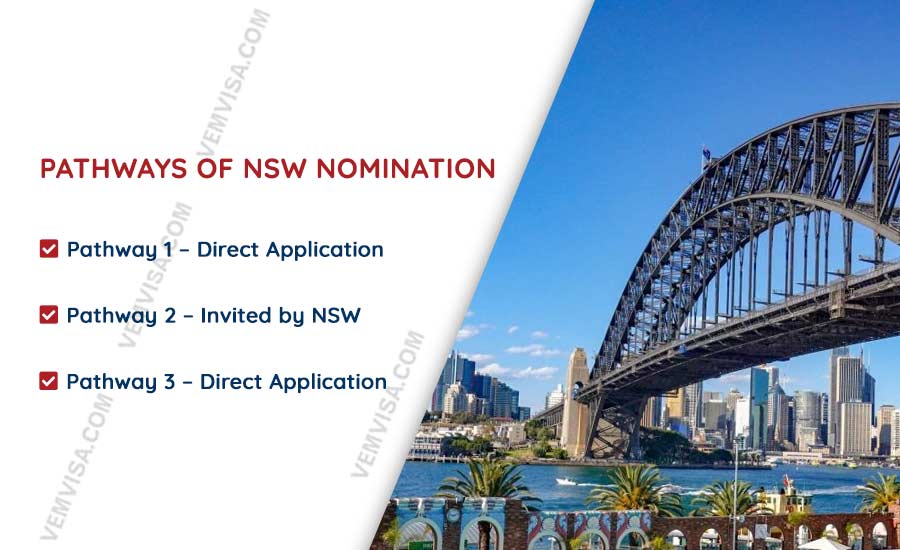
Comparison of New South Wales nomination pathways for subclass 190 and subclass 491 visas
NSW uses invitation-based and, when available, limited direct-application pathways for skilled nomination.

For the national visa criteria, see VEM’s guides to the 190 Visa Australia and the 491 Visa Australia.

190 visa requirements NSW applicants should check

The 190 visa requirements NSW applicants need to satisfy operate at two levels. Home Affairs controls the subclass 190 visa criteria, while NSW controls whether it will nominate an eligible person.

Federal subclass 190 baseline

  • Be invited to apply through SkillSelect.
  • Be under 45 when invited, unless a specific legal exception applies.
  • Have competent English or the level required for your claimed points and profession.
  • Hold a valid positive skills assessment for the nominated occupation.
  • Reach at least 65 points including the 5 nomination points.
  • Meet health, character and other visa requirements.

NSW nomination baseline

  • Meet every Home Affairs requirement for subclass 190.
  • Have an occupation eligible for the visa and within an ANZSCO unit group on the NSW Skills List.
  • Have a valid skills assessment that remains usable when applying.
  • Be working in NSW in the nominated occupation for at least 20 hours per week; or
  • Have continuously resided in NSW for at least six months; or
  • Have continuously resided offshore for at least six months.

Minimum eligibility is not a selection forecast. A valid EOI with 65 points can enter the system, but NSW nomination is exceptionally competitive. NSW may compare age, English, education, points and skilled work experience within the relevant ANZSCO unit group.

190 visa invitation round NSW: how selection actually works

A search for “190 visa invitation round NSW” often assumes NSW publishes a calendar or a fixed minimum score. It does not. NSW states that invitation rounds occur throughout an operating financial year, but there are no predetermined or publicly announced round dates.

Invitation question NSW position
When is the next round? NSW does not publish predetermined dates and will not provide special invitations outside normal round activity.
How are EOIs ranked? Factors can include age, English, education, points and total skilled work experience. Higher-ranking EOIs within an ANZSCO unit group may be selected.
Does an older EOI rank higher? NSW states that the date an EOI is submitted or amended does not affect the likelihood of invitation.
How long is an invitation valid? An NSW invitation to apply for nomination is valid for 14 days. NSW states that this window is not extended.
Can NSW predict my chance? The NSW migration team does not provide an individual likelihood assessment or a special-consideration invitation.

EOI discipline: Every point and personal detail must be supportable by valid evidence when invited. Updating an EOI is appropriate when facts change, but inventing extra points shortly before a rumoured round is not optimisation. It is evidence-shaped self-sabotage.

491 visa requirements NSW: the three nomination pathways

The 491 visa requirements NSW applicants must meet include the federal subclass 491 criteria and one of the NSW nomination pathways operating at the time. The visa is valid for five years and requires regional residence, work and study conditions.

The 2025–26 NSW structure used three pathways. They are explained below for planning, but applicants must verify which pathways reopen and whether any requirement changes for the next program year.

Pathway 1: regional employment

A direct-application pathway for eligible applicants who have continuously worked for the same regional NSW employer in the nominated or closely related occupation for the preceding six months and meet the salary requirement.

Pathway 2: NSW invitation

An invitation pathway for EOIs with an eligible occupation in an ANZSCO unit group on the NSW Regional Skills List and the required residence or employment position.

Pathway 3: regional graduate

A direct-application pathway for eligible recent graduates of a regional NSW institution whose study, occupation, EOI and residence evidence meet the pathway criteria.

Pathway 1 requirements for subclass 491 applicants working in regional New South Wales
Pathway 1 focuses on established skilled employment with a regional NSW employer.

Pathway 1: working with a regional NSW employer

  • Be working in a designated regional area of NSW.
  • Have worked continuously for the same regional NSW employer for the preceding six months.
  • Work in the nominated occupation or a closely related occupation.
  • Meet the salary threshold named by NSW at the time of application, including any approved concession.
  • Hold an occupation eligible for subclass 491.

Pathway 2: invited by Investment NSW

  • Have an occupation eligible for subclass 491 and within an ANZSCO unit group on the NSW Regional Skills List.
  • Be working in NSW in the nominated occupation; or
  • Have continuously resided in NSW for at least three months; or
  • Have continuously resided offshore for at least three months.
  • Keep every EOI claim supported by valid evidence if invited.

Pathway 3: recent regional NSW graduate

  • Complete an eligible bachelor degree, master degree or PhD at an institution in designated regional NSW.
  • Complete the qualification within the two years immediately before applying for nomination.
  • Ensure the study relates to the nominated or closely related occupation.
  • Be eligible to claim regional study points and include them accurately in the EOI.
  • Have an occupation eligible for subclass 491 and within an ANZSCO unit group on the NSW Regional Skills List.
  • Meet the applicable NSW residence or employment condition.
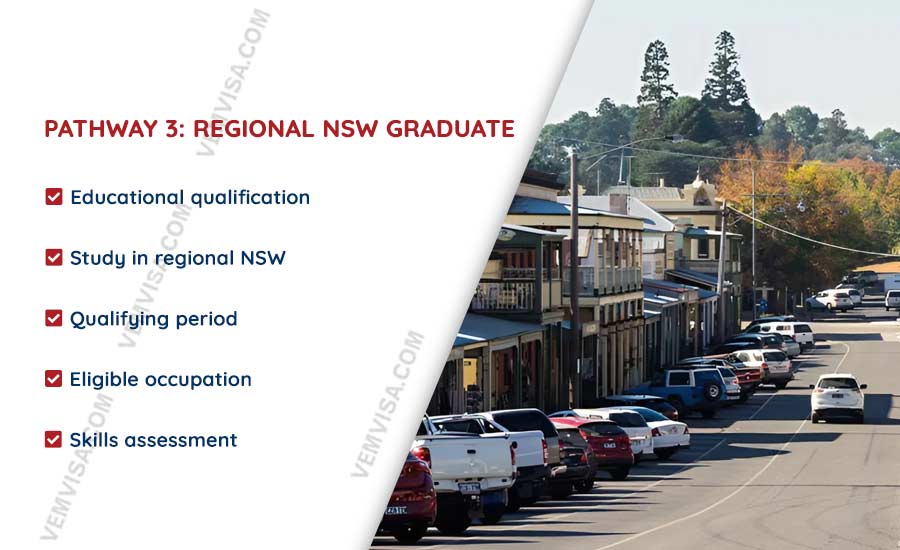
Regional NSW graduate pathway for Skilled Work Regional visa subclass 491 nomination
Regional graduate eligibility depends on the qualification, timing, occupation, points and current pathway settings.

NSW Skills Lists: occupation eligibility without false certainty

NSW publishes separate skills settings for subclass 190 and regional subclass 491 nomination. The lists are organised at the ANZSCO Unit Group level, but not every occupation inside a listed unit group is automatically eligible for the visa.

Check What must align
NSW unit group The nominated occupation must sit inside a unit group identified on the correct NSW list.
Federal visa list The exact occupation must also be eligible for subclass 190 or subclass 491 under current Home Affairs settings.
Skills assessment A valid assessment from the correct authority must match the nominated ANZSCO occupation.
Invitation competitiveness Occupation eligibility allows consideration; it does not establish the score or profile needed to receive an invitation.
NSW skilled occupation lists and priority workforce sectors for 190 and 491 nomination
A listed occupation is the beginning of an eligibility check, not the end of the nomination assessment.

Use VEM’s Australian Skilled Occupation List and Skills Assessment Australia guides to identify the occupation, assessing authority and evidence pathway before relying on a state list.

DAMA visa occupation list NSW: an employer-sponsored alternative

The search term “DAMA visa occupation list NSW” refers mainly to the Orana Designated Area Migration Agreement. A DAMA is not a state-nominated 190 or 491 visa and it is not an independent visa application. It is a regional employer-sponsored labour-agreement framework.

The Orana DAMA currently publishes a list of 129 occupations and covers employers operating in approved NSW regions. The exact occupation, location, concessions and visa route must be checked against the current Orana agreement and occupation schedule.

Employer-led

An individual cannot access a DAMA directly. A suitable employer operating in the designated area must sponsor the worker.

Occupation-specific

The occupation must appear in the current DAMA schedule and satisfy its qualification, experience, salary and concession settings.

Different visa routes

The agreement may support employer-sponsored pathways using subclass 482, subclass 494 or subclass 186, depending on the agreement and circumstances.

Pathway Selection basis Who starts the process?
NSW 190/491 Points-tested skilled migration plus NSW nomination criteria. The skilled applicant maintains an EOI and follows the applicable invitation or direct NSW pathway.
Orana DAMA Regional employer need, listed occupation, endorsement and an approved labour agreement. The eligible employer begins the endorsement and labour-agreement process before sponsoring the worker.

See VEM’s complete DAMA Visa Australia guide, plus the 482 Skills in Demand visa, 494 regional employer-sponsored visa and 186 Employer Nomination Scheme.

How to apply for NSW state nomination

The exact process depends on whether NSW is operating an invitation pathway or a direct-application pathway. The sequence below is the general planning order.

1

Confirm federal visa eligibility

Check age, English, points, occupation eligibility, skills assessment and the visa conditions applying to subclass 190 or 491.

2

Match the NSW pathway

Check the current NSW skills list, residence, employment, salary, study and pathway requirements rather than relying on a previous program year.

3

Lodge or update the SkillSelect EOI

Select NSW where required and make sure every point, employment period, relationship detail and qualification is supported by current documents.

4

Receive an invitation or use an open direct pathway

For invitation routes, wait for NSW selection. For a direct pathway, lodge only after confirming that the pathway is open and every requirement is met.

5

Submit NSW nomination evidence

Respond within the specified period, upload valid documents, pay the NSW application fee and avoid unsupported EOI changes.

6

Lodge the visa application after nomination

If NSW nominates you and Home Affairs issues the visa invitation, lodge the subclass 190 or 491 application within the invitation period.

Step by step process for NSW subclass 190 and subclass 491 state nomination
The NSW nomination application and the Home Affairs visa application are separate stages.

Documents to prepare before an NSW invitation

Identity and status

Passport, current visa, name-change documents and address history.

Skills and qualifications

Valid skills assessment, qualifications, transcripts, registration and licensing where required.

English and points

Current test results and documents supporting every SkillSelect point claim.

Employment

Contracts, employer references, payslips, tax evidence, superannuation and ANZSCO duty alignment.

NSW residence

Lease, utility bills, bank activity and other records covering the relevant continuous period.

Regional study

Completion letter, transcript, campus evidence, course dates and regional study point evidence.

Validity rule: NSW requires supporting documents to be valid when the nomination application is lodged and generally to remain valid for at least five days afterwards. An expired English result or skills assessment cannot be revived through optimism, creative file naming or a heartfelt cover letter.

NSW nomination cost and processing time

NSW nomination fee

NSW currently lists an application fee of AUD330, with an additional 10% GST where the applicant applies from within Australia.

This is separate from the Home Affairs visa charge and other professional or document costs.

Home Affairs visa charge

From 1 July 2026, Home Affairs lists the main applicant charge from AUD6,140 for subclass 190 and subclass 491, subject to limited concessions.

Family-member charges, second instalments and health, police, biometrics or translation expenses can increase the total.

NSW assessment period

NSW states that a nomination application is typically assessed within six weeks after payment.

This estimate begins after a nomination application, not while an EOI waits for selection.

Visa processing time

Home Affairs visa processing begins after the visa application is lodged and is separate from NSW nomination processing.

Use the official processing-time guide and VEM’s Australia visa processing times page for current planning.

Common mistakes that weaken an NSW nomination profile

Treating 65 points as competitive

It is the general visa threshold, not a promised NSW invitation score.

Using the wrong occupation list

NSW unit-group eligibility and federal occupation eligibility must both be checked.

Unsupported EOI points

Employment, English, partner and qualification points must match valid evidence.

Confusing NSW and Home Affairs

NSW assesses nomination; Home Affairs assesses and grants the visa.

Waiting only for NSW

NSW explicitly recommends exploring other skilled and employer-sponsored pathways.

Calling DAMA a 491 shortcut

DAMA is employer-sponsored and agreement-based, not a state-nominated points pathway.

NSW state nomination FAQs

Is NSW 190 visa nomination open?

NSW currently states that subclass 190 applications are closed for the completed program year because all nomination places were allocated. The next program settings will be published after review.

Is NSW 491 nomination open?

NSW currently states that subclass 491 applications are closed for the completed program year. Applicants should wait for the official next-year update before assuming Pathways 1, 2 or 3 have reopened.

When is the next 190 visa invitation round NSW?

NSW does not publish predetermined invitation-round dates. When a program is operating, rounds can occur throughout the financial year at NSW discretion.

What score is required for a 190 visa NSW invitation?

The general points-tested visa threshold is 65 points including nomination points, but NSW does not publish one guaranteed invitation score. Selection can compare the strength of EOIs within an ANZSCO unit group.

Can offshore applicants receive NSW nomination?

Yes, where the current pathway permits it. Under the previous settings, subclass 190 applicants could qualify through at least six months of continuous offshore residence, while certain subclass 491 pathways used a three-month offshore residence condition.

Does NSW nomination guarantee the visa?

No. NSW nomination supports the visa invitation, but Home Affairs separately assesses the subclass 190 or 491 application against all visa criteria.

Is the Orana DAMA occupation list the NSW 491 occupation list?

No. The Orana DAMA list belongs to an employer-sponsored labour-agreement pathway. The NSW Regional Skills List is used for specified NSW subclass 491 nomination pathways.

How long does NSW nomination take after applying?

NSW states that a paid nomination application is typically assessed within six weeks. Waiting for an EOI invitation has no published processing timeframe.

Build an NSW pathway around evidence, not invitation rumours

A realistic NSW strategy connects the correct ANZSCO occupation, valid skills assessment, English, points, employment, residence and pathway status. VEM can review whether subclass 190, subclass 491, employer sponsorship or an Orana DAMA route deserves priority in your circumstances.

Contact VEM
Registered migration services

Official sources and related VEM guides

5/5 - (1 vote)
ceo cong ty vem
CEO and Founder of VEM

Mr. Phong Cao is a licensed migration agent by MARA (MARN: 1577877). He is also a member of the Migration Institute of Australia (MIA: 12648), one of the most reputable organizations in the field of immigration in Australia. In addition, Mr. Phong Cao holds a QEAC certification in study abroad consulting (QEAC: K580) and Australian real estate investment (RA85931). With over 12 years of experience in Australian immigration, he provides comprehensive solutions for studying and settling in Australia.


Chia sẻ bài viết

Leave a Reply

Your email address will not be published. Required fields are marked *