Updated 27 August 2026 · Australian Parent Visa Queue Guide
Current estimates and queue milestones for Parent, Aged Parent and Contributory Parent visas, plus the separate Sponsored Parent 870 temporary pathway.
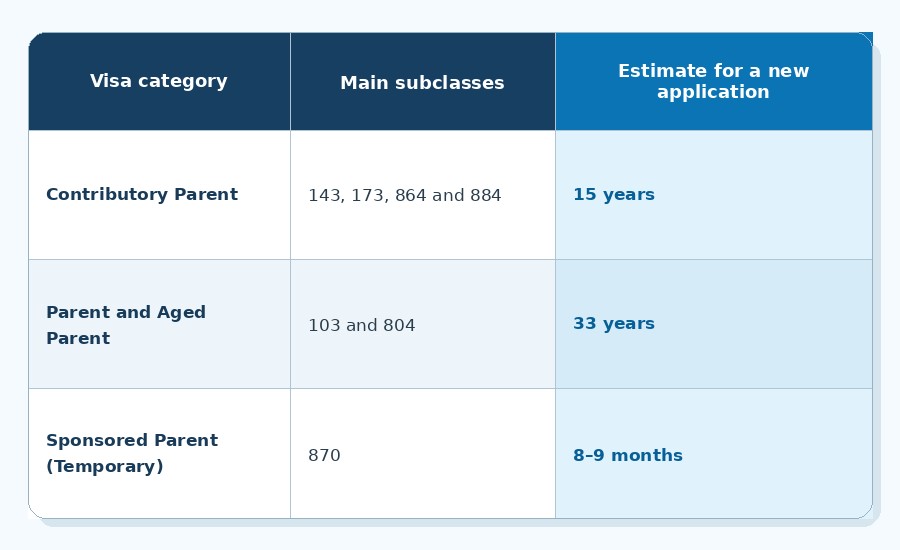
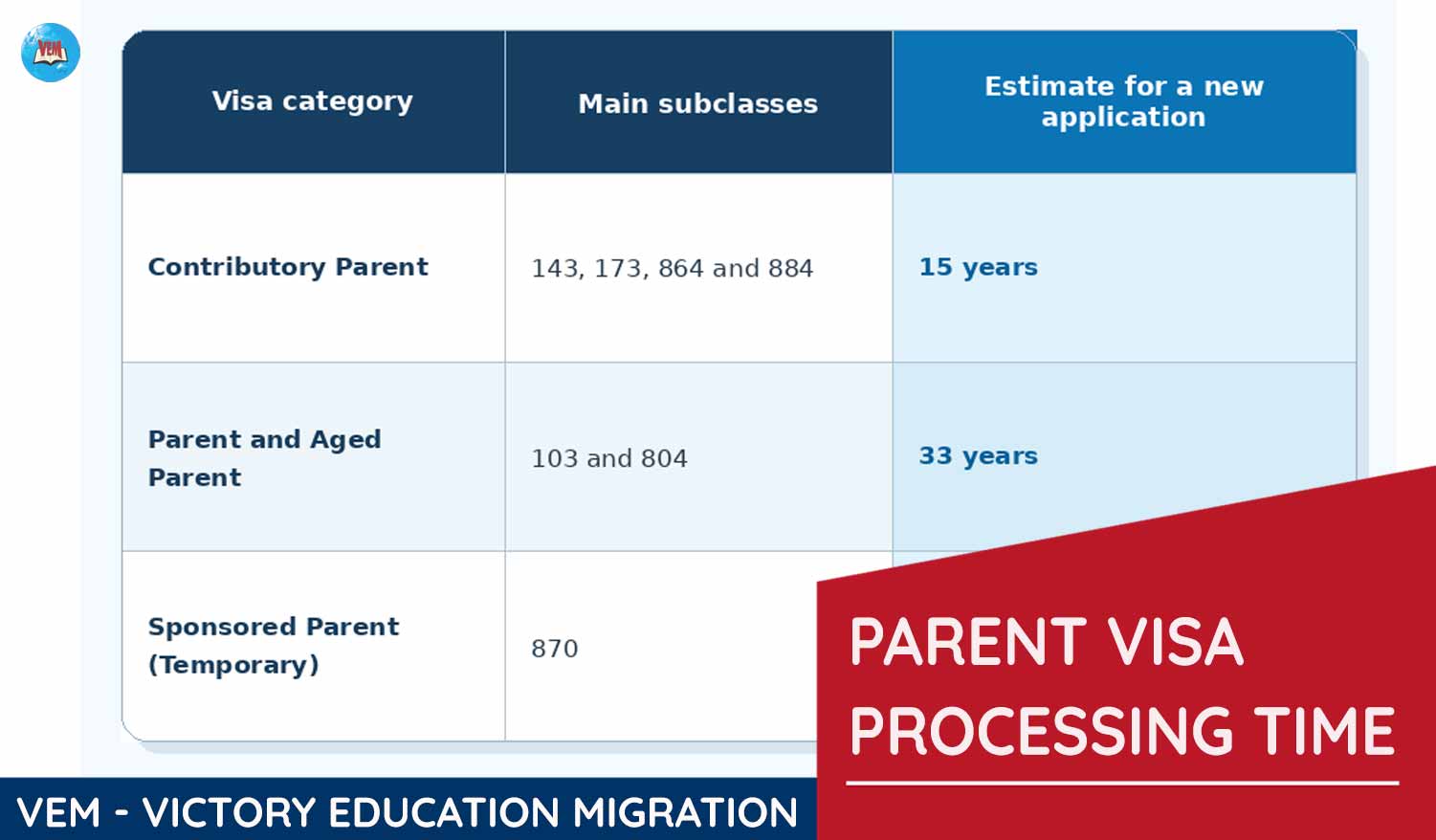
The current Australian Parent visa processing time is approximately 15 years for a new Contributory Parent application and 33 years for a new Parent or Aged Parent application, based on the number of places currently available each year.
Those estimates are not ordinary percentile processing times. Permanent Parent visas are capped and queued. An application may first be acknowledged, later assessed for queue placement, wait until its queue date is released, and then undergo final assessment. Each milestone answers a different question.
Australia Parent visa waiting time in 2026
The official estimates for new applications divide permanent Parent visas into two groups. VEM’s Australian Parent visa comparison explains the requirements, costs and trade-offs of each subclass.
| Visa category |
Main subclasses |
Estimate for a new application |
Key trade-off |
| Contributory Parent |
143, 173, 864 and 884 |
15 years |
Higher visa charges and Assurance of Support obligations, but a shorter queue than non-contributory Parent visas. |
| Parent and Aged Parent |
103 and 804 |
33 years |
Lower government charges, but the longest permanent Parent visa wait time. |
| Sponsored Parent (Temporary) |
870 |
Not part of the 15/33-year permanent queue |
Temporary stay for 3 or 5 years per visa, up to a 10-year cumulative maximum; no direct permanent-residence outcome. |
Contributory Parent
15 years
New-application estimate
Parent / Aged Parent
33 years
New-application estimate
Latest Parent visa queue release dates
Home Affairs published the following milestone data as at 31 May 2026. “Queue assessment” shows the lodgement period being assessed for eligibility to enter the queue. “Visa assessment” shows the queue dates released for final processing. Neither means the visa has already been granted.
| Visa type |
Acknowledge new application |
Queue assessment workload |
Released for visa assessment |
| Contributory Parent 143 |
Approx. 4 weeks |
Lodged November 2023 |
Lodged/queued up to November 2018 |
| Contributory Parent Temporary 173 |
Approx. 4 weeks |
Lodged November 2023 |
Lodged/queued up to November 2018 |
| Contributory Aged Parent 864 |
Approx. 4 weeks |
Lodged April 2023 |
Lodged/queued up to November 2018 |
| Contributory Aged Parent Temporary 884 |
Approx. 4 weeks |
Lodged April 2023 |
Lodged/queued up to November 2018 |
| Parent 103 |
Approx. 4 weeks |
Lodged February 2023 |
Queued up to March 2014 |
| Aged Parent 804 |
Approx. 4 weeks |
Lodged January 2023 |
Queued up to April 2014 |
| Temporary-to-permanent 173→143 / 884→864 |
Approx. 4 weeks |
Not applicable |
Applications lodged May 2026 |
The official page contains a small summary/table difference
The page summary says Parent and Aged Parent applications with queue dates up to February 2014 were released, while its detailed milestone table lists March 2014 for subclass 103 and April 2014 for subclass 804. Treat the reliable high-level position as early 2014 and use the live table for subclass-specific updates.
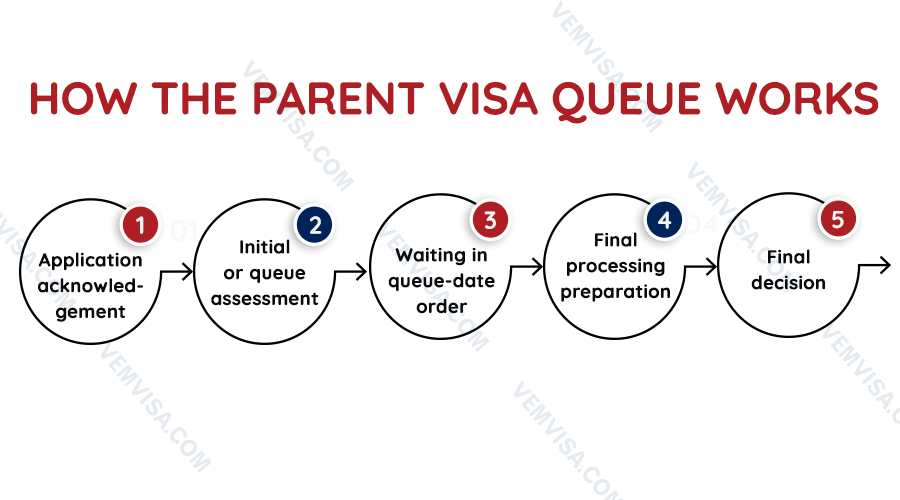
How the Parent visa queue works
Permanent Parent visas are subject to capping and queueing because demand is much greater than the annual number of places. A complete application can reduce avoidable administrative delays, but it cannot simply jump ahead of thousands of older queued cases.
1. Application acknowledgement
The Parent Visa Centre records the application and issues acknowledgement, currently shown as approximately four weeks. This is not queue placement and not approval.
2. Initial or queue assessment
Home Affairs checks relevant threshold criteria, including sponsorship and the Balance of Family Test where applicable. An eligible application receives a queue date.
3. Waiting in queue-date order
The application waits until Home Affairs releases its queue date for final processing, subject to annual places, processing directions and case movement.
4. Final processing preparation
The Department may request updated passports, health examinations, police certificates, family details, Assurance of Support and the second visa application charge.
5. Final decision
Queue release is not grant. Every remaining legal criterion must still be satisfied, and the visa remains subject to available program places.
Four weeks is not the Parent visa processing time
It is only the approximate acknowledgement period shown in the official milestone table. The actual parent visa waiting time for permanent categories remains approximately 15 or 33 years for new applications under current estimates.
Compare Australian Parent visa subclasses
| Pathway |
Outcome |
Waiting-time model |
Planning point |
| Parent 103 |
Permanent, generally offshore |
Non-contributory queue; 33-year estimate |
Lower charge but very long wait; Balance of Family and Assurance of Support generally apply. |
| Contributory Parent 143 |
Permanent |
Contributory queue; 15-year estimate |
Higher charge and longer AoS period, with a shorter estimate than subclass 103. |
| Contributory Parent 173→143 |
Temporary up to 2 years, then permanent |
Contributory queue followed by a separate permanent-stage application |
Spreads charges across stages but can cost more overall than direct 143. |
| Aged Parent 804 |
Permanent, onshore aged route |
Non-contributory queue; 33-year estimate |
Applicant must meet age and onshore validity rules; Bridging Visa conditions and travel need separate review. |
| Contributory Aged Parent 864 |
Permanent, onshore aged route |
Contributory queue; 15-year estimate |
Higher charge; must meet aged-parent and onshore requirements. |
| Contributory Aged 884→864 |
Temporary up to 2 years, then permanent |
Contributory queue followed by permanent stage |
Two-stage aged pathway with separate applications and charges. |
| Sponsored Parent 870 |
Temporary 3 or 5 years |
Outside permanent Parent queue |
No Balance of Family Test, but approved sponsorship, insurance and temporary-stay requirements apply; no direct PR conversion. |
For current government charges, including large second instalments that may not appear in a basic estimator result, see VEM’s Parent visa cost guide for 2026. Cost and queue speed must be considered together.
Contributory Parent visa processing time
The current contributory parent visa processing time estimate is 15 years for a new application. This includes direct permanent subclass 143, temporary subclass 173, direct Contributory Aged Parent 864 and temporary aged subclass 884 within the contributory category.
At 31 May 2026, Home Affairs was releasing contributory cases lodged or queued up to November 2018 for visa assessment. It was assessing queue eligibility for subclass 143/173 applications lodged around November 2023 and subclass 864/884 applications lodged around April 2023.
VEM’s Contributory Parent visa 143 guide explains the direct permanent route. Families wishing to spread the visa charges across two applications can review the temporary subclass 173 pathway, but the combined government charges are generally higher than a direct 143 application.
Temporary-to-permanent applications
The milestone table separately shows temporary-to-permanent applications—173 to 143 and 884 to 864—lodged in May 2026 being processed at 31 May 2026. This should not be misread as saying a new applicant can obtain the first temporary contributory visa in one month. The family must first complete the long first-stage queue before using the later permanent-stage conversion.
Aged Parent visa processing time
The aged parent visa processing time depends on whether the application is contributory. Subclass 804 sits in the Parent/Aged Parent group with a 33-year estimate. Subclasses 864 and 884 sit in the contributory group with the 15-year estimate.
An aged route is not automatically available simply because a parent is older. The applicant must meet the Australian Age Pension age threshold and the visa’s onshore application requirements. A current or previous Sponsored Parent 870 application, a No Further Stay condition, section 48 restrictions, lack of a substantive visa or another status issue can materially affect validity and strategy.
VEM’s Aged Parent subclass 804 guide covers age, sponsorship, Balance of Family, Assurance of Support and onshore considerations. Do not choose subclass 804 solely because a Bridging Visa may become available: a Bridging Visa A generally does not provide international travel, work rights depend on its conditions, and remaining in Australia for decades has healthcare and financial consequences.
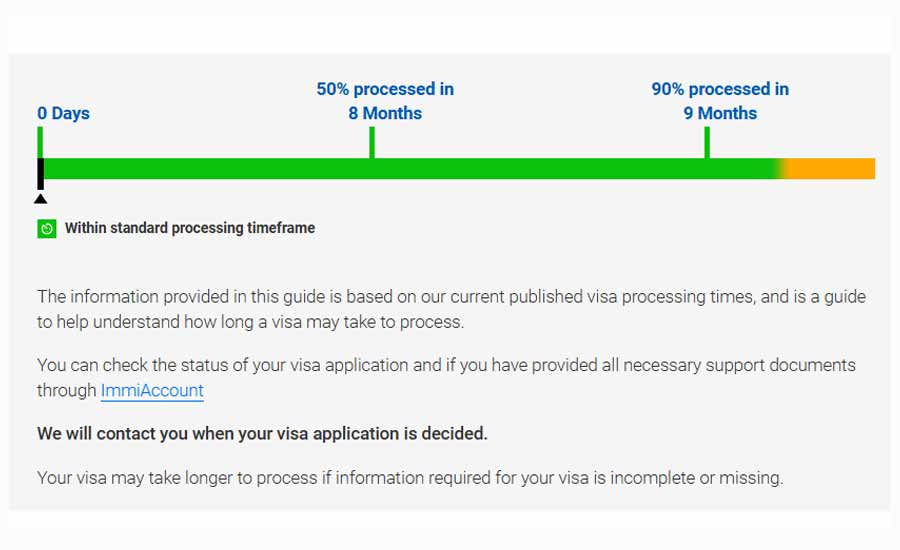
Sponsored Parent visa 870 processing time
Subclass 870 is different from the permanent Parent visas. It allows an approved sponsor’s parent to stay temporarily for three or five years, with further visas potentially allowing a cumulative maximum stay of ten years. It is not capped and queued with subclasses 103, 143, 173, 804, 864 and 884.
The process has two stages: the child or eligible sponsor first obtains sponsorship approval, then the parent lodges the visa application within the period stated by Home Affairs. The global processing-time tool should be checked separately for both sponsorship and visa indicators. VEM’s Sponsored Parent visa 870 guide explains the temporary stay, sponsorship and insurance requirements.
Subclass 870 is not a permanent Parent visa shortcut
It does not convert directly to permanent residence. A person who has applied for or holds subclass 870 cannot apply for specified permanent Parent visas while that restriction applies. Sequence the options before lodging rather than assuming both pathways can run together.
Why Parent visa waiting times change
The cap and annual planning level are the main drivers of the long Australia Parent visa waiting time. Home Affairs also identifies application numbers, withdrawals, refusals, Administrative Review Tribunal outcomes, Ministerial Intervention cases and changes to processing directions as factors that can change the estimates.
| Factor |
Effect on the case or queue |
What the family can do |
| Annual migration places |
More or fewer Parent places change how quickly queued cases can be finalised. |
Use yearly Home Affairs estimates; do not treat today’s 15/33-year figure as fixed forever. |
| Balance of Family Test |
An incorrect child count, residence classification or family structure can prevent queue placement or grant. |
Map every child and stepchild, their location and eligibility using documents—not informal family assumptions. |
| Changed family circumstances |
Births, deaths, relationship changes, sponsor changes or children moving countries can affect the assessment. |
Notify Home Affairs using the correct process and keep civil evidence current. |
| Health and character |
Requirements are assessed at relevant stages; medical or police issues may require further evidence or create refusal risk. |
Wait for instructions where required, disclose accurately and plan for age-related health risks over a long queue. |
| Assurance of Support |
Permanent Parent visas generally require an acceptable AoS and, depending on the category, a bond before grant. |
Identify a potential assurer early and review current Services Australia income and bond rules near final processing. |
| Missing contact updates |
A family can miss a request years after lodgement if email, address, passport or representative details are stale. |
Maintain a long-term record system and update the Department whenever details change. |
Can a Parent visa be prioritised?
Home Affairs may consider requests for priority processing in limited compassionate and compelling circumstances, but there is no routine paid fast-track and no entitlement to move ahead because a parent is older or because separation is difficult. Evidence should establish the exceptional circumstances and why priority is necessary. Even a priority request does not waive the visa criteria or guarantee grant.

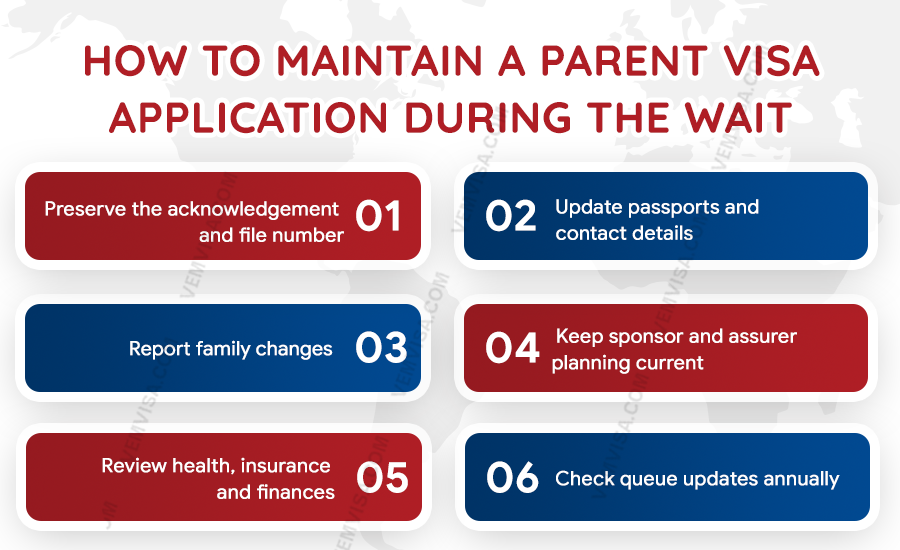
How to maintain a Parent visa application during the wait
- Preserve the acknowledgement and file number: keep copies of the full application, receipts, queue letter and all correspondence.
- Update passports and contact details: a decades-long wait will span renewals, moves and email changes.
- Report family changes: births, deaths, marriages, divorces, adoption and children moving countries may affect the Balance of Family assessment.
- Keep sponsor and assurer planning current: the person who could support or assure the application today may not be eligible years later.
- Review health, insurance and finances: ageing during the queue can change medical risk, care needs and the feasibility of an onshore aged route.
- Check queue updates annually: use the official queue-release page rather than comparing an old blog estimate with a new lodgement date.
For families still deciding among temporary and permanent options, VEM’s broader Australian family visa guide places Parent visas alongside other family pathways without treating a temporary stay as permanent migration.
Planning for parents to join your family in Australia?
VEM can compare subclasses 103, 143, 173, 804, 864, 884 and 870, assess the Balance of Family Test, review onshore visa conditions and map the waiting time, government charges and evidence.
Discuss Parent visa options with VEM
FAQs
How long does an Australian Parent visa take in 2026?
Home Affairs estimates approximately 15 years for a new Contributory Parent application and 33 years for a new Parent or Aged Parent application. These are category estimates based on current places and workload, not guaranteed individual decision dates.
What is the current Contributory Parent visa processing time?
The estimate for new contributory applications is 15 years. At 31 May 2026, Home Affairs was releasing subclass 143, 173, 864 and 884 cases lodged or queued up to November 2018 for visa assessment.
How long is the subclass 804 Aged Parent visa wait?
Subclass 804 falls in the Parent and Aged Parent category, with an estimated 33-year timeframe for a new application. The detailed official milestone table showed queue dates up to April 2014 released for visa assessment at 31 May 2026.
Does the four-week acknowledgement mean my Parent visa is processing?
It means the new application has been received and acknowledged. It is not a queue date, final assessment or grant. The application may still wait many years for queue assessment and release.
Which Parent visa is the fastest?
For a permanent Parent outcome, contributory subclasses currently have the shorter estimate—15 years compared with 33 years for subclasses 103 and 804. Subclass 870 may provide a temporary stay sooner, but it is outside the permanent queue and does not lead directly to permanent residence.
Can a parent stay in Australia while waiting for subclass 804 or 864?
An eligible onshore applicant may receive a Bridging Visa, but lawful stay, work rights and travel depend on the actual visa grant and conditions. Bridging Visa A generally does not permit return after overseas departure. Review No Further Stay, section 48 and application-validity issues before lodging.
Can I apply for subclass 870 while a permanent Parent visa is pending?
The sequence requires careful checking. Subclass 870 has statutory interactions with permanent Parent applications, including restrictions on applying for specified permanent Parent visas while an 870 application or visa exists. Do not assume both pathways can always proceed together.
Can I switch Parent visa categories and keep my old queue date?
Do not assume a new application in another category inherits the earlier queue position. Withdrawal and relodgement can affect fees, queue dates, status and eligibility. Obtain advice on the specific conversion or new-application rules before changing pathway.

 VN
VN
 Người
đăng
Người
đăng Ngày
cập nhật:
Ngày
cập nhật:



