Subclass 143 visa – an Australian permanent visa for parents
VEMVisa | Australian Parent Migration
A practical guide to the permanent Contributory Parent pathway, including eligibility, the Balance of Family Test, two-part visa charges, Assurance of Support and the parent visa queue.
The subclass 143 visa is a permanent Contributory Parent visa for an eligible parent of a settled Australian citizen, Australian permanent resident or eligible New Zealand citizen. It can provide permanent residence, work and study rights, Medicare access and an initial five-year travel facility.
The route involves more than paying a higher parent visa charge: applicants generally need an approved sponsor, must pass the Balance of Family Test, meet health and character requirements, obtain an Assurance of Support and wait in a capped visa queue.
Reviewed 20 July 2026: Home Affairs currently lists a starting cost of AUD49,900 over two instalments for one standard applicant. As at 31 May 2026, applications queued up to November 2018 had been released for final processing. These figures are not guarantees and can change.
Check the official visa page
Confirm current eligibility, lodgement, location and decision requirements before applying.
The Contributory Parent visa 143 is a permanent parent migration pathway. It is “contributory” because the visa application charge is substantially higher than the non-contributory Parent visa subclass 103. The higher charge does not remove the queue, guarantee a grant or create a fixed processing deadline.
An applicant can apply directly for the permanent subclass 143 visa or use a two-stage pathway by first obtaining the temporary subclass 173 visa and then applying for subclass 143 before the temporary visa expires.
Direct subclass 143
One permanent visa application with charges paid in two instalments. The full contributory amount is not paid at the beginning.
Subclass 173 then 143
A temporary visa followed by the permanent stage. This can spread payments over a longer period but generally costs more across both applications.
Not a bridging-visa strategy
A standard subclass 143 application does not generally create an associated bridging visa. Applicants in Australia must separately maintain lawful status.
Location matters: applicants can generally be in or outside Australia when lodging, but standard subclass 143 applicants usually need to be outside Australia when the Department decides the visa. Special rules apply to eligible subclass 173 holders, substituted Visitor visa holders and Retirement pathway applicants.
Benefits of the Contributory Parent visa 143
If granted, the visa provides permanent residence rather than a temporary visit. The practical benefits are significant, but access to particular payments or services can still depend on separate eligibility rules and waiting periods.
Permanent stay
Live in Australia indefinitely as a permanent resident.
Work and study
Work and study in Australia subject to general laws and requirements.
Medicare
Enrol in Australia’s public healthcare scheme when eligible.
Family sponsorship
Sponsor eligible family members under the rules applying at that time.
Five-year travel facility
Travel to and from Australia for five years, then consider an RRV if needed.
Citizenship pathway
Apply for Australian citizenship later if all citizenship criteria are met.
Subclass 143 is a permanent visa, but separate eligibility rules can apply to services, payments, citizenship and return travel.
Subclass 143 visa requirements
Eligibility is assessed across the applicant, sponsor, family composition and public-interest requirements. The following is a planning summary, not a personal eligibility decision.
Requirement area
General position
Planning question
Eligible child
The applicant must be the parent of a settled Australian citizen, Australian permanent resident or eligible New Zealand citizen.
Can you prove the parent-child relationship and the child’s status?
Sponsor
Usually the eligible child sponsors the parent. Different sponsor arrangements may apply if that child is under 18.
Who will complete the sponsorship and can the Department approve them?
Balance of Family Test
The applicant generally must pass the statutory family-links test. It is not waived for compelling circumstances.
Have all children and stepchildren been counted correctly?
Assurance of Support
A mandatory Assurance of Support is generally required before grant, unless a specific exception applies.
Who may meet the income test and provide the bank guarantee?
Health and character
Applicants and relevant family members may need health examinations and character evidence.
Are passports, police histories and health information complete and consistent?
Visa history and debts
Refusals, cancellations, application limitations and Australian Government debts can affect the case.
Does any past event need legal or migration advice before lodgement?
Subclass 870 restriction
A person cannot apply for subclass 143 if they have already applied for or hold a Sponsored Parent (Temporary) subclass 870 visa.
Has a subclass 870 application or visa changed the available pathway?
No general maximum age: subclass 143 is not the “aged” parent visa. Applicants do not need to be old enough for the Australian age pension merely to use this subclass. Compare subclass 864 if the aged-parent pathway is relevant.
The applicant, sponsor, family composition, Assurance of Support and public-interest requirements must be considered together.
How the Balance of Family Test works
The Balance of Family Test measures the applicant’s family links to Australia. A parent generally passes if at least half of their children and stepchildren are eligible children, or if more eligible children live in Australia than in any other single country.
The calculation includes the applicant’s and their partner’s relevant children, including adopted children and certain stepchildren. Children on temporary visas in Australia are not treated as eligible children for this test. Home Affairs states that the test cannot be waived, even in compelling or exceptional circumstances.
Family example
Children in Australia
Children elsewhere
Likely result
Two children total
1 eligible child
1 child in one country
Passes the “at least half” limb.
Three children total
1 eligible child
1 in country A and 1 in country B
Does not pass: Australia does not have more than any other single country.
Five children total
2 eligible children
1 in each of three countries
Passes because Australia has more children than any other single country.
Use the official Balance of Family Test guidance for definitions, exclusions and more examples. Do not rely on a simple headcount where stepchildren, adopted children, unknown locations or deceased children are involved.
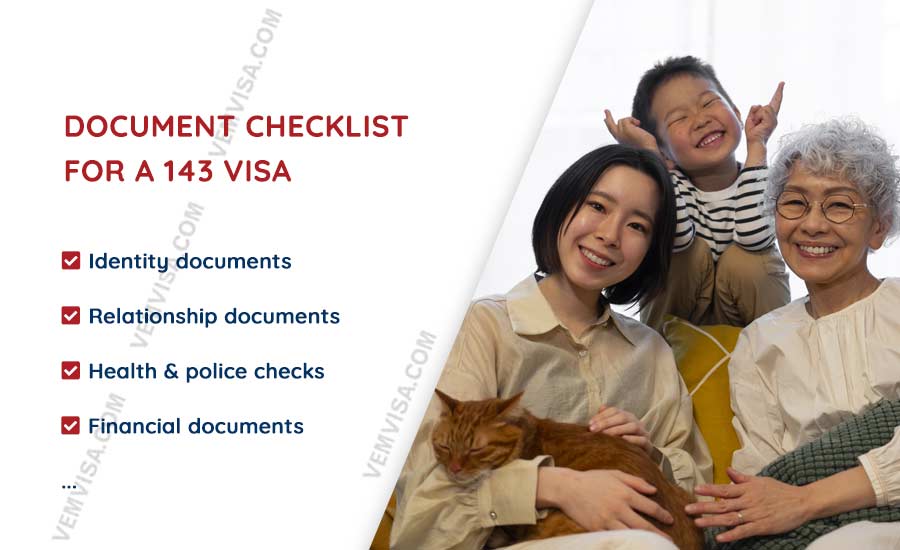
Subclass 143 document checklist
The ImmiAccount checklist is tailored to the application. Organise documents by the issue they prove rather than uploading a large, unstructured collection.
Applicant evidence
Current passport, identity documents and name-change records.
Birth, adoption and civil-status records showing family relationships.
Information about every child and stepchild for the Balance of Family Test.
Partner and dependant documents where family members are included.
Character documents when requested.
Health examinations when instructed by Home Affairs.
Sponsor and support evidence
Sponsor identity and Australian citizenship, permanent residence or eligible New Zealand status.
Evidence the sponsor is settled in Australia.
Form 40 sponsorship information and supporting records.
Evidence connecting the sponsor to the applicant.
Assurance of Support material only when the Department requests it.
Translations meeting the Department’s requirements for non-English documents.
Timing warning: do not obtain time-sensitive police certificates, health examinations or an Assurance of Support years too early merely to make the initial upload look complete. Follow the current Home Affairs instructions and requests.
Build the evidence around identity, family relationships, sponsorship, the Balance of Family Test and later-stage requests.
How to apply for a subclass 143 visa
Home Affairs now requires Parent visa subclasses 103, 143, 804 and 864 to be lodged online through ImmiAccount. Temporary subclass 173 applications continue to use the paper process unless the official instructions change.
1
Map the correct parent pathway
Compare direct 143, 173-to-143, aged-parent and temporary 870 options before paying a charge.
2
Check threshold eligibility
Confirm the eligible child, sponsor arrangement, Balance of Family Test and any visa-history restrictions.
3
Create or secure ImmiAccount
Use a controlled email address, multi-factor authentication and a document naming system the family can maintain for years.
4
Complete the application and sponsorship
Enter consistent family details and prepare the sponsor information, including Form 40 where requested.
5
Pay the first instalment and lodge
A submitted form without the correct charge may not become a valid application. Save the receipt and full application copy.
6
Initial assessment and queue placement
The Department assesses core criteria. If met, it assigns a queue date; otherwise the application can be refused.
7
Maintain the application during the queue
Update passports, addresses, family composition, sponsor details and authorised representatives. Monitor messages even during long periods of inactivity.
8
Final processing, AoS and second instalment
When released from the queue, respond to current health, character, Assurance of Support and payment requests before a decision.
A subclass 143 application has an initial eligibility and queue stage, followed much later by final assessment.
143 visa fee and application charges
The current Home Affairs page lists the 143 visa fee from AUD49,900 over two instalments for a standard single applicant. The first instalment is paid when applying; the much larger second instalment is paid only when the Department requests it before grant.
The final 143 visa application fee depends on the number and ages of applicants, whether the applicant uses the 173-to-143 pathway, whether a concession applies and the charges in force when Home Affairs receives the application.
Cost item
Current planning figure
When or why it applies
Single main applicant total
From AUD49,900
Published starting charge across two instalments as at 20 July 2026.
First instalment
Current table amount at lodgement
Paid when lodging. Additional applicant charges can apply.
Second instalment
Standard adult amount currently includes a substantial AUD43,600 component
Paid when invoiced before grant. Different amounts can apply to children and pathway categories.
Assurance of Support bond
AUD10,000 for one adult or AUD14,000 for two adults when an individual provides a 10-year AoS
A refundable bank guarantee, separate from the visa application charge.
Related costs
Variable
Health examinations, police certificates, translations, biometrics, professional fees and payment surcharges.
Do not transfer the second instalment or set up the Assurance of Support bank guarantee early. Pay or arrange these items only after the relevant government body issues the request and confirms the amount and deadline.
Assurance of Support for a parent visa 143
An Assurance of Support is a legal agreement under which an assurer undertakes to financially support the visa applicant and repay certain recoverable income-support payments if they are paid during the assurance period. For Contributory Parent visas, the Assurance of Support generally lasts 10 years.
The sponsor does not have to be the assurer. An eligible individual, joint assurers or an organisation may provide the assurance if Services Australia accepts the application. The assurer must meet the applicable income test and may need to lodge a bank guarantee and term deposit with the Commonwealth Bank of Australia.
Wait for the request
Home Affairs issues a Request for Assurance of Support when the application reaches the relevant stage.
Apply through myGov
An individual assurer generally applies through a Centrelink online account linked to myGov.
Arrange the bond last
Do not open the special term deposit until Services Australia asks in writing and states the required amount.
143 visa processing time and current queue position
The most important point about 143 visa processing time is that it is not a normal service-standard estimate. Parent visas are subject to capping and queueing. Home Affairs first assesses whether the application meets the core criteria for a queue date, then releases queued cases for final processing as places become available.
For a new application, Home Affairs currently estimates a contributory parent visa 143 processing time of 15 years. This is a planning estimate, not a promise. The actual subclass 143 processing time can change with annual program places, demand, policy, the queue and the individual application.
Official milestone
Position reported by Home Affairs
What it means
New application acknowledgement
Approximately 4 weeks
This is acknowledgment only, not substantive processing or queue release.
Queue assessment activity
Applications lodged around November 2023
The Department was assessing these applications for core eligibility and a queue date.
Final processing release
Queue dates up to November 2018
These queued cases had been released for final processing as at 31 May 2026.
New-application estimate
15 years
An estimate based on current places and demand, generally updated annually.
A complete file cannot remove the statutory queue. Accurate documents can reduce avoidable requests or prevent refusal at the initial assessment, but an agent or lawyer cannot lawfully promise to move an ordinary application ahead of the cap-and-queue system.
The phrases visa 143 processing time and parent visa 143 processing time should therefore be answered with both the 15-year new-application estimate and the live queue milestones. Check the official queue page every time you rely on the figures.
Compare subclass 143 with other Parent visa pathways
The correct visa depends on whether the goal is permanent migration, a staged contributory route, a lower-charge permanent queue or a temporary visit. Do not compare only the headline application fee.
Visa
Status
Cost and timing profile
Key planning point
143 Contributory Parent
Permanent
Higher contributory charge; new applications currently estimated at 15 years.
Direct permanent route with payments split into two instalments.
173 Contributory Parent
Temporary, up to 2 years
Staged charges across 173 and later 143; overall route generally costs more.
Apply for 143 before the 173 expires to preserve the intended stage-two route.
103 Parent
Permanent
Lower visa charge but a much longer current new-application estimate.
The lower fee does not make it suitable where family timing is critical.
870 Sponsored Parent
Temporary visit
Three- or five-year stay options, up to a maximum total stay under that program.
It is not permanent residence and can restrict a later 143 application.
Do you need a 143 parent visa lawyer or migration agent?
You may prepare a subclass 143 application yourself. Where professional immigration assistance is provided, the person must generally be a registered migration agent, an Australian legal practitioner or an exempt person. The agency’s brand name alone is not proof of authority.
A search for a “143 parent visa lawyer” may be appropriate where the matter involves legal proceedings, review rights, complex statutory issues or another legal dispute. A registered migration agent may assist with pathway advice, family-test analysis, forms, evidence and ongoing application management within their competence. Verify the individual adviser before paying.
When help may be useful
What the consultation should clarify
Complex family structure
Which children and stepchildren count and whether the Balance of Family Test is met.
Applicant is in Australia
Lawful status, No Further Stay issues, bridging-visa expectations and decision-location requirements.
Prior refusal or cancellation
Whether application limitations, review pathways or legal advice are relevant before lodgement.
173-to-143 transition
Timing, changed circumstances, documents and the effect of the temporary visa expiry.
Long-term file management
Who monitors correspondence, updates details and preserves a complete application record over many years.
VEM migration assistance
VEM can assess the pathway, review the Balance of Family Test, prepare the subclass 143 application and help manage requests and updates. VEM’s immigration assistance is provided through its registered migration agent, not promoted as a law firm.
What is the current contributory parent visa 143 processing time?
Home Affairs currently estimates 15 years for a new Contributory Parent application. As at 31 May 2026, queued contributory parent applications up to November 2018 had been released for final processing. Treat both figures as changeable.
Is a “contributory parent visa 143 processing time 2024” estimate still reliable?
No historical 2024 estimate should be treated as the current position. Queue releases, planning places and annual estimates change. Use the Home Affairs parent visa queue page, which was last updated on 9 July 2026 at the time of this review.
How much is the subclass 143 visa?
The official starting cost for one standard applicant is currently AUD49,900 over two instalments. Additional applicants, the pathway used, concessions, medicals, police checks, translations, the Assurance of Support bond and professional services can change the total budget.
Can I apply for subclass 143 while in Australia?
You can generally lodge while in or outside Australia, but a standard application usually does not provide an associated bridging visa and standard applicants generally need to be outside Australia at decision. Check your current visa and the official location rules before lodging.
Is the sponsor always the person who provides the Assurance of Support?
No. The sponsor and assurer can be different people. Services Australia decides whether an individual, joint assurers or an organisation can provide the Assurance of Support.
Can a complete application reduce the 15-year queue?
A well-prepared application can reduce avoidable errors and help it pass the initial assessment, but it cannot remove capping and queueing. No representative can guarantee priority or a fixed grant date for an ordinary application.
Do I have to use an immigration lawyer?
No. You may apply yourself. For paid immigration assistance, use an authorised provider such as a registered migration agent or Australian legal practitioner. The appropriate professional depends on whether the case is ordinary visa preparation or also involves legal proceedings or another complex legal issue.
Plan the visa, queue and family budget together
Before lodging, confirm the Balance of Family Test, sponsor eligibility, decision-location rules, the two-instalment charge and who may provide the Assurance of Support years later.
Official sources used for this review: Department of Home Affairs subclass 143 page, current visa pricing table, Parent visa queue release dates, Balance of Family Test guidance, and Services Australia Assurance of Support guidance.
This article provides general information and does not guarantee eligibility, processing priority or a visa outcome. Check the current government instructions and obtain advice for your circumstances where needed.
Yes, Australia allows for dual sponsorship under the Subclass 143 visa. Two children in Australia can sponsor their parents, subject to meeting income test and Assurance of Support requirements.
Mr. Phong Cao is a licensed migration agent by MARA (MARN: 1577877). He is also a member of the Migration Institute of Australia (MIA: 12648), one of the most reputable organizations in the field of immigration in Australia. In addition, Mr. Phong Cao holds a QEAC certification in study abroad consulting (QEAC: K580) and Australian real estate investment (RA85931). With over 12 years of experience in Australian immigration, he provides comprehensive solutions for studying and settling in Australia.
Chia sẻ bài viết
15 thoughts on “Subclass 143 visa – an Australian permanent visa for parents”
Harvinder Ghuman says:
I applied my visa on 23 November 2018 and I received a queue date assigned on 24 November 2023 and can you tell me when my file will open?

 VN
VN

 Người
đăng
Người
đăng Ngày
cập nhật:
Ngày
cập nhật: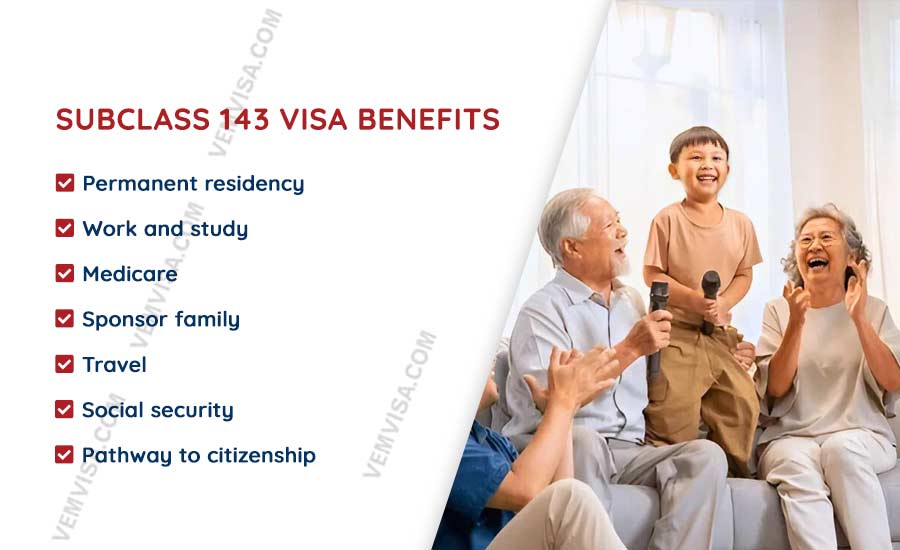




I applied my visa on 23 November 2018 and I received a queue date assigned on 24 November 2023 and can you tell me when my file will open?
OK
OK now I am send to you again my email ID
I applied my visa on 23 November 2018 and I received a queue date assigned on 24 November 2023 and can you tell me when my file will open?