VEM Visa | Visitor Health Cover Planning
A practical guide to checking condition 8501, understanding OVHC and comparing health cover before a Visitor visa 600 trip.
Visitor visa 600 health insurance can be a visa requirement, a request made during processing or a sensible financial safeguard. The answer depends on the conditions attached to the individual visa—not simply the subclass number.
Check the grant letter first: If condition 8501 appears, the holder must maintain adequate arrangements for health insurance while in Australia. Even without that condition, most visitors should consider cover because they are generally responsible for their own medical and hospital costs.
This guide explains how 600 visa health insurance works, what Overseas Visitors Health Cover (OVHC) may include and how to compare policies without choosing on price alone. For visa streams, eligibility and application evidence, start with VEM’s Visitor visa Australia guide.
Is health insurance mandatory for a Visitor visa 600?
Health insurance is not automatically expressed as the same condition on every subclass 600 grant. Home Affairs may require evidence of adequate health insurance before deciding an application, and condition 8501 may be attached to a granted visa. Your application correspondence, visa grant letter and VEVO record are the sources to check.
Condition 8501 is attached
Maintain adequate health insurance for the period specified by the condition. Keep the policy active and retain evidence.
Evidence is requested
Provide a current certificate or policy document that matches the applicant, intended stay and the Department’s request.
No insurance condition appears
Cover may still be prudent. Most visitors do not receive full Medicare benefits and treatment can create substantial personal costs.
Do not assume that approval without an immediate request means insurance will never matter. Read the final grant carefully. VEM’s guide on checking visa details through VEVO explains how to review the current in-effect visa and its conditions.
A health examination is different from health insurance. A visa medical checks whether an applicant meets the immigration health requirement. Insurance helps manage eligible treatment costs during the stay. Completing one does not replace the other.
What is OVHC for a 600 visa?
Overseas Visitors Health Cover is private health insurance designed for people visiting Australia who may not have access to Medicare. Depending on the product, OVHC can contribute to eligible hospital, medical, ambulance and prescription costs. Products vary substantially, even when two policies are both marketed for visitors.
The label alone is not proof that a policy satisfies condition 8501. Some low-cost visitor products are intended for people who do not need condition-compliant cover. Before buying OVHC for a 600 visa, ask the insurer to confirm in writing whether the selected product is suitable for the exact visa condition and travellers listed on the policy.
OVHC, travel insurance and OSHC are not interchangeable labels
- OVHC: health cover designed for eligible temporary visitors and other overseas visa holders.
- Travel insurance: may combine emergency medical benefits with trip cancellation, luggage and travel disruption, but limits and visa suitability vary.
- OSHC: a separate product for international student visa holders; it should not be selected merely because it sounds similar.
Does Medicare cover Visitor visa 600 holders?
Visitors are generally not covered by Australia’s public Medicare system for medical and hospital expenses. A person from a country with a Reciprocal Health Care Agreement may be eligible for some medically necessary care, provided the agreement’s residence, citizenship or enrolment rules are met.
Reciprocal access is limited and differs by country. It may not include private hospital treatment, ambulance, dental, optical, planned treatment or every out-of-hospital service. Check the current Services Australia rules for your country rather than treating an RHCA as complete visa 600 medical insurance.
If you may qualify under an RHCA
Confirm eligibility, enrolment steps, the start and end of access, and exactly what the agreement covers. Then compare insurance for services and financial risks outside that limited entitlement.
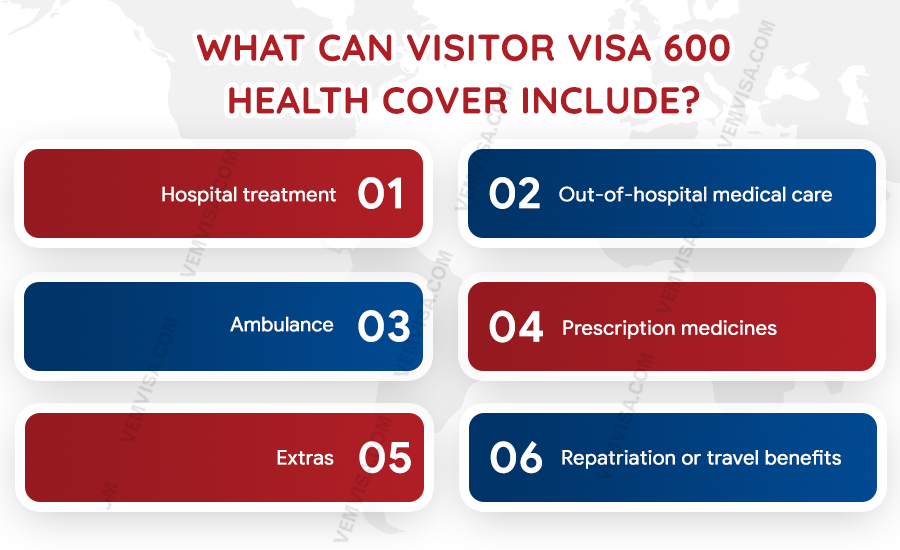
What can Visitor visa 600 health cover include?
Policy benefits are defined by the insurer’s product documents. The following categories are useful comparison points, not a promise that every product pays for them.
Hospital treatment
Check public and private hospital benefits, accommodation, theatre fees, intensive care, inpatient doctors and the applicable excess.
Out-of-hospital medical care
Review GP visits, specialists, pathology and diagnostic imaging, including benefit limits and possible gaps above the insurer’s scheduled amount.
Ambulance
Check whether emergency transport is covered nationwide and whether non-emergency transfers or call-out fees are excluded.
Prescription medicines
Look at per-item and annual limits, member co-payments and whether high-cost or non-PBS medicines are excluded.
Extras
Dental, optical and physiotherapy may require optional extras cover and usually have separate annual limits, waiting periods and provider rules.
Repatriation or travel benefits
Do not assume OVHC includes evacuation, repatriation, cancellation or luggage benefits. These may sit in a separate travel policy.
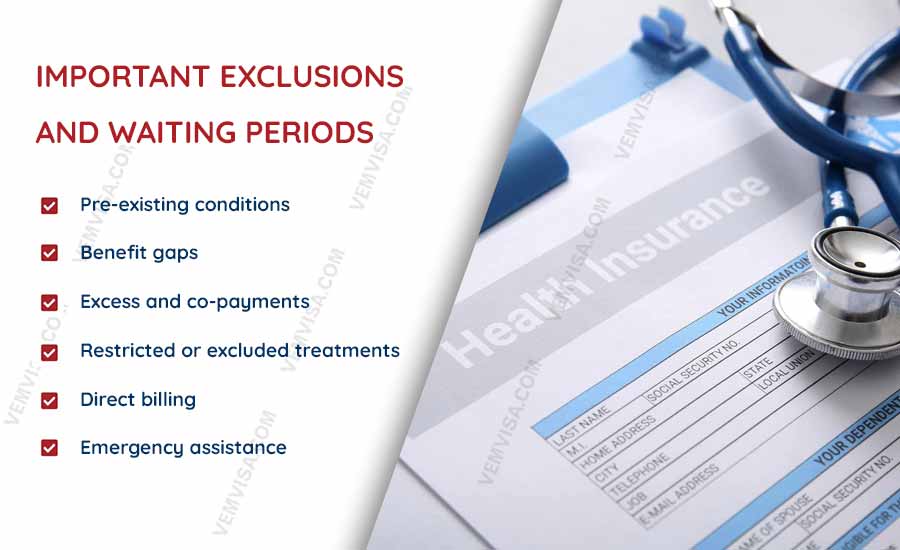
Important exclusions and waiting periods
A policy can be suitable for a visa yet still leave significant out-of-pocket costs. Read the full product rules for pre-existing conditions, pregnancy and birth, psychiatric treatment, rehabilitation, joint replacements, dialysis, planned treatment and services obtained during a waiting period.
- Pre-existing conditions: understand the insurer’s definition, assessment process and waiting period.
- Benefit gaps: a provider may charge more than the amount recognised by the policy.
- Excess and co-payments: confirm whether they apply once, per admission, per year or to each service.
- Restricted or excluded treatments: do not rely on a short marketing summary.
- Direct billing: check when the insurer pays a provider directly and when the visitor must pay first and claim later.
- Emergency assistance: save the correct 24-hour number and understand pre-authorisation requirements.
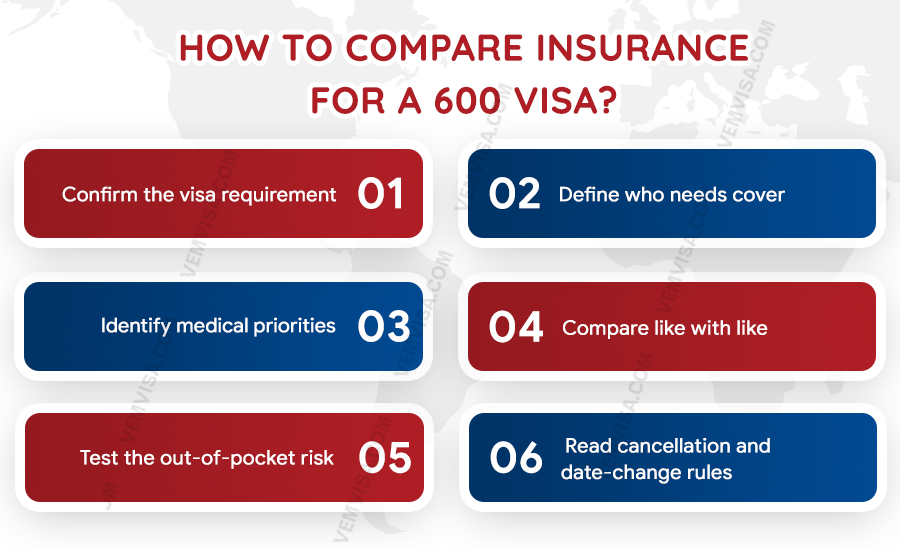
How to compare insurance for a 600 visa
The best policy is the one that meets the visa requirement and the traveller’s health, budget and risk profile. A low premium can be poor value if it excludes the services most likely to be needed or uses an excess the traveller cannot comfortably pay.
Step 1. Confirm the visa requirement
Check the Home Affairs request, grant letter and VEVO. Tell the insurer if condition 8501 applies and ask for a compliance certificate where required.
Step 2. Define who needs cover
List every traveller, date of birth, arrival date and expected departure. Confirm whether the insurer offers a suitable single, couple or family policy.
Step 3. Identify medical priorities
Consider age, regular medication, known conditions, mobility, pregnancy plans and likely specialist needs. Disclose information accurately when the application asks for it.
Step 4. Compare like with like
Use the same cover dates and excess when obtaining quotes. Compare hospital and outpatient benefits, waiting periods, exclusions, annual limits and provider networks—not only the monthly premium.
Step 5. Test the out-of-pocket risk
Ask what you would pay for a GP visit, emergency department attendance, hospital admission, ambulance trip and regular prescription under each option.
Step 6. Read cancellation and date-change rules
Check how to move the start date if travel changes, extend cover for a longer stay, cancel after a refusal and obtain any refund. Keep the final certificate and policy wording.
How to assess “cheap” cover: Compare the total premium plus excess, co-payments and likely benefit gaps. The cheapest visitor visa 600 health insurance quote is not necessarily the lowest-cost outcome after treatment.
Visitor visa 600 health insurance for parents
Parents often plan longer visits and may have age-related conditions, regular prescriptions or specialist care. Premiums can rise with age, while some products have maximum entry ages or restrict enrolment for older visitors. A basic policy selected for a young tourist may be inappropriate for a parent staying for six or twelve months.
Ask about existing conditions
Obtain a clear answer on waiting periods, exclusions and how the insurer assesses symptoms or conditions that existed before joining.
Check medicines and follow-up care
Review prescription limits, GP and specialist benefits, diagnostics and care needed after a hospital discharge.
Plan for practical access
Confirm nearby agreement hospitals, interpreter support, claims assistance and whether family in Australia may communicate with permission.
Families preparing a longer visit can use VEM’s Parent Visitor visa checklist. If the goal is a different temporary parent pathway, compare the insurance and sponsorship requirements for the Sponsored Parent visa 870.
When should you buy and start the policy?
If Home Affairs requests evidence before grant, purchase or arrange the policy in time to provide a valid certificate by the response deadline. Otherwise, arrange cover before the traveller needs it and ensure the start date aligns with the requirement, intended arrival and insurer’s terms. Do not create an uninsured gap at the beginning or between policies when condition 8501 applies.
Travel dates often change. Ask whether the commencement date can be amended before arrival and what evidence is needed. If the visitor extends the stay or receives another visa, contact the insurer before the policy ends. A new visa may require a different product.
Health insurance cannot compensate for choosing the wrong visa stream or missing a condition. Review the visa plan, intended stay, applicant evidence and insurance arrangements together before lodgement or travel.
For individual visa guidance, visit the VEM Australian migration agency page.
Documents to keep
- Visa grant notification and any Home Affairs request for insurance evidence.
- Policy certificate showing each insured person and the cover dates.
- Full product disclosure statement, benefit schedule and exclusions.
- Receipts, medical invoices, referrals and claim correspondence.
- Written confirmation that the selected policy satisfies condition 8501, if applicable.
- The insurer’s emergency assistance and claims contact details.
FAQs
Is health insurance required for every Visitor visa 600?
Do not assume the same requirement applies to every grant. Check application correspondence, the visa grant letter and VEVO. If condition 8501 is attached, adequate health insurance must be maintained as required by that condition.
What does condition 8501 mean?
Condition 8501 requires the visa holder to maintain adequate arrangements for health insurance while in Australia. Confirm the applicable dates and retain proof of continuous cover.
Can travel insurance replace OVHC?
Only if the selected policy meets the actual requirement. General travel insurance can have different medical limits and exclusions. Ask the insurer to confirm suitability for condition 8501 in writing when that condition applies.
Can a Visitor visa 600 holder use Medicare?
Visitors are generally not covered. Some people from countries with a Reciprocal Health Care Agreement may qualify for limited medically necessary care if they meet the country-specific rules. This access is not the same as comprehensive insurance.
How much does 600 Visitor visa insurance cost?
There is no single price. Premiums vary with the traveller’s age, number of people, cover dates, benefit level, excess and insurer. Obtain current quotes using identical inputs and compare the product rules as well as the premium.
Does OVHC cover pre-existing medical conditions?
Coverage varies. A waiting period, exclusion or insurer assessment may apply. Read the definition of a pre-existing condition and disclose information accurately when asked before relying on the policy.
What is the best Visitor visa 600 health insurance for parents?
There is no universally best product. Compare age eligibility, existing-condition rules, hospital and outpatient benefits, medicines, ambulance, excess, exclusions, provider access, and support against the parent’s health needs and planned stay.

 VN
VN
 Người
đăng
Người
đăng Ngày
cập nhật:
Ngày
cập nhật:



