VEM Visa | Temporary Graduate Family Planning
A practical guide for eligible partners and children applying later to join a Temporary Graduate visa subclass 485 holder.
A 485 subsequent entrant visa allows an eligible member of a Temporary Graduate visa holder’s family unit to apply separately to join them in Australia. The application is made after the primary subclass 485 visa has been granted and is assessed against the family-member requirements that apply at the time.
This is not an extension of the primary visa: the family member lodges their own subclass 485 application as a subsequent entrant. They must prove family-unit membership, arrange adequate health insurance and meet health, character and other relevant criteria.
This guide covers eligibility, relationship evidence, documents, application steps, visa fees, processing and rights after grant. For the main graduate pathway and current streams, read VEM’s Temporary Graduate visa 485 guide.
What is a 485 visa subsequent entrant?
Subclass 485 is a temporary visa for eligible international graduates to live, study and work in Australia after completing their studies. Home Affairs states that family may apply to join a primary Temporary Graduate visa holder as subsequent entrants after the primary visa is granted.
Same subclass
The family member applies under subclass 485, linked to the primary visa holder and the stream relevant to that holder.
Separate lodgement
A person cannot simply be added to an application that has already been finalised; the subsequent entrant lodges online separately.
Connected visa period
The grant is tied to the primary holder’s temporary graduate pathway. Rely on the dates in the family member’s own grant letter.
The phrase subsequent visa is sometimes used loosely online, but it can describe many different applications. For accurate research, identify the exact subclass, applicant role and stream rather than assuming that every subsequent-entrant pathway follows the same rules. VEM’s overview of Australian visa types can help distinguish graduate, student, family and other temporary pathways.

Who can apply as a subsequent entrant?
The applicant must be an eligible member of the primary 485 holder’s family unit. This commonly includes a spouse, de facto partner or dependent child, subject to the definitions, age and dependency rules in force.
Spouse
Provide the legal marriage record and evidence that the relationship is genuine and continuing. The certificate does not replace evidence of shared life and ongoing commitment.
De facto partner
Show that the de facto relationship meets the applicable legal definition and duration requirement unless an exception applies.
Dependent child
Provide birth, custody and dependency evidence. Eligibility can change with age, marital status and dependency, so assess the child against the rules expected at decision.
Relationship formed later
If the relationship began after the primary 485 application or grant, establish the genuine chronology with dated evidence rather than trying to fit it into the earlier form.
Check the primary application: Home Affairs advises visa holders to confirm that their visa allows subsequent entrants and that family members were previously declared. If the family relationship did not exist then, provide clear evidence of when it began. If it did exist but was omitted, obtain advice before lodging.
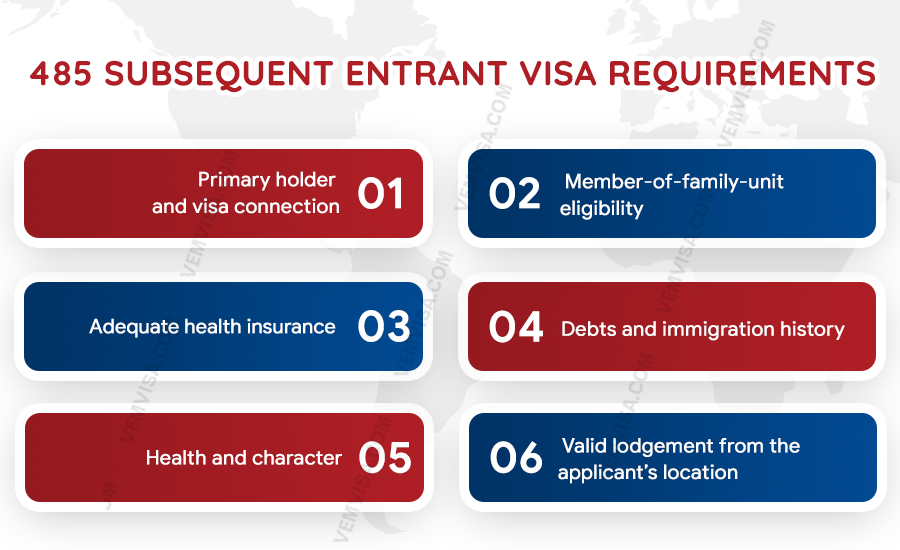
485 subsequent entrant visa requirements
A family connection by itself is not enough. The applicant must satisfy the relevant subclass 485 criteria and provide evidence suited to their individual circumstances.
1. Primary holder and visa connection
Provide the primary holder’s passport, subclass 485 grant notification and current visa details. Confirm that the primary visa remains in effect long enough for the proposed family plan.
2. Member-of-family-unit eligibility
Prove the qualifying relationship and, for a child, any required dependency. Evidence must show the relationship is genuine, continuing and consistent with the application timeline.
3. Adequate health insurance
Arrange health cover suitable for a Temporary Graduate visa applicant and attach the policy certificate. Do not assume the primary holder’s policy automatically covers the new family member or that student OSHC remains the right product.
4. Health and character
Complete examinations, biometrics and police certificates if required. Requests depend on age, residence and travel history, intended work and other risk factors.
5. Debts and immigration history
Disclose refusals, cancellations and prior stays accurately, and address any debt owed to the Australian Government under the applicable rules.
6. Valid lodgement from the applicant’s location
The current visa and attached conditions matter for an onshore application. A person outside Australia does not receive a bridging visa simply by lodging offshore.
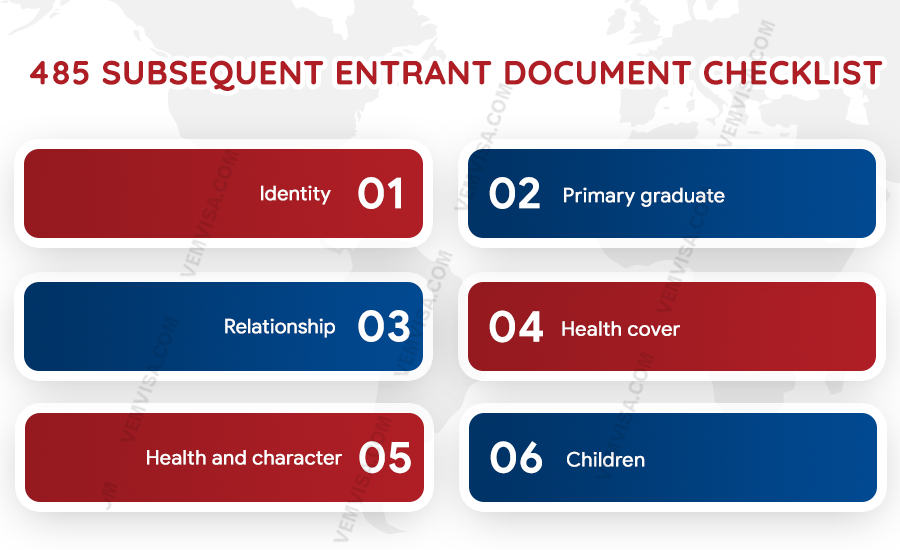
485 subsequent entrant document checklist
The attachment list in ImmiAccount is tailored to the application. Use the following categories to prepare, then follow any case-specific request from Home Affairs.
Identity
Passport bio page, birth certificate, national identity documents, photographs and name-change records where relevant.
Primary graduate
Passport, 485 grant letter, VEVO evidence, Australian address and documents connecting the applicant to the primary holder.
Relationship
Marriage or birth records plus evidence of joint finances, household, social recognition, communication, travel and ongoing commitment.
Health cover
A current certificate identifying the applicant, policy type and coverage dates, with insurer confirmation of visa suitability if needed.
Health and character
HAP details, medical results when requested, police certificates and military or service records where applicable.
Children
Custody, consent and dependency documents, including Form 1229 where required and evidence addressing the child’s family arrangements.
English translations should accompany non-English originals and meet the Department’s translator-detail requirements. Avoid screenshots with missing dates or names, and explain any conflicting address or relationship history.
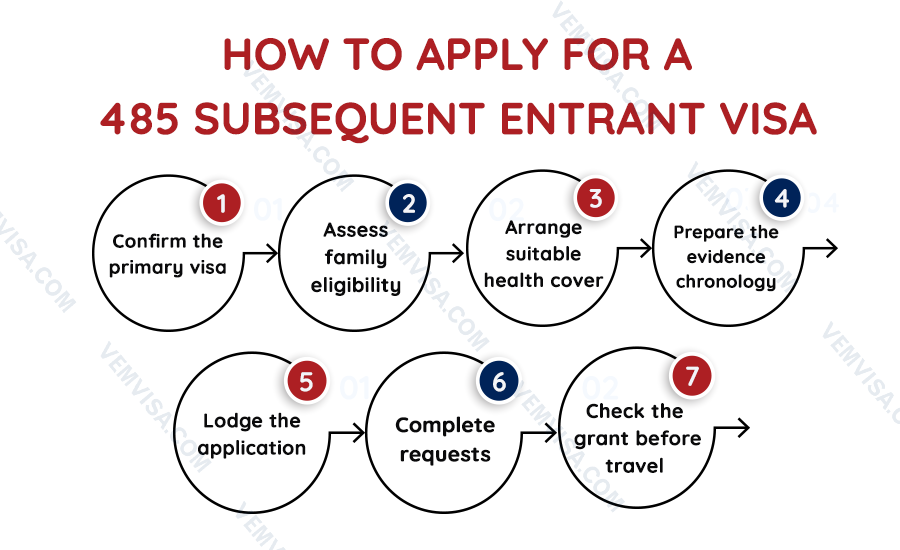
How to apply through ImmiAccount
Step 1. Confirm the primary visa
Check the stream, grant and expiry details. Reconstruct what the primary application said about family members and identify any later relationship change.
Step 2. Assess family eligibility
Confirm marriage or de facto status, the child’s dependency and the applicant’s location. Resolve uncertain eligibility before paying a non-refundable application charge.
Step 3. Arrange suitable health cover
Add the applicant to appropriate family cover or purchase a suitable policy. Match the name, passport and proposed cover date to the visa application.
Step 4. Prepare the evidence chronology
Organise identity, relationship, primary visa, health insurance and character evidence by topic and date. Statements should explain how the relationship developed and why the family now plans to live together.
Step 5. Lodge the subsequent entrant application
Select the correct Temporary Graduate subsequent-entrant application in ImmiAccount, enter the primary holder’s details accurately, upload evidence and pay the amount shown.
Step 6. Complete requests promptly
Monitor ImmiAccount for health, biometrics, police certificates or further-information requests. Update Home Affairs if a material fact, passport, address or family circumstance changes.
Step 7. Read the grant before travel
Confirm visa dates and conditions. Do not resign from work, buy non-refundable travel or assume work rights solely because the primary holder has a 485 visa.
VEM’s guide to ImmiAccount and VEVO explains how to monitor a pending application and then verify the granted visa’s conditions.
485 subsequent entrant visa fee
A family member applying separately to join a primary Temporary Graduate Visa holder must pay the full application charge for a Subclass 485 subsequent entrant visa:
- Applicant aged 18 or over: AUD 5,750
- Dependent child under 18: AUD 1,450
These charges apply because a subsequent entrant lodges a separate visa application rather than being added to the primary holder’s original application.
Budget beyond the application charge
- Health insurance premiums for the required period.
- Health examinations, biometrics and police certificates.
- Translation, certification and document-delivery costs.
- School or childcare expenses for accompanying children.
- A possible payment surcharge or subsequent temporary application charge where the rules apply.
485 subsequent entrant visa processing time
Home Affairs does not promise a personal decision date. Published global figures are historical indicators, and a subsequent-entrant case may not move at the same speed as a straightforward primary application. Community reports ranging from days to many months are not a reliable forecast.
Application quality
Missing relationship, insurance or identity evidence can prompt further requests or a decision on the material supplied.
External checks
Health examinations, police certificates, biometrics and document verification can add time.
Caseload and complexity
Processing demand, location, relationship chronology and adverse immigration history may affect assessment.
Check Home Affairs’ live processing-time tool and VEM’s Australia visa processing-times guide. Lodge a complete application early, but do not treat an online range as a travel guarantee.
Work, study and travel after grant
A granted family member can generally live, work and study in Australia while the visa remains valid, subject to every condition on their own grant. They can travel while the travel facility remains in effect. These rights do not create permanent residence or extend beyond the granted period.
Check both visas: The family member should review their own expiry and conditions in VEVO. If the primary 485 is nearing expiry, compare whether the remaining period justifies the cost and whether the family has another lawful plan afterwards.
Common mistakes that weaken an application
- Using the wrong online form: choosing a primary 485 pathway instead of the subsequent-entrant application.
- Ignoring the original family declaration: failing to reconcile what was stated when the primary applicant lodged.
- Relying on one relationship document: a marriage certificate alone does not show the full genuine and continuing relationship.
- Submitting unsuitable insurance: using OSHC or a visitor product without confirming that it satisfies the 485 requirement.
- Copying an old fee: charges can change and may vary by the applicant’s circumstances.
- Promising a fixed grant date: reported processing times are not a Department commitment.
- Overlooking limited remaining validity: the primary visa may expire sooner than the family expects.

A coherent application links the primary 485 grant, the family timeline, relationship evidence, health cover and the proposed period in Australia. Every document should support the same facts.
For individual assessment, visit the VEM Australian migration agency page.
FAQs
Who can apply for a 485 subsequent entrant visa?
An eligible member of the primary subclass 485 holder’s family unit may apply, commonly a spouse, de facto partner or dependent child. The person must meet the relationship, health insurance, health, character and other applicable requirements.
Can my partner apply if we married after my 485 visa was granted?
Potentially, if the partner meets the family-unit rules and the relationship is genuine and continuing. Provide dated evidence showing when the relationship began and how it developed after the primary application.
Can a subsequent entrant apply inside or outside Australia?
Location rules depend on the relevant stream, stage and the applicant’s current visa. Home Affairs states for current 485 settings that a subsequent entrant may be in or outside Australia at decision, but valid-lodgement requirements still need checking.
How much is the 485 subsequent entrant visa fee?
The current amount depends on the lodgement date, age, location and visa history. Use the official Visa Pricing Estimator. Also budget for insurance, medicals, police checks, biometrics, translations and payment surcharges.
How long does a 485 subsequent entrant visa take?
There is no guaranteed timeframe. Check the Home Affairs global processing-time tool and allow for relationship assessment, health, character, biometrics, verification and caseload. Do not use social-media grant reports as a deadline.
Does a 485 subsequent entrant need health insurance?
Applicants must make adequate arrangements for health insurance unless an applicable exemption is accepted. Confirm that the selected policy covers the family member and is suitable for subclass 485.
Can a 485 subsequent entrant work full-time?
Subclass 485 family members generally have work rights, but they should read their own grant letter and check VEVO before working. Any condition on the individual visa takes priority over a general description.
CEO and Founder of VEM
Mr. Phong Cao is a licensed migration agent by MARA (MARN: 1577877). He is also a member of the Migration Institute of Australia (MIA: 12648), one of the most reputable organizations in the field of immigration in Australia. In addition, Mr. Phong Cao holds a QEAC certification in study abroad consulting (QEAC: K580) and Australian real estate investment (RA85931). With over 12 years of experience in Australian immigration, he provides comprehensive solutions for studying and settling in Australia.

 VN
VN

 Người
đăng
Người
đăng Ngày
cập nhật:
Ngày
cập nhật:



