Updated 2026 Guide | Subclass 417 and 462
Requirements, specified work, evidence, and application steps for a second year in Australia.
A second Working Holiday visa can give an eligible young traveller another 12 months in Australia. Most applicants qualify by completing at least three months of specified work while holding their first eligible Working Holiday Maker visa. The exact work, location and evidence rules depend on whether the applicant is in subclass 417 or subclass 462. For the broader program, see VEM’s Working Holiday visa Australia guide.
Current fee: the government Visa Application Charge for a second subclass 417 or 462 visa is AUD 840. Payment surcharge, health examinations, police certificates, biometrics, insurance and professional assistance are separate.
What is an Australian second Working Holiday visa?
The second Working Holiday visa is a separate visa, not an automatic extension of the first visa. Once granted, it normally provides a further 12-month working holiday with permission for short-term work, up to four months of study, and multiple travel while the visa is valid. The start date depends on whether the applicant applies in or outside Australia and the status of any current Working Holiday Maker visa.
Another 12 months
The second visa can be used directly after the first or later, subject to age and other requirements.
Holiday remains primary
Work can fund the trip, but the program is designed around an extended holiday.
No sponsor required
An employer does not sponsor the visa, although employment evidence may prove specified work.
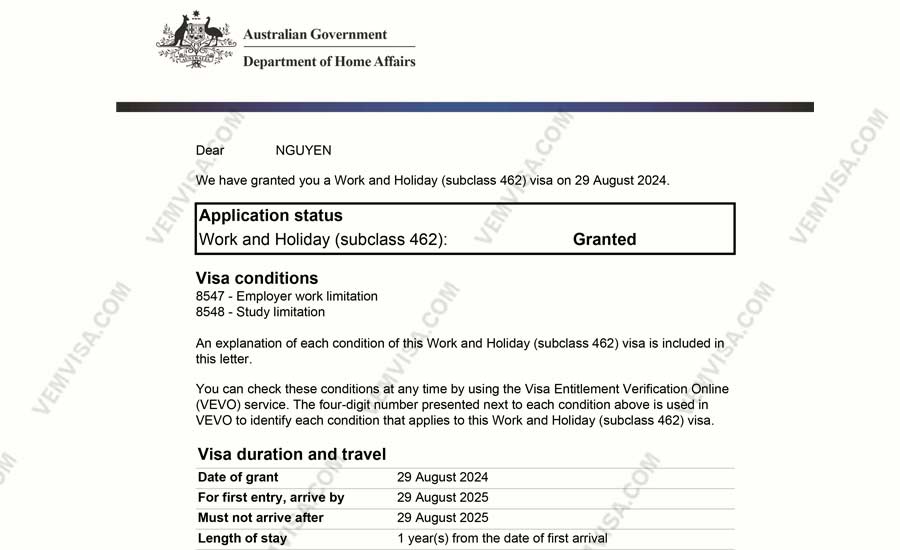
Second Working Holiday 417 vs second Work and Holiday 462
| Point |
Subclass 417 |
Subclass 462 |
| Passport |
Working Holiday partner countries or jurisdictions. |
Work and Holiday partner countries. |
| Prior visa |
Currently holds or previously held a first subclass 417. |
Currently holds or previously held a first subclass 462. |
| Work requirement |
Usually 3 months of specified subclass 417 work; UK passport exemption applies. |
Usually 3 months of specified subclass 462 work. |
| First-visa cap or ballot |
Not the 462 country-cap system. |
Caps and ballots generally concern first visas; there are no country caps for second or third 462 visas. |
| Current fee |
AUD 840 |
AUD 840 |
Do not use a subclass 417 regional-work list for a subclass 462 case, or vice versa. Some industries overlap, but the eligible areas and detailed definitions can differ.
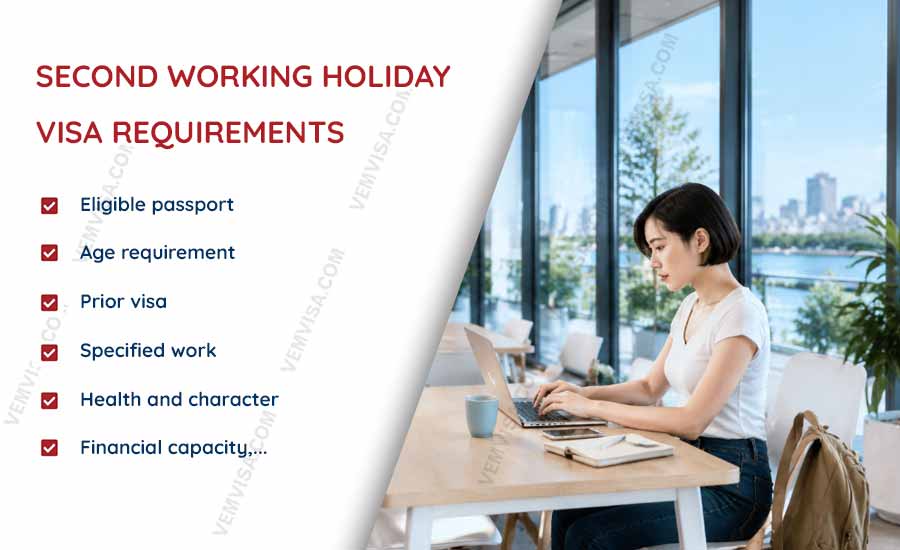
Second Working Holiday visa requirements
- Eligible passport: use a passport accepted for the same Working Holiday Maker stream.
- Age: generally 18 to 30 inclusive, with an upper limit of 35 for specified passport holders. The applicable age is assessed at lodgement.
- Prior visa: currently hold or have previously held the relevant first subclass 417 or 462 visa.
- Specified work: complete at least three months of eligible work while holding the first visa, unless an exemption applies.
- Health and character: satisfy current requirements and provide examinations or police records if requested.
- Financial capacity: show sufficient funds to support the initial stay and onward or return travel when required.
- Dependent children: do not be accompanied by dependent children during the stay.
- Government debts and compliance: address relevant debts and previous visa-condition issues.
UK passport holders have a major exemption
For subclass 417 applications lodged on or after 1 July 2024 using an eligible UK passport, the applicant does not need specified work for a second or third visa. This includes qualifying British National (Overseas) passports. Other eligibility and visa conditions still apply.
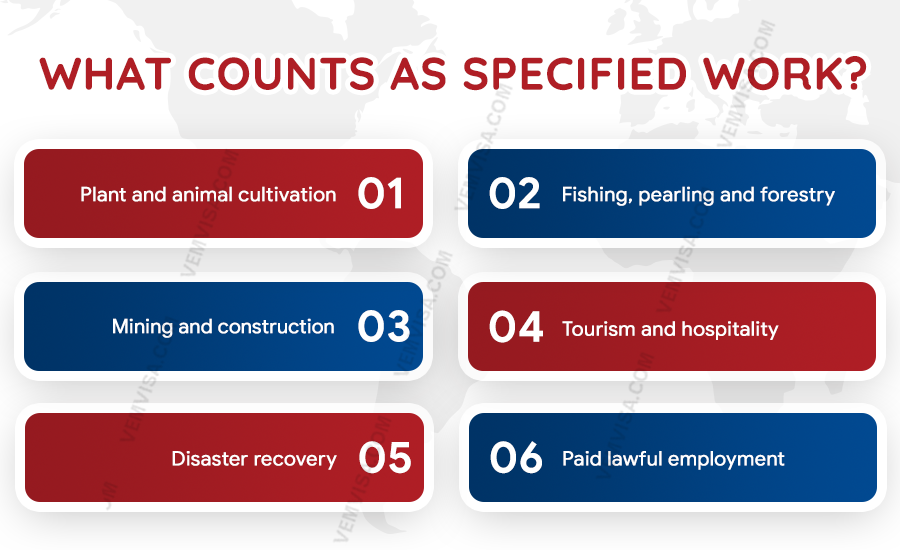
What counts as specified work?
Specified work is defined by the occupation or activity, the location, and the period in which it was performed. A job being physically demanding, rural or advertised as “88-day work” does not make it eligible.
Plant and animal cultivation
Harvesting, packing produce as part of cultivation, pruning, livestock and other defined primary-production duties.
Fishing, pearling and forestry
Eligible fishing, pearling, tree farming and felling duties in the areas specified for the subclass.
Mining and construction
Defined mining or construction activity where both the work and geographic rule are satisfied.
Tourism and hospitality
Eligible roles only in designated northern, remote or very remote areas under the applicable subclass rules.
Disaster recovery
Defined bushfire, flood, cyclone or other recovery work in declared or eligible areas and periods.
Paid lawful employment
Work must generally be paid under Australian workplace law and awards; narrow volunteer disaster-recovery exceptions can apply.
Check the actual duties rather than the employer’s industry label. Reception work at a farm, retail work in a mining town or cleaning in an ordinary metropolitan hotel may not qualify. Confirm the workplace postcode against the current Home Affairs list before starting.
How the 88 days or three months are calculated
Home Affairs uses “three months”, meaning the equivalent of the shortest three calendar months of full-time work. The popular figure of 88 days is a planning shortcut. Full-time, part-time, casual, piece-rate or multiple-employer arrangements may count when they satisfy the rules.
- Full-time continuous work: rostered days off can count where they are part of normal full-time employment.
- Part-time or casual work: count qualifying days actually worked until the equivalent period is reached.
- Piece-rate work: can count if lawful and documented by a valid piecework agreement and payment records.
- Several employers: eligible periods can be combined; they do not need to be consecutive.
- Double shifts: working two shifts in one calendar day does not usually create two eligible days or compress three months into six weeks.

Paid sick leave or other paid leave may count in a qualifying employment period; unpaid leave and days without eligible work generally do not. Seasonal interruptions require careful calculation. Keep a dated calendar rather than relying only on an employer’s verbal total.
Evidence for a 2nd year Working Holiday visa
The application should demonstrate who employed the applicant, what they did, where they worked, when they worked and how they were paid. Useful evidence includes:
- all payslips and the written employment contract;
- bank statements showing matching wage deposits;
- income statement, payment summary, tax return and superannuation records;
- employer reference stating duties, workplace address, dates and hours;
- piecework agreement, rosters and timesheets where applicable;
- evidence of eligible volunteer disaster-recovery work where the rules permit it.
Cash-in-hand and false claims create serious risk
Undeclared cash work may be impossible to verify and can breach tax or workplace laws. Home Affairs can contact employers and check records. False payslips, invented duties or altered dates can lead to refusal, cancellation and future visa consequences.
How to apply for a second Working Holiday visa
1. Confirm the subclass and age limit
Use the same 417 or 462 program and check the age concession for the passport held on the lodgement date.
2. Audit specified work
Match duties, location, dates, and payment evidence against the current Home Affairs page for the subclass.
3. Prepare documents
Upload passport and identity evidence, work records, financial evidence and any requested health or character documents.
4. Lodge through ImmiAccount
Complete the correct second visa application online, declare the full visa and employment history and pay the current charge.
5. Monitor the application
Respond promptly to requests and check the grant letter before travel or assuming new work rights.
An applicant can lodge in or outside Australia. If applying in Australia, they must be in Australia when Home Affairs decides the application. If applying outside Australia, they must be outside Australia at decision. Lodging while still holding the first visa may result in a bridging visa if the first visa ends before the onshore decision; check its activation and travel conditions in VEVO.

Second Working Holiday visa cost and processing time
Government fee
AUD 840
Current second subclass 417 or 462 Visa Application Charge.
Processing time
Check live data
Home Affairs processing estimates change and are not decision guarantees.
Extra costs can include the payment surcharge, health examinations, biometrics, police certificates, translations and insurance. A refused or withdrawn application is not normally refunded simply because the result is disappointing or travel plans change. See VEM’s visa processing-times guide.
Conditions during the second year
Employer limit
Condition 8547 generally limits work with one employer to six months, subject to current exemptions or written permission.
Study limit
Study or training is generally limited to four months during the visa period.
Workplace rights
Minimum pay, safety and other Australian workplace protections apply regardless of nationality.
Current exemptions to the six-month employer limit cover specified settings, including different workplace locations, plant and animal cultivation, critical sectors and disaster recovery. If no exemption applies, request permission before the initial six months ends. Confirm conditions through VEM’s VEVO guide.
Pathway to a third Working Holiday visa Australia
A person planning a third Working Holiday visa Australia should start keeping records from the beginning of the second visa. Most applicants need at least six months of eligible specified work performed on or after 1 July 2019 while holding the second visa or an eligible bridging visa. It is an additional requirement; the first year’s three months cannot simply be reused.
The 417 and 462 specified-work definitions still need to be checked separately. UK passport holders applying for subclass 417 on or after 1 July 2024 do not need the six months of specified work. The current third-visa charge may differ from the second-visa charge, so confirm it with the Pricing Estimator before lodgement.
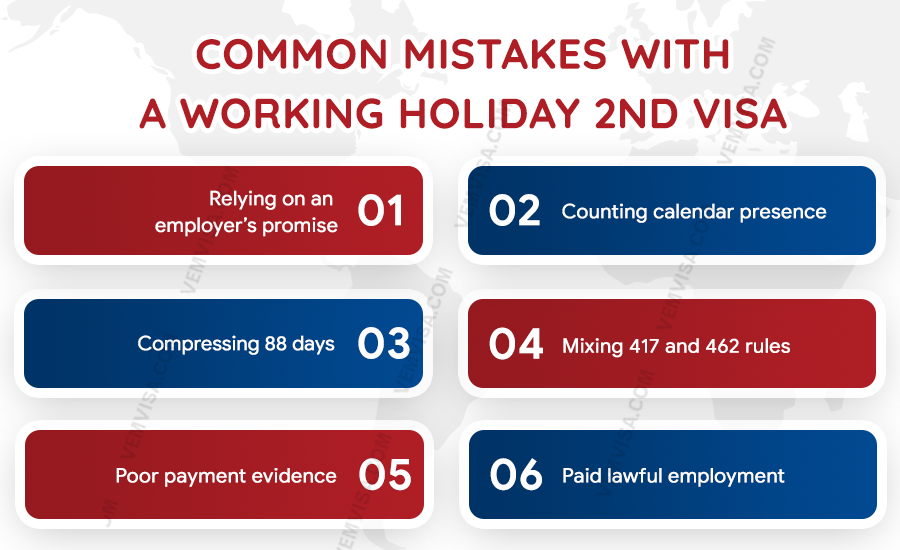
Common mistakes with a working holiday 2nd visa
- Relying on an employer’s promise: failing to check the official occupation and postcode rules.
- Counting calendar presence: treating every day in regional accommodation as a work day.
- Compressing 88 days: assuming double shifts create two eligible days.
- Mixing 417 and 462 rules: using the wrong industry or regional-area list.
- Poor payment evidence: accepting cash without payslips, tax or bank records.
- Missing the age deadline: waiting until after the permitted age to lodge.
- Leaving during processing: ignoring the inside/outside decision-location requirement or bridging visa travel limits.
If you need further assistance, please contact VEM. Our consultant, Mr. Peter Cao, a registered migration agent (MARN: 1577877), with more than 10 years of experience in the migration field, will help you.
Not sure whether your 88 days count?
Review the subclass, duties, postcode, dates and payment evidence before lodging a non-refundable application.
Contact VEM Visa
FAQs
How do I qualify for a second Working Holiday visa?
Hold or have held the relevant first 417 or 462 visa, meet passport and age requirements and usually complete at least three months of eligible specified work while holding the first visa.
How much does the second visa cost?
The current government charge is AUD 840 for a second subclass 417 or 462 application, excluding card surcharge and any health, character, biometrics or professional costs.
Do I need exactly 88 days of farm work?
Not necessarily. The rule is three months of specified work, and farm work is only one category. Eligible days and industries depend on the subclass, duties, location and employment pattern.
Can part-time specified work count?
Yes, eligible part-time or casual work can be accumulated, but the applicant must reach the required equivalent period. It cannot normally be compressed by counting multiple shifts in one day as multiple days.
Can I work for the same employer for the second year?
Condition 8547 generally limits work with one employer to six months, but exemptions and a permission process exist. Check the current rules for the role and workplace.
How do I qualify for a third-year Working Holiday visa?
Most applicants need six months of eligible specified work while holding the second visa or an eligible bridging visa. UK passport holders using subclass 417 are exempt from specified work for applications lodged from 1 July 2024.
CEO and Founder of VEM
Mr. Phong Cao is a licensed migration agent by MARA (MARN: 1577877). He is also a member of the Migration Institute of Australia (MIA: 12648), one of the most reputable organizations in the field of immigration in Australia. In addition, Mr. Phong Cao holds a QEAC certification in study abroad consulting (QEAC: K580) and Australian real estate investment (RA85931). With over 12 years of experience in Australian immigration, he provides comprehensive solutions for studying and settling in Australia.

 VN
VN

 Người
đăng
Người
đăng Ngày
cập nhật:
Ngày
cập nhật:



