Updated Guide | Lawful Status While Waiting
A practical guide to Bridging Visa C subclass 030, work restrictions, financial-hardship evidence, travel limits and application steps.
A Bridging Visa C (BVC), or subclass 030, is a temporary visa that can allow a person to remain lawfully in Australia while a substantive visa application or an eligible review process is unresolved. It commonly arises where the person did not hold a substantive visa when the new substantive application was lodged.
Check the grant before doing anything: a BVC does not automatically include work rights and does not permit international travel. Condition 8101 means “no work”. You must wait until a new BVC without that restriction is granted before beginning or resuming work.
This article explains eligibility, commencement and cessation, the Bridging Visa C work rights application, evidence of financial hardship, conditions, cost and processing. Bridging visas are highly fact-dependent, so compare the general information with the individual grant letter and VEVO. VEM’s Australian bridging visa overview explains the broader A, B, C and E framework.
What is a Bridging C visa?
A bridging visa is not a replacement for the substantive visa being sought. Its immediate purpose is to manage lawful status while another immigration matter is decided. The BVC is usually relevant when an applicant is in Australia and is unlawful, or did not hold a substantive visa, when making a valid application for a substantive visa.
Lawful stay
It can keep the holder lawful during the associated application or qualifying review process.
Temporary status
It is not permanent residence and does not improve the merits of the substantive visa application.
Individual conditions
Work rights, commencement, and cessation must be read from the person’s own grant and VEVO record.
A BVC is different from a Bridging Visa A, which is generally associated with a valid onshore substantive application made while the applicant still held a substantive visa. It is also different from a Bridging Visa E, which is often used to resolve unlawful status, arrange departure, or manage other immigration processes. The label depends on the legal facts, not the applicant’s preference.
Who may be eligible for Bridging Visa C subclass 030?
The rules contain several pathways and exclusions. In the common substantive-visa scenario, the applicant must be in Australia but not in immigration clearance and have an unresolved valid application with which the BVC can be associated.
- Location: the applicant must be in Australia and not at immigration clearance when applying.
- No current substantive visa: the person generally did not hold a substantive visa when lodging the associated substantive application.
- Associated matter: there must be an eligible substantive visa application or prescribed review process.
- Valid application: an invalid substantive application may not create the expected bridging-visa pathway.
- BVE history: current or previous Bridging Visa E circumstances can affect BVC eligibility.
- Character and compliance: identity, immigration history and applicable public-interest requirements remain relevant.
Lodging a substantive application does not always restore lawful status immediately
If the previous visa has already ceased, verify whether a bridging visa was validly applied for and granted. Do not assume an ImmiAccount receipt by itself authorises stay or work.

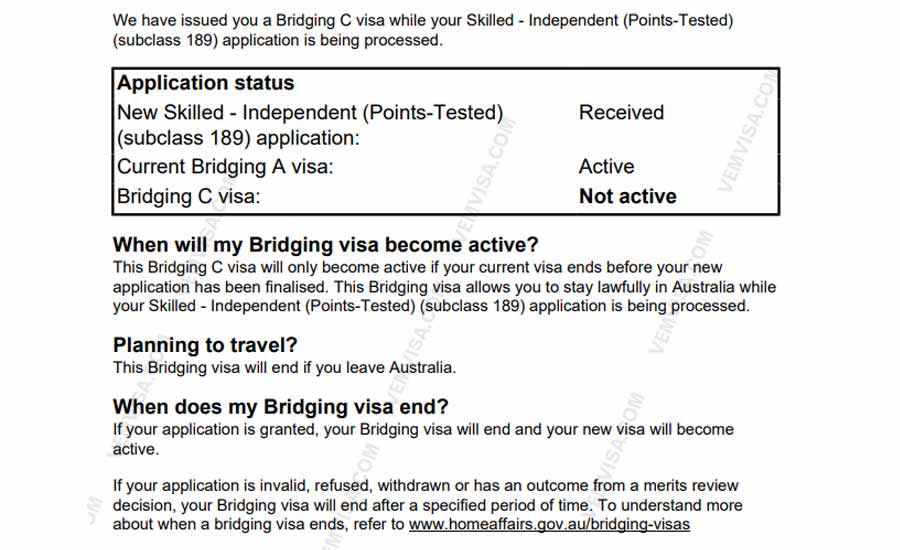
When does a Bridging Visa C become active?
Grant and commencement are different concepts. A BVC can be granted but not yet be the visa in effect. If another visa is still active, the BVC grant notice should explain when it commences. If the applicant was unlawful when it was granted, it may become effective immediately.
Grant date
The date Home Affairs approves the BVC application.
In-effect date
The date the BVC becomes the current visa and its conditions begin to govern the holder.
Cessation event
A date or event stated in the grant or legislation, such as departure or finalisation of the associated matter.
The BVC commonly remains relevant until the substantive visa application is finally determined, withdrawn or otherwise reaches a specified end point. Different cessation rules and review periods can apply after refusal. Read every date and event in the grant notification and obtain timely advice after an adverse decision. VEM’s Australian visa refusal guide explains why review and departure deadlines require immediate attention.
Bridging Visa C work rights
Work rights are not automatic. Many BVC grants carry condition 8101—no work. If that condition appears in VEVO, the holder must not engage in work unless Home Affairs grants a new BVC without the restriction. Paid work, cash-in-hand work and arrangements presented as “unpaid” can still create a breach depending on what is done. Use VEM’s VEVO and visa-status guide to locate the in-effect visa and conditions.
The safe sequence
Check VEVOPrepare hardship evidenceApply for a new BVCWait for grantRecheck conditions
Some applicants may receive work rights because of the type of substantive application or the regulations applying to their circumstances. Protection, judicial-review and other special cases can have different mandatory conditions. Never rely on another BVC holder’s outcome as proof of personal work permission.
How to make a Bridging Visa C work rights application
A request for work rights is generally made by applying for a new Bridging Visa C and asking for a visa without the work restriction. It is not simply an informal request to edit the existing grant. Form 1005 is used for a BVA or BVC application.
1. Confirm the current visa and condition
Download the grant notice and check VEVO. Identify whether condition 8101 or another work restriction is actually attached and when the BVC is in effect.
2. Complete Form 1005
Select the reason for applying for another bridging visa and provide accurate details about the associated substantive application, status and work-rights request.
3. Build the financial position
Show present resources, income, essential living expenses, debts and realistically available support. The evidence should demonstrate a compelling need to work, not simply a preference to work.
4. Lodge through the correct channel
If the associated substantive application was lodged through ImmiAccount and no review application is involved, lodge there. Otherwise, use the Home Affairs BVA/BVB/BVC webform where its instructions apply.
5. Retain proof and monitor messages
Save the submitted form, attachments and acknowledgement. Respond promptly if Home Affairs requests more information.
6. Do not work until approval
Continue following the existing BVC conditions. After a new grant, check that the no-work restriction is absent before starting employment.

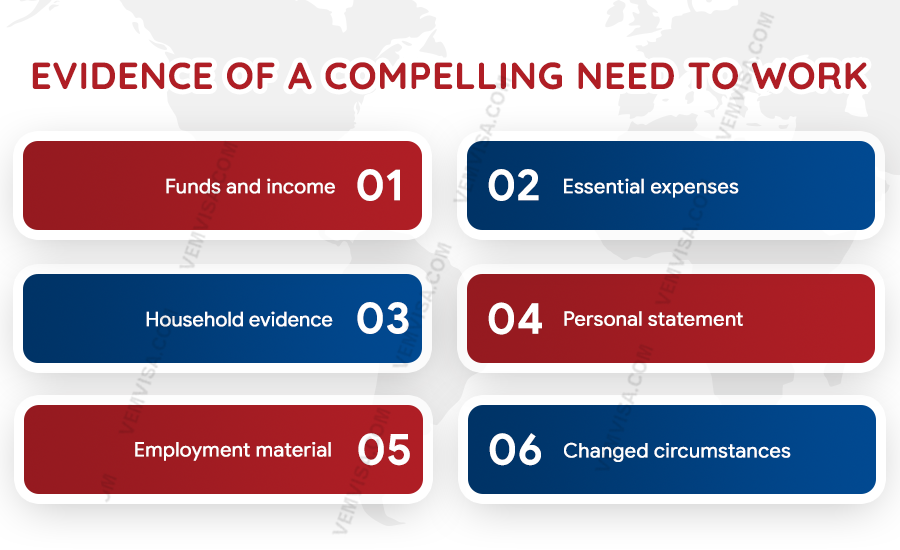
Evidence of a compelling need to work
Financial hardship is generally assessed by comparing reasonable living costs with the resources available to meet them. A large expense list alone is not persuasive if savings, partner income or other reliable support can cover those costs. Conversely, a low bank balance without a complete budget may not explain the full position.
Funds and income
Recent bank statements, savings, investments, benefits, partner income and any overseas support.
Essential expenses
Rent, utilities, food, transport, medical costs, insurance, child expenses and unavoidable debt repayments.
Household evidence
Partner or household budget, dependants, shared liabilities and evidence explaining why others cannot meet the shortfall.
Personal statement
A dated explanation of how the hardship arose, current weekly or monthly deficit and why employment is necessary.
Employment material
A genuine job offer, proposed hours and pay can show how work would address the deficit, but does not itself prove hardship.
Changed circumstances
Evidence of job loss, illness, separation, exhausted support or another event that explains a recent financial change.
Use a consistent date range and explain unusual transactions. If a family member previously agreed to support the applicant, address what changed. A concise budget with source documents is easier to assess than an unstructured upload of screenshots.
Bridging Visa C conditions and travel restrictions
Condition 8101 – no work
If attached, no work is permitted until another BVC with suitable conditions is granted.
No international travel facility
A BVC does not allow the holder to leave and return. Departure causes the BVC to cease.
No simple BVB conversion
A BVC holder cannot assume they can obtain a Bridging Visa B for travel. Seek advice before any proposed departure.
Notify changes
Keep contact and passport details current and respond to Home Affairs correspondence about the associated matter.
Leaving Australia is a major legal step
The BVC ceases on departure and cannot be used to return. Leaving can also affect an onshore substantive application or review. Obtain advice before buying a ticket, even for an emergency.
Bridging Visa C cost and processing time
Government application fee
AUD 0
There is no government Visa Application Charge for a standard BVC or Form 1005 work-rights request.
Official processing standard
Not published
Home Affairs does not provide a fixed BVC or work-rights processing time.
The Bridging Visa C work rights application processing time depends on the application channel, whether Form 1005 and evidence are complete, the urgency of lawful-status issues, financial material, requests for information and Department workload. Some private sources mention periods of a few weeks, but these are anecdotal and must not be treated as a deadline.
Do not lodge duplicates merely because no decision has arrived; Home Affairs warns that repeat applications can add to processing delays. If the existing BVC has condition 8101, that restriction remains until a new grant changes it. VEM’s visa processing-times guide explains how to interpret published Department data without treating it as a personal deadline.
Common mistakes with a Bridging C visa
- Working after lodging: assuming a work-rights request suspends condition 8101.
- Showing expenses but not resources: omitting savings, partner income or available support from the hardship assessment.
- Submitting inconsistent budgets: using figures that conflict with bank statements or previous visa evidence.
- Using the wrong channel: sending Form 1005 by webform when the application should be lodged through ImmiAccount, or vice versa.
- Assuming every bridging visa permits travel: treating BVC like BVB.
- Ignoring the substantive case: focusing on BVC work rights while missing a deadline or request on the main application.
- Relying on another applicant’s VEVO: work conditions and cessation events must be checked individually.

Need to confirm your BVC position?
Bring the grant notice, VEVO record, substantive visa receipt and financial evidence for an individual assessment.
Contact VEM Visa
Bridging Visa C FAQs
Can I work on a Bridging Visa C?
Only if the BVC currently in effect permits work. If VEVO shows condition 8101, you cannot work unless and until Home Affairs grants a new BVC without that restriction.
How do I apply for Bridging Visa C work rights?
Complete Form 1005 and apply for a new BVC through the correct Home Affairs channel, requesting permission to work and attaching evidence of a compelling need, usually financial hardship.
Can I travel overseas on Bridging Visa C?
No. A BVC has no international travel facility and ceases when the holder leaves Australia. It cannot be used to return.
Can a BVC holder apply for Bridging Visa B?
A BVC holder should not assume a BVB is available simply to obtain travel rights. Eligibility is restricted, and departure can affect both the BVC and the associated application. Get advice before making travel plans.
When does Bridging Visa C end?
It ends when a cessation event under the grant or migration law occurs. This may relate to departure, withdrawal, grant or final determination of the substantive matter, or expiry of a review period. Read the individual grant.
Does a BVC guarantee the substantive visa will be granted?
No. The BVC manages temporary lawful status. The associated substantive visa is assessed separately against its own criteria.

 VN
VN
 Người
đăng
Người
đăng Ngày
cập nhật:
Ngày
cập nhật:



