8558 Visa Conditions Calculator: Check Your 12-Month Limit
VEM Visa | Visitor Visa Stay Planning
A practical guide to understanding condition 8558, recording your Australian travel dates and checking the rolling 12-in-18-month limit.
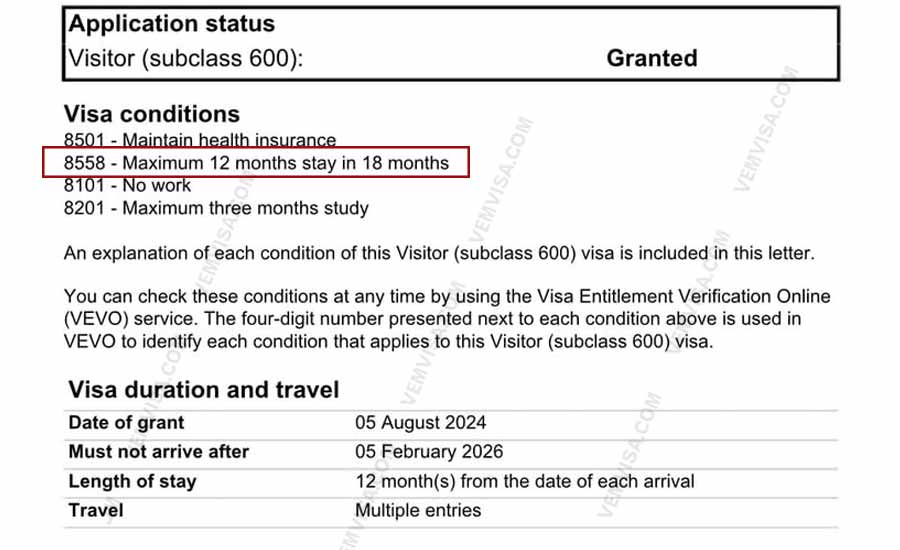
If your visa grant letter includes the 8558 visa condition, every Australian arrival and departure can affect how long you may remain. The rule is often attached to longer-validity visitor visas, including visas used for repeated family visits. It is easy to misunderstand because visa validity, the permitted stay on each visit and the cumulative 12-in-18-month limit are different controls.
Use the result as a planning guide: Condition 8558 limits a visa holder to no more than 12 months in Australia in any 18-month period. Because the period moves with the date being checked, a calculator can help organise travel history—but it remains an estimate, not a decision by the Department of Home Affairs.
This guide explains how an 8558 visa condition calculator should be used, which dates to enter and why the result must be checked against your own visa record. If you are still comparing visitor options, see VEM’s guide to the Australian Visitor visa (subclass 600).
The legal wording of condition 8558 is concise: the holder must not stay in Australia for more than 12 months in any 18-month period. The condition applies only when it appears on your visa. Check your grant notification and your current in-effect visa in VEVO rather than assuming that every visitor visa carries the same conditions.
Visa validity
The period during which the visa may be used, subject to the “must not arrive after” date and other grant details.
Stay per entry
The maximum stay allowed on an individual visit, as stated in the grant letter or VEVO.
Condition 8558
A cumulative cap across all time spent in Australia during every relevant rolling 18-month period.
A three-year multiple-entry grant therefore does not necessarily allow three uninterrupted years in Australia. Likewise, leaving Australia briefly does not automatically reset the 8558 count. VEM’s explanation of a three-year multiple-entry visa provides more context on the difference between visa validity and length of stay.
What does visa condition 8558 mean
Do not rely on the visa expiry date alone
A visa may remain valid for travel while condition 8558 still restricts the amount of time you can spend in Australia. The grant letter, VEVO record and travel history need to be read together.
How an 8558 visa condition calculator works
A calculator places each completed or current stay onto a timeline. For a date you want to test, it looks back across the relevant 18-month window and estimates how much of that period you spent physically in Australia. A useful tool should also consider overlapping trips, a current stay with no departure date and old travel that gradually falls outside the moving window.
The key concept is the rolling window. It can be assessed for different dates—not only the day you first arrived, the day the visa was granted or the start of a calendar year. As time passes, an earlier day in Australia may leave the 18-month window, but a new day of presence may enter it. This is why a single total of all trips since grant can be misleading.
What the result should tell you
Days already used Estimated days remaining Relevant 18-month window Possible limit date
Calculation conventions may differ between third-party tools, especially around arrival and departure days and calendar-month arithmetic. Treat the output as planning support. It cannot amend your visa, confirm compliance or guarantee that travel will be permitted.
How to use the 8558 visa condition calculator
Prepare a complete travel record before entering anything. Passport stamps can help, but they may be incomplete. Use airline itineraries, boarding passes, calendar records and any official movement record available to you to reconcile uncertain dates.
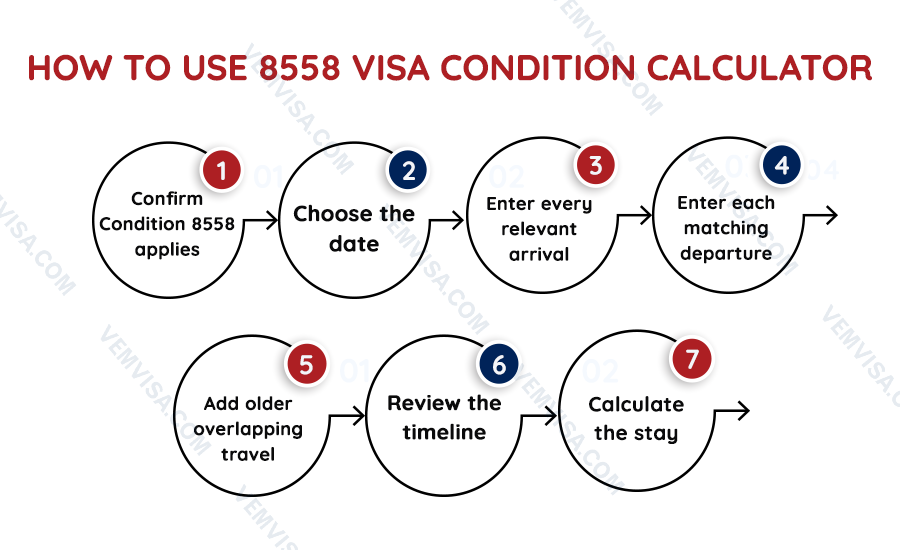
1. Confirm that condition 8558 applies
Open your visa grant notification and check VEVO. Confirm the visa in effect, its conditions, period of stay, entries and “must not arrive after” date. VEM’s VEVO and visa-status guide explains where these details appear.
2. Choose the date you want to assess
This might be today, a proposed arrival date or a planned departure date. A result for today does not automatically remain accurate for a future itinerary, so calculate the period that matters to your travel plan.
3. Enter every relevant arrival
Add the date you physically arrived in Australia for each trip that overlaps the relevant 18-month period. Do not use the visa grant date, booking date or the date your flight left another country if you landed on a later calendar day.
4. Enter each matching departure
Match every arrival to the date you left Australia. If you are currently in Australia, use the tool’s “currently in Australia” option or leave the departure field open only when its instructions expressly say to do so.
5. Add older overlapping travel
A trip may have started before the displayed window but continued into it. Include it if the calculator requests all stays that overlap the period; otherwise the estimated total may be too low.
6. Review the timeline before calculating
Check for missing trips, reversed dates, duplicated entries, overlaps and gaps. Confirm that every date uses the same format.
7. Calculate and test the full proposed stay
Run the calculation, then test the intended departure date—not only the proposed arrival. Keep a copy of the dates entered and allow a practical buffer for errors, flight changes or disputed date-counting assumptions.
A simple rolling-window example
Assume a traveller has made several long visits and wants to plan another stay. Adding all previous days in Australia may show a large total, but the calculator must focus on the 18 months relevant to each date being tested. Days from an early visit can stop counting once they fall outside that moving period. At the same time, each new day spent in Australia becomes part of the current window.
Past stays
Enter every trip that overlaps the window being assessed.
Proposed stay
Test both the intended arrival and intended departure dates.
Moving result
Recalculate if travel dates change or more time passes.
This example deliberately avoids presenting one universal “safe return date”. The answer depends on the traveller’s actual entries and exits, the date assessed and the wording on the individual visa. Two people holding the same subclass can receive different outcomes because their travel histories and visa conditions differ.
Common mistakes when calculating condition 8558
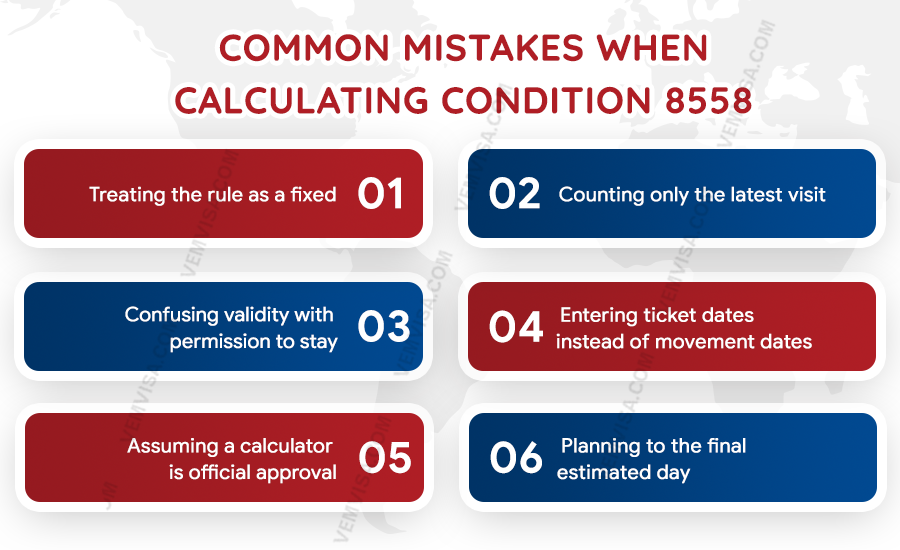
Treating the rule as a fixed block
The relevant 18-month period moves. It does not necessarily restart after six months outside Australia or on a visa anniversary.
Counting only the latest visit
Earlier stays within the relevant window still contribute to the cumulative limit.
Confusing validity with permission to stay
A valid multiple-entry visa does not override its per-entry stay period or attached conditions.
Entering ticket dates instead of movement dates
International flights can cross dates and time zones. Use the date of physical arrival in and departure from Australia.
Assuming a calculator is official approval
A result is not a new visa condition, waiver, travel authority or assurance from border officials.
Planning to the final estimated day
No margin remains for a cancelled flight, illness, date-entry error or a different counting convention.
What should you do if you are close to the limit?
First, stop relying on memory. Reconstruct a complete travel chronology and compare it with the grant notice and VEVO. If you have not yet travelled, consider changing the itinerary before committing to non-refundable bookings. A shorter stay or later arrival may create more room, but only a date-specific calculation can show the estimated effect.
If you are already in Australia and the figures indicate a possible breach, obtain individual advice promptly. Do not assume that another visa application, a short trip offshore or a request to the Department automatically suspends the condition. The consequences and available steps depend on the visa in effect, other attached conditions and the person’s circumstances.
A calculator cannot grant a waiver
Condition 8558 is different from conditions commonly described as “No Further Stay”. Do not use a waiver page for another condition as evidence that 8558 has been removed. Seek advice about the exact conditions shown on your own visa.
Read the grant notification: check the period of stay, entries, last arrival date and every attached condition.
Check VEVO: confirm the details of the current in-effect visa.
Verify travel history: reconcile every relevant arrival and departure date.
Test the whole itinerary: calculate the proposed departure date as well as the arrival date.
Recheck before flying: repeat the assessment if any travel date changes.
The Department states that VEVO shows the current in-effect visa, expiry details, period of stay and conditions. If your travel history is complex, your dates are uncertain or the result is close to the limit, a registered migration agent or Australian immigration lawyer can assess the documents and explain the risk. Learn how to evaluate professional support in VEM’s guide to choosing an Australian migration agency.
Unsure whether your travel plan complies?
Bring your grant letter and complete entry-and-exit history so the advice can address your actual visa and dates.
It requires the visa holder not to stay in Australia for more than 12 months in any 18-month period. It applies when condition 8558 is attached to the individual visa.
Does condition 8558 reset after I leave Australia?
Not simply because you depart. The test concerns any rolling 18-month period. Earlier days gradually cease to count as they move outside the relevant window, so the effect of time offshore depends on your complete travel history.
Is an 8558 visa condition calculator an official Home Affairs tool?
Unless a tool is expressly published by the Department, treat it as a third-party estimate. It does not replace the visa grant letter, VEVO, legislation or individual professional advice.
Does a three-year Visitor visa allow a three-year stay?
No. Visa validity is not the same as continuous permission to remain. The period of stay for each entry and all attached conditions—including condition 8558 if imposed—must also be followed.
Which dates should I enter into the calculator?
Use the dates you physically arrived in and departed from Australia for every relevant trip. Include any stay overlapping the period being assessed, and follow the tool’s instructions for a current stay without a departure date.
Can I return as soon as an old day falls outside the 18-month window?
A single day leaving the window does not by itself prove that an entire proposed stay complies. Test the full itinerary against the moving window and confirm every other visa limit before travelling.
What if the calculator shows that I may exceed the limit?
Recheck all dates and visa details. If the result still indicates a possible breach—especially if you are already in Australia—seek advice promptly about your individual position rather than relying on another online calculation.
Mr. Phong Cao is a licensed migration agent by MARA (MARN: 1577877). He is also a member of the Migration Institute of Australia (MIA: 12648), one of the most reputable organizations in the field of immigration in Australia. In addition, Mr. Phong Cao holds a QEAC certification in study abroad consulting (QEAC: K580) and Australian real estate investment (RA85931). With over 12 years of experience in Australian immigration, he provides comprehensive solutions for studying and settling in Australia.

 VN
VN

 Người
đăng
Người
đăng Ngày
cập nhật:
Ngày
cập nhật: