Updated 1 September 2026 · Employer Nomination Scheme
A practical guide to the subclass 186 Direct Entry stream for skilled workers and Australian employers.
The 186 visa Direct Entry stream allows an eligible skilled worker nominated by an Australian employer to become a permanent resident without first completing a qualifying period on a subclass 482 visa. It may suit applicants in Australia or overseas who can satisfy the occupation, skills assessment, experience, age and English requirements.
This is not a points-tested invitation visa. There is no SkillSelect EOI or minimum points score. Instead, the employer nomination and the worker’s visa application must both meet the Employer Nomination Scheme rules.
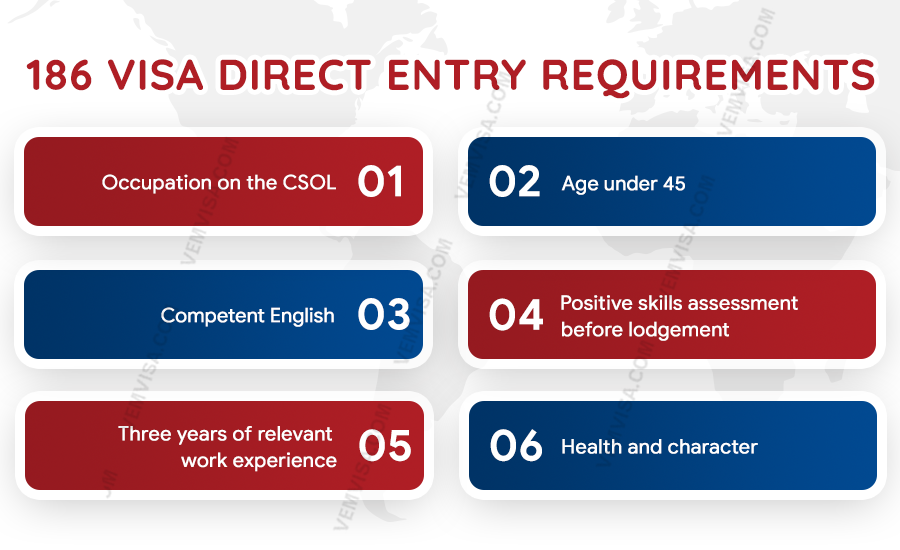
Quick answer: Is the 186 visa PR? Yes. A granted subclass 186 is permanent residence. A standard Direct Entry applicant must generally be under 45, have a CSOL occupation, obtain a positive skills assessment before application, show at least three years of relevant work experience and have Competent English, unless a prescribed exemption applies.
What is the 186 Direct Entry visa?
The Employer Nomination Scheme visa has three streams: Direct Entry, Temporary Residence Transition and Labour Agreement. Visa 186 Direct Entry is designed for applicants who qualify directly through their occupation, assessed skills and relevant experience. Holding a 482 is not a prerequisite.
The visa is linked to an employer nomination at decision, but the grant itself is permanent residence. VEM’s complete subclass 186 visa guide compares all three streams and explains the broader ENS framework.
Permanent
PR status begins on grant.
No points
No EOI or invitation round.
Employer-led
Nomination is essential.
Onshore/offshore
Apply from either location if eligible.
186 visa Direct Entry requirements
Eligibility is assessed across two connected applications. The employer must secure an approvable nomination, while the nominee must independently satisfy the visa criteria. A strong worker profile cannot repair a defective nomination, and a strong business cannot waive an applicant requirement.
| Requirement |
Standard Direct Entry rule |
Critical timing |
| Employer nomination |
An eligible Australian employer nominates the applicant for a genuine, full-time position. |
Nomination and visa must both be approved. |
| Age |
Usually under 45, unless a prescribed exemption applies. |
Tested on the visa application date. |
| Occupation |
The nominated occupation must be on the Core Skills Occupation List and satisfy any applicable caveat. |
Use the rules applying to the nomination. |
| Skills assessment |
A positive assessment for the nominated occupation is usually required. A subclass 485 assessment is not accepted. |
Must be obtained before visa application. |
| Work experience |
At least three years of relevant work experience is usually required. |
Must be established by application/decision rules. |
| English |
Competent English is generally required unless an exemption applies. |
Evidence must meet current test and validity rules. |
| Health and character |
Applicant and included family members must satisfy the applicable criteria. |
Police and health evidence may be requested after lodgement. |
Occupation on the Core Skills Occupation List
Direct Entry uses the Core Skills Occupation List and the ANZSCO 2022 classification for subclass 186 and 482. Eligibility depends on the actual duties, not an upgraded job title. The nominated role must align with the occupation code and any caveat shown in the official list. Start with VEM’s current CSOL occupation guide for 482 and 186, then verify the live Home Affairs instrument.
Positive skills assessment before lodgement
Most applicants need a positive assessment from the authority specified for their occupation before lodging the visa application. Home Affairs states that it generally cannot have been issued more than three years before application, or a shorter period if the assessment itself specifies one. An assessment obtained only for a subclass 485 visa is not acceptable for this purpose.
Assessment rules vary sharply by profession, qualification, licensing and employment history. VEM’s skills assessment for Australian migration guide explains how to identify the correct authority and why the assessed occupation must match the nomination.
Three years of relevant work experience
Unless exempt, most Direct Entry applicants need at least three years of relevant experience in the nominated occupation. Do not assume every year appearing on a résumé will count. The Department may examine whether the work was at the required skill level, relevant to the nominated duties, properly evidenced and already used by an assessing authority to compensate for a qualification shortfall.
Age under 45 and limited exemptions
The standard rule is that the applicant must be under 45 when applying. Exemptions are prescribed and fact-specific—for example, certain academic or scientific positions and defined high-income circumstances. An age concession discussed for TRT does not automatically apply to Direct Entry. Check the precise exemption before the 45th birthday, not after lodgement.
Competent English
Competent English generally means IELTS 6 in each of the four components or the prescribed equivalent in another accepted test, subject to the rules applying to the test date. Certain passport holders may satisfy the requirement without a test. Professional registration can demand a higher result than the visa minimum, so the two standards must be checked separately.
Exemptions must be proved, not assumed
Skills-assessment, experience, age and English exceptions do not operate as a single package. An applicant exempt from one criterion is not necessarily exempt from the others. Identify the exact legislative basis and supporting documents for each claimed exception.
Employer nomination requirements
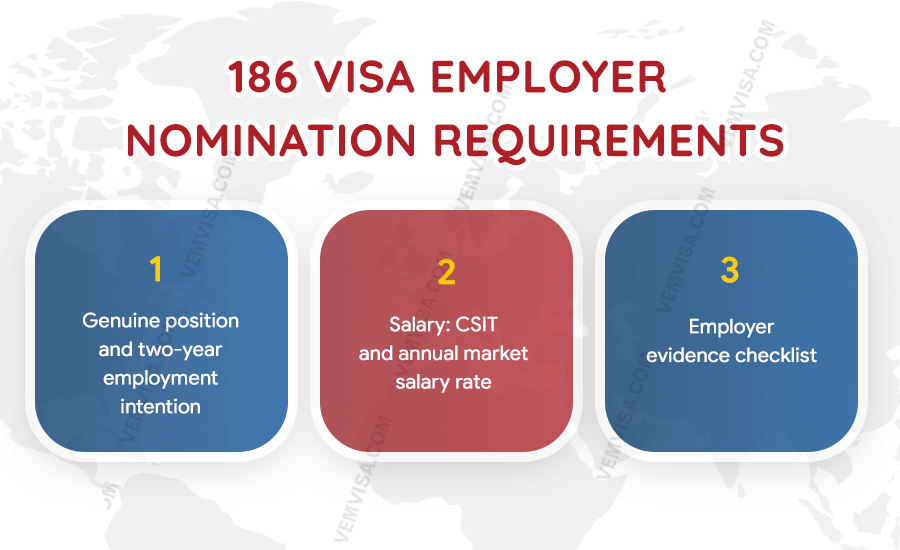
The employer must be actively and lawfully operating in Australia and nominate a genuine position that is generally available for at least two years. The role, organisational need, duties, location, salary, employment contract and business capacity should tell one consistent story.
Genuine position and two-year employment intention
Subclass 186 does not require the employee to sign away permanent-resident mobility. However, the nomination must be genuine: at nomination and decision, the employer should genuinely intend the full-time position to be available for at least two years, and the applicant should genuinely intend to work in it. A later change does not automatically cancel PR, but evidence that the arrangement was never genuine can create serious risk.
Salary: CSIT and annual market salary rate
For ENS nominations lodged from 1 July 2026 to 30 June 2027, the Core Skills Income Threshold is AUD 79,423. The employer must also determine the Annual Market Salary Rate correctly. Where the market rate is higher than the threshold, paying only AUD 79,423 is not enough. Non-monetary benefits do not simply convert an under-threshold salary into compliance.
Employer evidence checklist
| Party or issue |
Core evidence |
Common risk |
| Business |
Registration, trading activity, financial capacity, organisational chart and workforce information. |
Records do not demonstrate an operating business or capacity to employ. |
| Position |
Contract, detailed duties, reporting line, business need, location and full-time two-year availability. |
Generic duties or a role apparently created for migration. |
| Salary |
Market-rate methodology, comparator evidence, award or enterprise agreement and guaranteed earnings. |
Confusing the CSIT with the complete salary test. |
| Applicant |
Skills assessment, qualifications, references, payroll/tax evidence, English, registration and identity documents. |
Occupation, assessment, references and nominated duties do not align. |
Businesses comparing permanent and temporary sponsorship can use VEM’s employer-sponsored visa Australia comparison for the 482, 186 and 494 pathways.
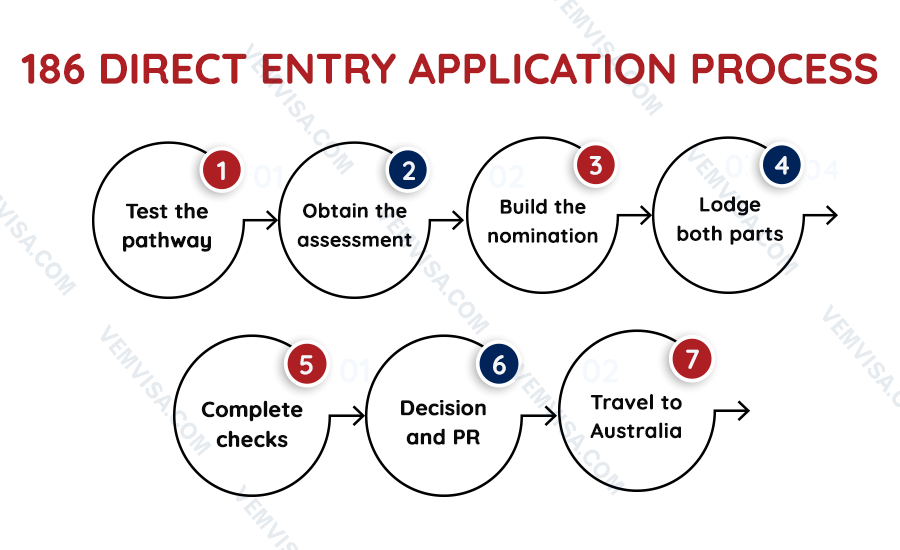
186 Direct Entry application process
1. Test the pathway
Confirm stream, occupation, caveats, age, experience, English and assessing authority.
2. Obtain the assessment
Secure the correct positive skills assessment before the visa application.
3. Build the nomination
Document the genuine role, salary, business need and two-year employment intention.
4. Lodge both parts
The visa can be lodged after nomination, including before the nomination decision where strategically appropriate.
5. Complete checks
Provide health, police, family and any requested further evidence by the deadline.
6. Decision and PR
The visa can be granted only when both nomination and visa criteria are satisfied.
Applying onshore or offshore
An applicant may apply in or outside Australia, subject to validity rules and any visa conditions. An onshore valid application may lead to a Bridging Visa, but work and travel rights depend on that bridging visa and when it comes into effect. A Bridging Visa does not cure an expiring skills assessment, missing nomination or Schedule 3 issue.
Can nomination and visa be lodged together?
The visa application may generally be lodged after the nomination is lodged, without waiting for nomination approval. This can protect a time-sensitive age or visa position, but it also exposes the applicant VAC if the nomination later fails. Lodging together is a strategy decision, not proof that either application will be approved.
186 Direct Entry vs Temporary Residence Transition
| Feature |
Direct Entry |
Temporary Residence Transition |
| Typical applicant |
Qualified directly through eligible occupation, skills and experience. |
Eligible 457/482 pathway worker transitioning through sponsored employment. |
| Prior 482 required? |
No. |
Usually relies on eligible sponsored visa and work history. |
| Occupation framework |
Occupation must be on the CSOL and satisfy caveats. |
Different occupation rules apply; do not import the Direct Entry CSOL test automatically. |
| Skills assessment |
Usually required before visa application. |
Usually not required, subject to applicable rules. |
| Experience |
Usually at least three years relevant experience. |
Usually requires the relevant period of qualifying sponsored employment; currently commonly two years within the prescribed framework. |
| Best fit |
Applicant already meets direct professional requirements. |
Applicant has built an eligible sponsored-employment history. |
Direct Entry is not automatically faster or better. TRT may avoid a new skills assessment, while Direct Entry can provide PR without waiting to complete TRT employment. A worker considering temporary sponsorship first should review VEM’s subclass 482 Skills in Demand visa guide alongside the 186 criteria.
186 Direct Entry visa fees in 2026
For applications lodged from 1 July 2026, Home Affairs lists the subclass 186 visa from AUD 6,140 for the main applicant. Family charges, the employer nomination and SAF levy are separate. Eligible Pacific Island and Timor-Leste citizens may qualify for a limited concession.
| Cost item |
Current amount |
Usually paid by |
Planning note |
| Main applicant VAC |
AUD 6,140 |
Applicant or employer voluntarily |
Standard charge from 1 July 2026. |
| Additional applicant 18+ |
AUD 3,070 each |
Applicant/family |
A second instalment may apply without Functional English. |
| Additional applicant under 18 |
AUD 1,535 each |
Applicant/family |
Age is assessed under the applicable charging rules. |
| Nomination charge |
AUD 540 |
Employer or agreed payer, subject to law |
A regional concession may apply in prescribed cases. |
| SAF levy – turnover under AUD 10m |
AUD 3,000 |
Employer |
The employer must not recover the levy from the worker. |
| SAF levy – turnover AUD 10m+ |
AUD 5,000 |
Employer |
Paid with the permanent nomination. |
Additional expenses may include the skills assessment, English testing, health examinations, police certificates, translations, registration and professional assistance. The VAC is generally not refunded simply because the nomination or visa is refused or withdrawn. Confirm all amounts in the Home Affairs Visa Pricing Estimator immediately before payment.
Processing time and decision factors
Home Affairs directs applicants to the live visa processing time guide, which reports recently decided applications and is not a promise for a new case. Published figures move monthly. Rather than treating an old 9-, 13- or 19-month number as a deadline, check the Direct Entry stream in the official tool on the day the article or application is reviewed.
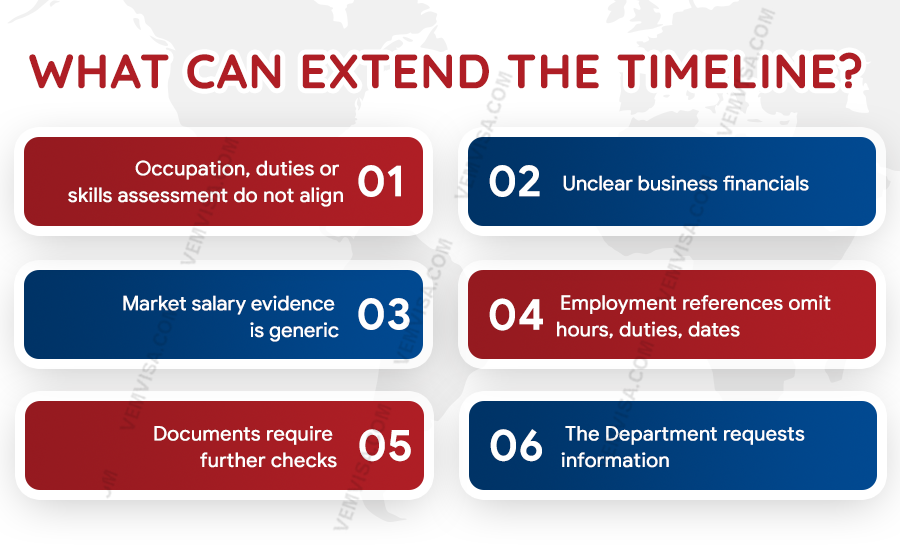
What can extend the timeline?
- Occupation, duties or skills assessment do not align.
- Business financials do not clearly support the genuine two-year position.
- Market salary evidence is generic or the CSIT is applied incorrectly.
- Employment references omit hours, duties, dates or independent payroll/tax support.
- Health, character, registration or family documents require further checks.
- The Department requests information and the response is late or incomplete.
Regional positions, healthcare and teaching applications may receive processing priority under current directions, but priority affects order, not eligibility or guaranteed decision time.
What the 186 PR visa provides
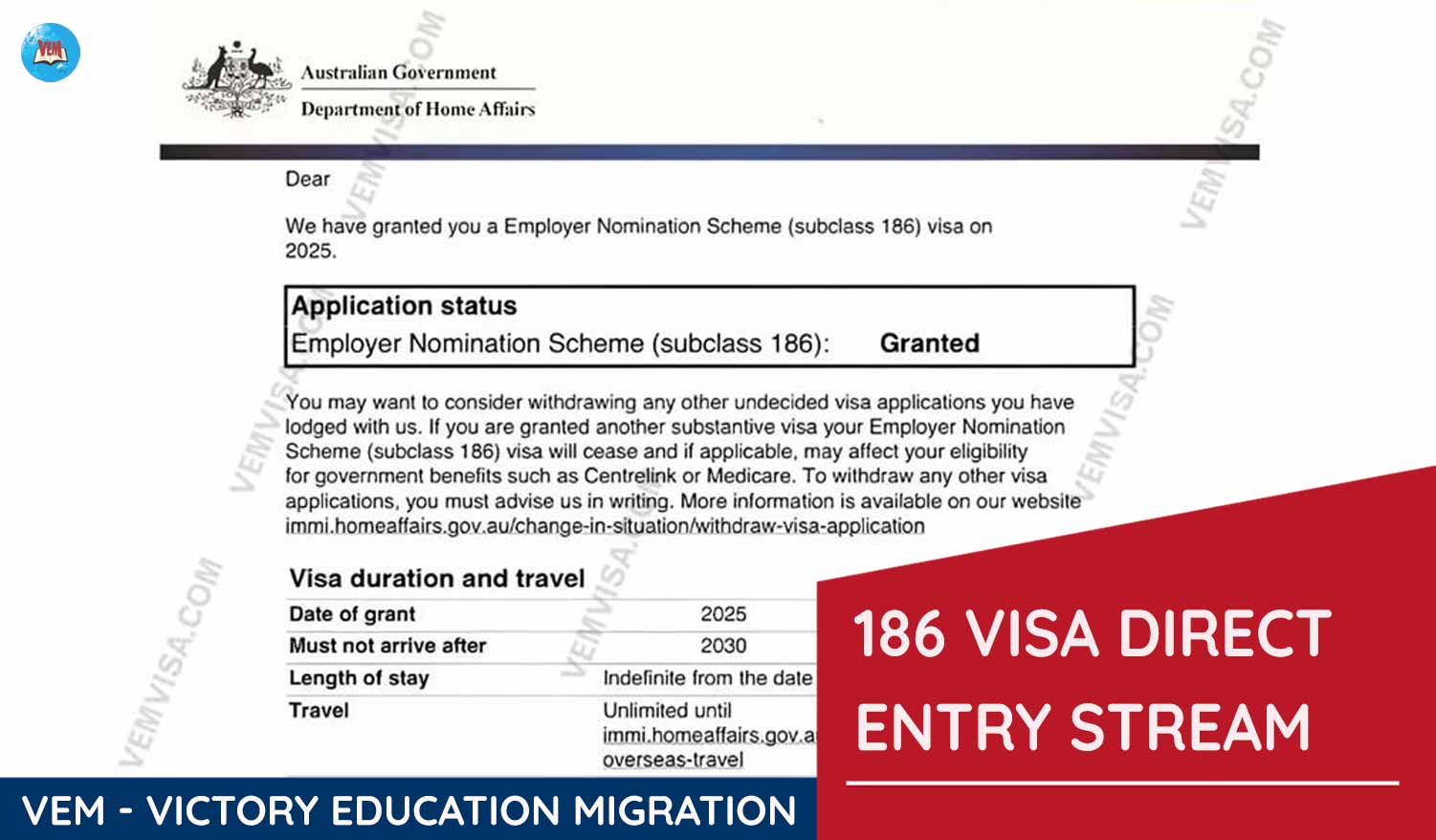
A granted permanent residency visa 186 allows the holder to live, work and study in Australia indefinitely, enrol in Medicare if eligible, sponsor eligible relatives and apply for citizenship after meeting the separate citizenship rules. Eligible family members included in the application also become permanent residents.
Permanent stay vs five-year travel facility
Permanent residence does not expire after five years. The initial travel facility generally allows travel to and from Australia for five years. After it expires, a person outside Australia may need a Resident Return visa or citizenship to return as a permanent resident. This distinction answers the common query “is 186 visa PR?” without incorrectly claiming unlimited international re-entry.
Common refusal risks
Frequent problems include choosing a title that does not match the duties, using the wrong assessing authority, counting insufficient experience, relying on an inapplicable exemption, weak market-salary evidence, inconsistent business records and assuming nomination approval guarantees the visa. Review both applications as one evidence system before lodgement.
Planning a direct pathway to Australian PR?
VEM can assess the Direct Entry stream, occupation and skills-assessment alignment, employer nomination, salary evidence, work history and family application before lodgement.
Discuss your 186 visa with VEM
FAQs
Is the 186 visa permanent residency?
Yes. The 186 is a permanent residence visa from the date of grant. Its five-year travel facility is different from the right to remain permanently in Australia.
Do I need a 482 visa before applying for 186 Direct Entry?
No. Direct Entry does not require prior subclass 482 sponsorship. Applicants generally qualify through an eligible occupation, employer nomination, positive skills assessment, three years of relevant experience and the other visa criteria.
How much work experience is required?
Most applicants need at least three years of relevant work experience in the nominated occupation unless exempt. Whether particular employment counts depends on its skill level, relevance and evidence.
Can I apply for a 186 Direct Entry visa after age 45?
The standard rule requires the applicant to be under 45 at application. Narrow prescribed exemptions exist for certain applicants and roles. A TRT exemption should not be assumed to apply to Direct Entry.
Does the skills assessment have to be ready before application?
Usually yes. A positive assessment for the nominated occupation must generally be obtained before the visa application and meet its validity rules. A skills assessment obtained for a subclass 485 visa is not accepted.
What English score is required?
Competent English is generally required, commonly IELTS 6 in each component or the prescribed equivalent, unless an exemption applies. Use the score table and test-validity rule applying to the actual test date.
Can nomination and visa applications be lodged at the same time?
The visa can generally be lodged after the nomination has been submitted and before it is decided. This may help with timing but creates financial risk if the nomination is refused because the visa charge is generally not refundable.
Must I stay with the nominating employer for two years after grant?
The nomination requires a genuine full-time position generally intended to be available for at least two years, and both parties should genuinely intend the employment. There is no simple automatic two-year visa condition, but evidence the arrangement was never genuine can create compliance or cancellation risk.

 VN
VN
 Người
đăng
Người
đăng Ngày
cập nhật:
Ngày
cập nhật:



