Updated 7 September 2026: Sponsored Parent (Temporary) visa subclass 870 holders must have and maintain adequate health insurance from an Australian health insurance provider. Always check the visa grant letter and live policy wording.
For a parent coming to Australia on a Sponsored Parent (Temporary) visa, health cover is both a visa-compliance issue and a major financial safeguard. Most temporary visitors do not receive the same Medicare access as Australian permanent residents, while hospital treatment, specialist care, medicines and ambulance transport can create substantial out-of-pocket costs.
Quick answer
870 visa health insurance must be adequate and kept active while the parent is in Australia. The visa is subject to condition 8501. In practice, families commonly use an eligible Overseas Visitors Health Cover (OVHC) policy issued by an Australian insurer, but the policy name alone does not prove that its benefits suit the parent or meet the Department’s requirement.
What are the 870 visa health insurance requirements?
The subclass 870 is a temporary visa that lets an approved Parent Sponsor bring an eligible parent to Australia for up to three or five years. Further grants may allow a cumulative stay of up to ten years. It does not provide permanent residence and it does not automatically give the parent unrestricted Medicare access. Families comparing the wider pathway can first read VEM’s Sponsored Parent visa 870 guide.
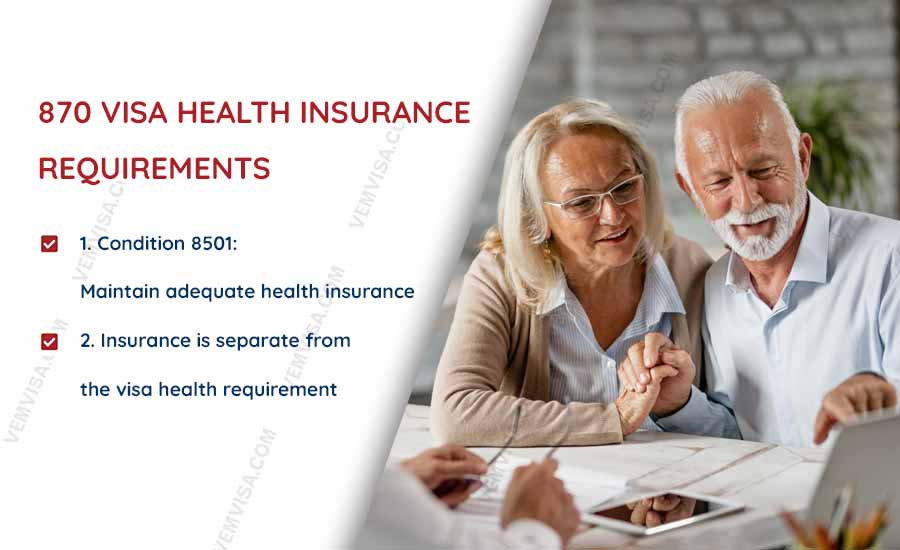
Condition 8501: Maintain adequate health insurance
Home Affairs lists condition 8501 for the 870 visa. It requires the visa holder to maintain adequate arrangements for health insurance while in Australia. The subclass-specific page goes further and states that cover must be from an Australian health insurance provider. Evidence may be requested before the visa is decided, and the grant letter should be checked for the exact conditions attached.
A certificate of insurance should clearly identify the insured parent, policy type and cover dates. If both parents hold separate 870 visas, each person needs appropriate cover—whether under individual policies or an eligible couple/family arrangement.
Insurance is separate from the visa health requirement
Buying insurance does not replace the immigration health examination. Home Affairs may still ask the parent to complete medical examinations, chest imaging or further tests. Conversely, passing the health requirement does not remove the obligation to maintain insurance. VEM’s overview of Australian Parent visa options explains how temporary 870 planning differs from permanent Parent pathways.
| Requirement |
What it addresses |
When it matters |
| Health examination |
Whether the applicant meets Australia’s immigration health requirement. |
During visa assessment when requested. |
| Health insurance |
How treatment costs will be covered during the temporary stay. |
Before grant if evidence is requested, and continuously while in Australia. |
| Medicare or RHCA eligibility |
Whether limited public benefits may be available under separate health rules. |
After eligibility is checked with Services Australia; it is not inferred from the visa alone. |
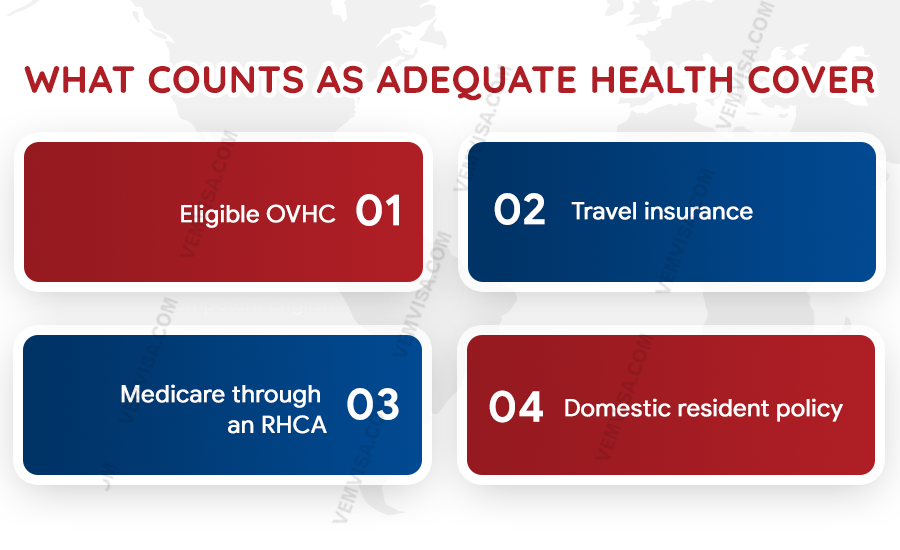
What counts as adequate health cover?
Home Affairs does not endorse one commercial product as the universal answer. Its published benefit guide focuses on meaningful hospital, medical, surgical, pharmacy and ambulance protection. OVHC is the usual starting point, but policies differ significantly. A low premium may reflect exclusions, benefit caps, high excesses or limited outpatient cover.
| Cover type |
Can it be suitable? |
Important limitation |
| Eligible OVHC |
Commonly used for temporary visitors and can provide evidence for condition 8501. |
Benefits, exclusions, waiting periods and gaps still need checking. |
| Travel insurance |
Useful for travel disruption and some emergencies. |
A short-term travel policy may not satisfy the 870 requirement or cover long-term care. |
| Medicare through an RHCA |
May provide medically necessary treatment for eligible visitors from agreement countries. |
Coverage is limited by the specific agreement and is not a substitute to assume condition 8501 is met. |
| Domestic resident policy |
Only if the insurer confirms the parent is eligible and the cover meets the visa requirement. |
Many resident products are designed around Medicare eligibility and may not fit an overseas visitor. |
Do not rely on the policy label. Ask the insurer in writing whether the product is accepted for a subclass 870 holder and whether it can issue a compliance certificate. Home Affairs warns that OVHC products do not all provide comprehensive cover and that patients can still face gaps, excesses and co-payments.
When should cover start, and how long must it continue?
Arrange the policy early enough to provide evidence when requested. The effective date should leave no uninsured period when the parent is in Australia. If travel is delayed, ask the insurer how to amend the start date rather than cancelling the cover without a replacement.
Keep continuous cover for the authorised stay
A three-year or five-year visa does not necessarily require paying the whole premium upfront; insurers may offer monthly or other payment cycles. What matters for visa compliance is that the policy remains active. Check direct-debit details, card expiry dates, renewal notices and contact information. Retain certificates, payment receipts and correspondence in case Home Affairs asks for proof.
Changing insurer without creating a gap
It is possible to change insurer, but activate the new policy before ending the old one. Obtain the new certificate and confirm how served waiting periods will be treated. A transfer does not automatically preserve every benefit or remove a waiting period, particularly when upgrading cover. Never cancel simply because the parent has not made a claim.

Does an 870 visa holder get Medicare?
An 870 visa by itself does not make the holder a permanent resident or establish ordinary Medicare eligibility. A parent from one of Australia’s Reciprocal Health Care Agreement countries may qualify for some medically necessary care under that country’s arrangement. The participating countries and benefits are not identical, and some visitors must enrol while others receive limited treatment without a Medicare card.
Check eligibility directly with Services Australia. Even where RHCA benefits exist, they may not cover private treatment, ambulance, all medicines, elective care or treatment arranged specifically by travelling to Australia. Do not cancel the Australian health policy unless the insurer and relevant authorities confirm in writing that the visa requirement remains satisfied.
How to choose health insurance for a parent aged 60, 70 or 80+
There is no single “best” health insurance for every 870 visa holder. Older applicants should compare the treatment they are more likely to need, not only the monthly premium. Provide the insurer with complete and accurate health information, then request the full policy wording and a written explanation of exclusions.
| Feature to compare |
Questions to ask |
Why it matters |
| Hospital benefits |
Public and private hospital? Accommodation, theatre, intensive care and prostheses? |
Hospital admissions can be the largest expense. |
| Outpatient care |
GP, specialist, pathology, imaging and physiotherapy benefits? |
Routine and follow-up care often occurs outside hospital. |
| Pre-existing conditions |
What definition, exclusions and waiting periods apply? |
Chronic conditions become more common with age. |
| Medicines |
What is paid after the member contribution and what annual limits apply? |
Non-Medicare visitors can face higher medicine costs. |
| Ambulance |
Emergency only or broader transport? Nationwide or state-limited? |
Ambulance arrangements vary by state and policy. |
| Excess and gaps |
Excess per admission, co-payments, benefit caps and provider gaps? |
Insurance rarely guarantees that every bill is paid in full. |
| Repatriation |
Medical evacuation or return of remains included? |
Long-distance transport can be exceptionally costly. |

How much does 870 visa health insurance cost?
There is no government-set premium. The cost depends on the parent’s age, single or couple cover, chosen benefit level, excess, included treatments, waiting periods, location, and insurer pricing. Quotes can change, so an article cannot provide a reliable universal monthly figure. Compare like-for-like policies and calculate the maximum realistic out-of-pocket exposure—not just the annual premium.
A practical family budget
Annual premium + policy excess + possible co-payments + excluded services + amounts above insurer benefits + medicines and dental/optical care not included.
Keep a contingency fund. Home Affairs notes that even adequate cover may not pay the entire healthcare bill, and patients should seek informed financial consent before non-emergency treatment.
The visa applicant and sponsor can decide who pays the premium, but the parent’s condition 8501 obligation remains. Separately, an approved Parent Sponsor has obligations under the sponsorship framework, including responsibility connected with certain public health debts. This is one reason cover should be selected as a risk-management decision rather than treated as a document needed only for visa grant.
Common 870 insurance mistakes
| Mistake |
Risk |
Better approach |
| Buying the cheapest visitor policy |
Important treatments may be excluded or heavily capped. |
Compare benefits, waiting periods, excesses and written visa eligibility. |
| Assuming travel insurance is enough |
It may end early or not meet condition 8501. |
Obtain confirmation for subclass 870 from an Australian health insurer. |
| Cancelling after visa grant |
Creates a visa-condition breach and exposes the family to full costs. |
Maintain continuous cover while the parent is in Australia. |
| Assuming Medicare pays everything |
The parent may be ineligible or only partly covered under an RHCA. |
Verify benefits with Services Australia and keep compliant private cover. |
| Hiding medical history |
Claims may be denied under disclosure or pre-existing-condition rules. |
Answer insurer questions accurately and retain written advice. |
| Allowing payment failure |
The policy may lapse without the family noticing. |
Monitor renewals, direct debit and contact details. |
How VEM can help with the subclass 870 process
Health insurers advise on their products; a registered migration agent advises on the visa pathway and evidence. VEM can help a family check sponsorship and visa eligibility, organise the required documents, respond to Department requests and understand how health insurance evidence fits into the overall 870 application. Families still deciding between a temporary sponsored stay and other routes can also review VEM’s Australian family visa guide.
Plan the visa and insurance evidence together
Before buying long-term cover, confirm the correct Parent visa strategy, intended stay and evidence timetable. VEM can assist with the migration application; the insurer should confirm product benefits and eligibility.
FAQs
Is health insurance mandatory for the 870 visa?
Yes. The subclass 870 is subject to condition 8501, and Home Affairs says the holder must have and maintain adequate health insurance from an Australian health insurance provider.
Does OVHC automatically satisfy condition 8501?
Not merely because it is called OVHC. Confirm that the specific product is suitable for subclass 870 and obtain a compliance certificate. Also check exclusions, waiting periods, limits and gaps.
Can my parent use Medicare instead of private insurance?
Do not assume so. The 870 visa itself does not establish ordinary Medicare eligibility. Limited RHCA benefits may apply to eligible visitors from certain countries, but condition 8501 and the grant letter still need to be satisfied.
When should an 870 insurance policy start?
It should be active by the date required for the visa and leave no gap while the parent is in Australia. If Home Affairs requests evidence before grant, provide the current certificate by the stated deadline.
Can we change health insurers after the 870 visa is granted?
Yes, but arrange the new cover before cancelling the old policy. Confirm the new policy’s subclass 870 suitability and whether previous waiting periods will be recognised.
Are pre-existing conditions covered?
It depends on the policy. Waiting periods, exclusions or benefit restrictions may apply. Disclose medical history accurately and obtain written confirmation from the insurer about the conditions most relevant to the parent.
How much is health insurance for an 870 visa holder?
There is no fixed government price. Premiums depend on age, cover level, excess, policy structure and insurer. Compare the total exposure, including gaps and excluded care, rather than premium alone.
Is the health examination included in the insurance policy?
Usually not. Immigration medical examinations are a separate visa requirement and expense. Insurance covers eligible treatment according to the policy after it starts; it does not replace the visa health assessment.

 VN
VN
 Người
đăng
Người
đăng Ngày
cập nhật:
Ngày
cập nhật:



