407 Visa Australia: Training Visa Requirements, Cost & Work Rights
VEMVisa | Australian Occupational Training
A current guide to the Training visa (subclass 407), including sponsorship, training purpose, English evidence, work conditions, costs and processing-time checks.
From 1 July 2026: Home Affairs currently lists the Training visa (subclass 407) application charge from AUD 535 for the main applicant. Crucially, applications lodged through Department systems from 11 March 2026 require an approved sponsor and an approved Training visa nomination before the visa application is valid, except where the sponsor is a Commonwealth Government agency.
The Training visa (subclass 407) is a temporary visa for genuine workplace-based occupational training and professional development in Australia. It is not a general work visa and it is not a shortcut around ordinary employer-sponsored migration requirements.
Maximum stay
Up to 2 years
Visa purpose
Structured occupational training, not unrestricted employment
A 407 application must be built around a credible training outcome, not an ordinary vacancy.
What is a 407 visa in Australia?
The Training visa subclass 407 lets an eligible person take part in workplace-based occupational training or professional development in Australia. The program should improve skills for the person’s occupation, field of tertiary study or area of expertise, or meet an eligible capacity-building or registration purpose.
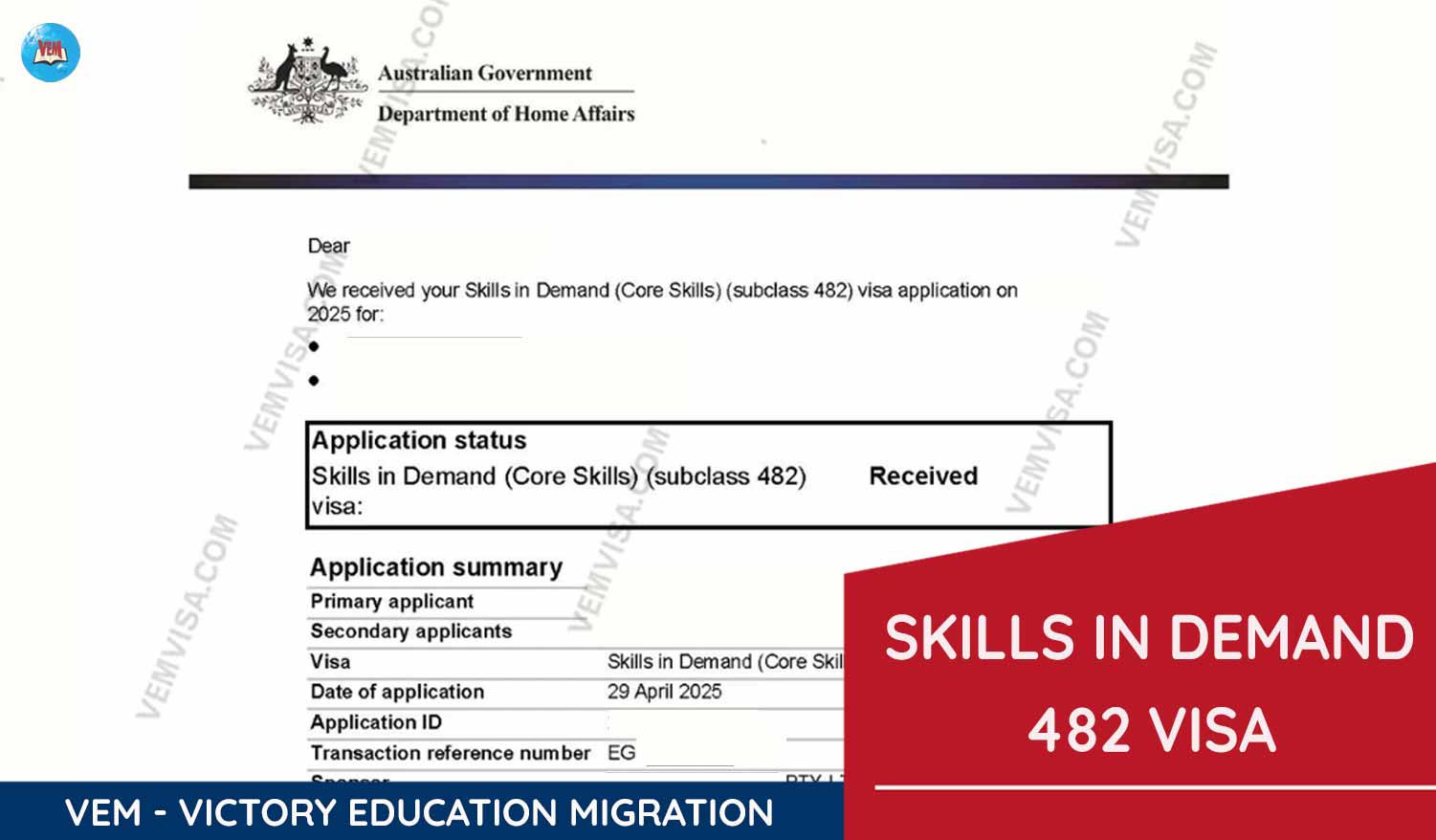
It differs from a Skills in Demand visa (subclass 482). A 482 is designed for an employer to fill a skilled role; a 407 is designed around a structured training program and training outcomes. That distinction affects the sponsor evidence, the program design and the visa holder’s work rights.
Not a generic work visa: the training must be genuine, structured and connected to the nominated purpose. A job title alone is not a training plan, and a thinly disguised labour-hire arrangement is not improved by calling it “professional development”.
Three types of 407 visa training programs
Home Affairs identifies three occupational training purposes. Nomination requirements differ depending on which purpose applies, so this decision should happen before documents are assembled.
Training purpose
When it may fit
Evidence focus
Occupational training required for registration
Practical training is required to obtain occupational registration, membership or licensing in Australia or the home country.
The relevant registration, licensing or membership requirement and why the program is necessary.
Occupational training to enhance skills
Training builds existing skill in an eligible occupation or relevant area of study/expertise. The relevant occupation context should be checked carefully.
The applicant’s background, structured plan, supervision, training outcomes and link to the nominated occupation.
Occupational training for capacity building overseas
Training develops capability for the applicant’s workplace, industry or organisation outside Australia.
The capacity-building purpose, overseas benefit and link between the training and future use of the skills.
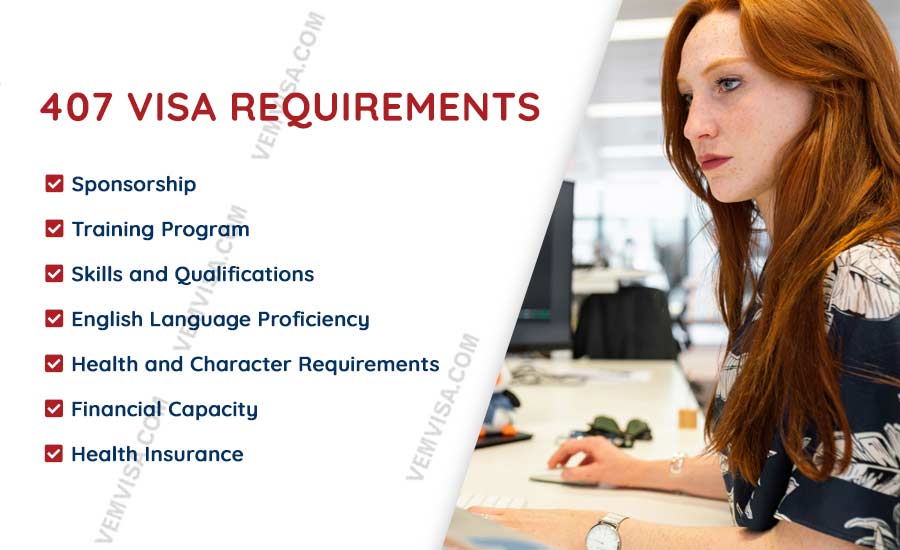
The final requirements depend on the training type and the person’s circumstances. A practical 407 visa requirements checklist usually includes the following.
Approved sponsorship and nomination
For applications lodged from 11 March 2026, the sponsorship and nomination must already be approved, unless the sponsor is a Commonwealth Government agency.
Relevant background
Evidence should show that the applicant has the qualifications, experience or prior study needed to undertake the proposed training credibly.
Functional English
Provide approved functional English evidence unless an exemption applies. The current test rules depend on both test type and test date.
Health, character and insurance
Meet the health and character requirements and maintain adequate health insurance for the stay where the visa condition requires it.
Genuine temporary purpose
The case should explain the training objective, why it is needed now and why the applicant is suited to take part.
Identity and supporting records
Prepare identity documents, qualifications, employment history, English evidence, insurance, character records and family evidence where relevant.
407 visa IELTS and PTE requirements
The 407 visa normally uses the Department’s functional English standard. For approved tests taken on or after 7 August 2025, Home Affairs lists an IELTS Academic or General Training average band score of at least 4.5, or a PTE Academic overall band score of at least 24, among the accepted evidence options. Other English evidence pathways can also apply.
Test-date warning: the approved English tests and score settings changed on 7 August 2025. Do not copy a PTE score from an old blog without matching the score to the date you sat the test. The Department does not accept fully online, remote-proctored English tests for visa evidence.
If long-term skilled migration may later form part of the plan, review VEM’s skills assessment guidance and skilled visa Australia information. They are planning resources, not a statement that a 407 holder automatically meets another visa’s requirements.
Training purpose, qualifications and English evidence should tell one consistent story.
407 training visa sponsorship: what the sponsor must do
A business or organisation generally needs to hold approval as a Temporary Activities Sponsor before it can nominate and sponsor a 407 trainee. The organisation must be lawfully established and actively engaged in business activities in Australia, subject to the relevant sponsor rules.
The nomination should demonstrate an eligible occupational training purpose and a structured, supervised program. The sponsor is also responsible for ongoing sponsorship obligations. Home Affairs says sponsors must notify the Department if the person does not start or unexpectedly ends the approved program, or where material program arrangements change.
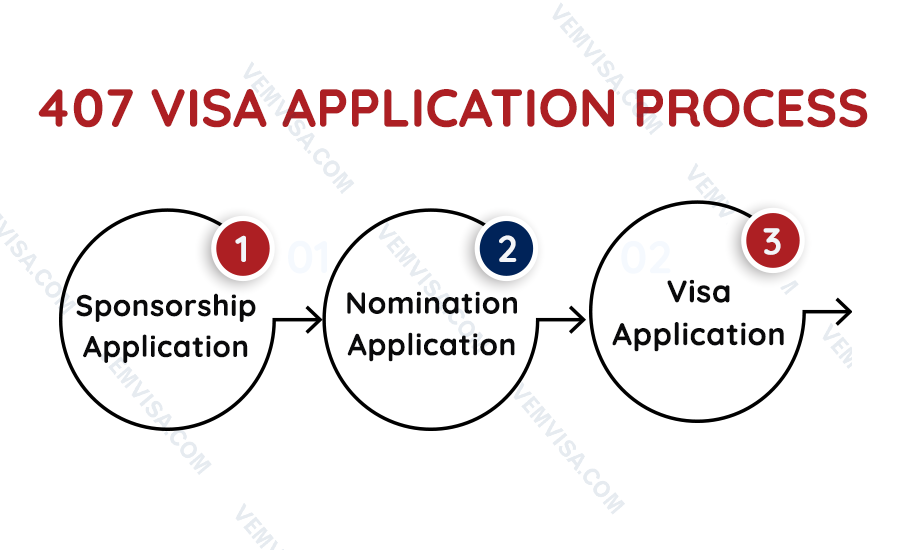
Sequence from 11 March 2026: first secure sponsor approval, then the approved training nomination, then lodge the visa application. A visa application lodged before those approvals is not valid under the current change, except for the Commonwealth Government agency exception.
How to apply for a 407 visa Australia: step by step
1. Match the training purpose to the right category
Identify whether the program is for registration, skills enhancement or capacity building overseas. Design the training outcome before drafting application wording.
2. Check sponsor eligibility
Confirm the organisation’s Temporary Activities Sponsor approval or prepare the sponsorship application. Verify that the organisation can deliver and supervise the proposed program.
3. Prepare and approve the nomination
The sponsor provides the training plan, applicant background, role details, supervision arrangements and evidence that the program meets the relevant training category.
4. Assemble applicant documents
Prepare identity, qualifications, employment or study evidence, English evidence, health insurance, character documents and family documents where relevant.
5. Lodge the visa after approvals are in place
For post-11 March 2026 applications, lodge only after the sponsor and nomination approvals are confirmed, unless the Commonwealth agency exception applies.
6. Meet conditions throughout the program
Keep to the approved activity, maintain health insurance where required and notify or seek advice before changes that could affect the training arrangement.
The current 407 process is sequential: sponsor approval, nomination approval, then visa application.
407 visa work rights and conditions after grant
The standard principle is simple: a 407 holder may take part in the approved training activity, but should not assume unrestricted work rights outside it. Condition 8102 is commonly relevant and means not working other than in relation to the study or training specified for the visa.
Do not reuse a student-visa rule for a 407 dependent. A fixed “20 hours per week” statement for 407 family members is not a reliable general rule. The exact conditions on each grant should be checked in VEVO and in the visa grant letter.
Practical compliance checks
Participate only in the approved training activity and keep records of the program.
Maintain adequate health insurance where condition 8501 applies.
Check the grant letter and VEVO for attached conditions rather than relying on a generic list.
Assess any change to employer, training plan, role or work activity before it happens.
407 visa fee and training visa sponsorship cost
A 407 budget should separate the visa applicant’s charge from the sponsor’s costs. The person paying a cost should also be clear in the service agreement or employment/training documentation. Miraculously, that prevents awkward surprises later.
Cost group
Current guide
What to verify
Visa application charge
From AUD 535 for the main applicant, checked 1 July 2026.
Lodgement date, applicant location, additional applicants, any concession and payment surcharge.
Temporary Activities Sponsor application
AUD 420, where sponsor approval is needed.
Whether the organisation already holds a valid sponsor approval and which entity is the sponsor.
Nomination and program preparation
A separate nomination charge and preparation costs can apply.
Current Department charge, training-plan preparation, legal/agent services and any document costs.
Applicant-related costs
Variable.
Health examinations, police certificates, biometrics, English testing, translations, private health insurance and any applicable subsequent temporary application charge.
The Visa Pricing Estimator should be used immediately before lodgement. For some onshore temporary visa applications, a Subsequent Temporary Application Charge can apply based on each applicant’s individual visa history.
407 visa processing time in 2026
There is no responsible fixed answer to “how long is the 407 visa processing time?” that applies to every case. The Department’s processing-time guide is based on recently decided applications, changes over time and does not guarantee a decision date for a particular file.
The timeline also includes upstream work: sponsor approval, nomination approval, the quality of the training plan, applicant documents, health/character checks and responses to any further-information request. From 11 March 2026, the sequential approval requirement can materially affect the overall planning timeline.
For the current estimate: use the Home Affairs processing-time guide, select the Training visa (subclass 407), choose the correct stream and use your intended application date. Treat the result as an indicator, not a grant promise.
Can a 407 visa lead to permanent residency?
A 407 visa does not provide a direct PR pathway. Completing the training may improve practical experience or professional development, but any future visa must be assessed under its own current requirements.
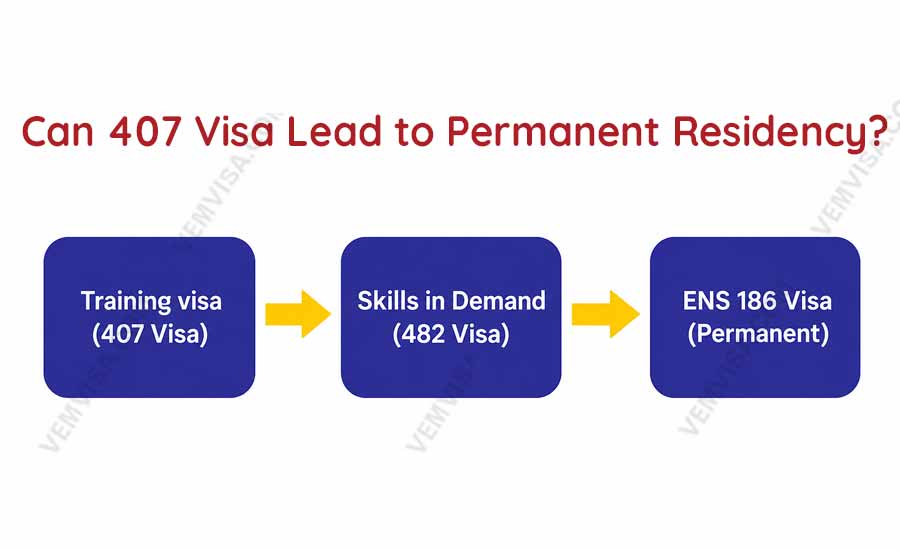
Some people later consider a Skills in Demand visa (subclass 482), a permanent employer-sponsored route such as the subclass 186 visa, or points-tested skilled migration. None is automatic after a 407 grant, and work undertaken as a trainee should not be assumed to meet a future visa’s employment-experience rules without checking the relevant program.
A future permanent visa requires a fresh eligibility assessment under that visa’s rules.
Assess the training plan before the sponsorship work starts
A credible 407 case starts with the right training category, an eligible sponsor, a documented program and applicant evidence that actually supports the training purpose. Review those components before spending on the wrong pathway.
The subclass 407 is a temporary Training visa for genuine, structured workplace-based occupational training or professional development. It can allow a stay of up to two years.
What are the 407 visa work rights?
The visa is for the approved training activity. Condition 8102 can restrict work that is not related to the specified study or training. Check the individual grant letter and VEVO before taking other work.
What IELTS or PTE score is required for a 407 visa?
The usual standard is functional English. For approved tests taken on or after 7 August 2025, Home Affairs lists IELTS at an average band of 4.5 and PTE Academic at an overall band of 24, subject to current rules and any exemption.
Is there a 407 visa age limit?
Do not assume the under-45 rule from points-tested skilled visas applies here. The 407 assessment focuses on the training purpose, sponsor/nominaton, English, health, character and the applicant’s suitability for the program. Check the current visa listing and any occupation-specific rule for your circumstances.
How much does a 407 visa cost?
The main applicant charge is currently from AUD 535. Additional applicant, nomination, insurance, medical, police and possible subsequent temporary application charges can change the total.
Does the 407 Training visa lead to PR?
No. It is not a direct PR visa. The training may be relevant to future planning, but a later 482, 186, skilled or regional visa application must independently meet all requirements in force at that time.
Mr. Phong Cao is a licensed migration agent by MARA (MARN: 1577877). He is also a member of the Migration Institute of Australia (MIA: 12648), one of the most reputable organizations in the field of immigration in Australia. In addition, Mr. Phong Cao holds a QEAC certification in study abroad consulting (QEAC: K580) and Australian real estate investment (RA85931). With over 12 years of experience in Australian immigration, he provides comprehensive solutions for studying and settling in Australia.
Chia sẻ bài viết
5 thoughts on “407 Visa Australia: Training Visa Requirements, Cost & Work Rights”

 VN
VN

 Người
đăng
Người
đăng Ngày
cập nhật:
Ngày
cập nhật:



Tôi muốn tư vấn visa 407 và 482
Thân chào Châu, VEM đã gửi thông tin email cho bạn. Nếu cần đặt lịch tư vấn chi tiết hơn với tôi bạn vui lòng phản hồi lại nha.
Haxuanthanhhd89@gmail.com
VEM sẽ liên hệ em ha.