Student Visa Subsequent Entrant 500: Bring Your Family To Australia
VEM Visa | Student Family Planning
A practical guide for eligible partners and children applying later to join a Student visa subclass 500 holder in Australia.
A Student visa subsequent entrant application allows an eligible member of a Student visa holder’s family unit to apply separately under subclass 500 after the primary student’s application. It is commonly used when a spouse, de facto partner or dependent child plans to join the student at a later stage.
Start with the original Student visa application: Home Affairs tells visa holders to check that the visa allows subsequent entrants and that family members were previously declared. A relationship formed or a child born after lodgement or grant needs evidence showing when the family circumstances changed.
This is not a separate “family visa” subclass. The applicant seeks a Student visa (subclass 500) as a subsequent entrant and must satisfy the requirements that apply to a genuine student dependent. For the primary pathway, read VEM’s complete Student visa Australia guide.
A subsequent entrant is an eligible family member who did not apply together with the primary student and later lodges a separate Student visa application linked to that student. The family member must still meet the subclass 500 criteria relevant to their role, including relationship, genuine dependency, financial, health, character and health-cover requirements.
Same visa subclass
The applicant applies for subclass 500 in the subsequent-entrant setting; the application is connected to the primary student.
Separate application
It is lodged after the primary application rather than adding the family member to an application that has already been decided.
Temporary stay
The purpose is to accompany the student during their temporary study period, not to create an independent permanent pathway.
Do not confuse this pathway with a Student Guardian visa. Subclass 590 is designed for an eligible parent, custodian or relative providing care to a student under 18, subject to its own criteria and restrictions. VEM explains that option in the Student Guardian visa guide.
Student subsequence entrance visa
Who may apply for a subsequent entrant visa 500?
The applicant must be a member of the primary student’s family unit under the migration rules. In the usual Student visa context, this means an eligible spouse or de facto partner, or an eligible dependent child of the student or the student’s partner.
Spouse
Provide the marriage certificate and evidence that the relationship is genuine and continuing. A certificate alone may not explain the couple’s shared life or current circumstances.
De facto partner
Show that the de facto relationship satisfies the applicable definition and duration rules, unless an exception applies, with evidence across financial, household and social aspects.
Dependent child
Provide identity, birth and dependency evidence. Student visa rules impose specific age and family-unit limits, so check eligibility at the expected decision date rather than assuming a child remains eligible.
Child born after lodgement
A newborn may be dealt with under special notification and application rules. Notify Home Affairs promptly and provide the birth certificate, passport and requested documents.
Previous declaration matters: If the family relationship existed when the primary student applied but the family member was not declared, eligibility can be affected. Do not create an explanation after the fact. Review the original form and provide accurate evidence about when the relationship began and why the person was omitted.
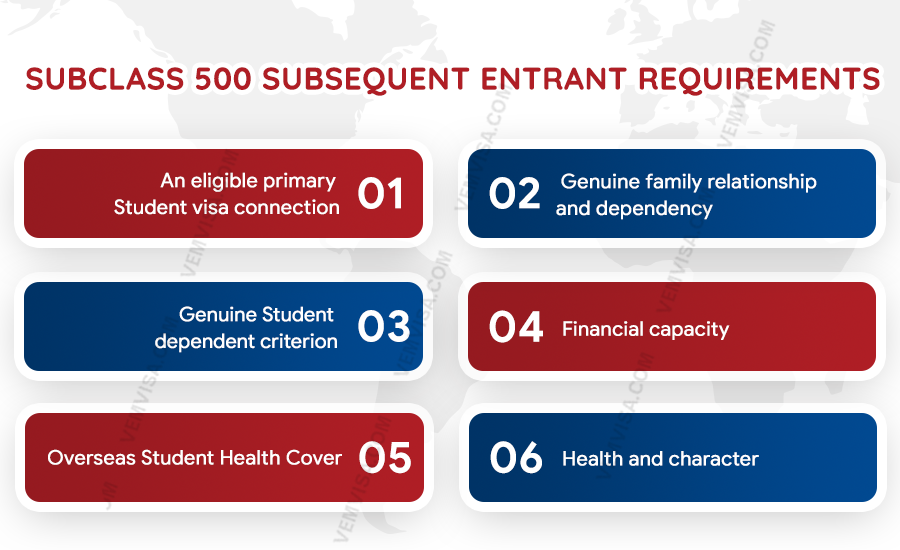
Subclass 500 subsequent entrant requirements
Home Affairs assesses the family member’s circumstances as well as the primary student’s current course and visa position. The exact evidence list is generated by ImmiAccount and the Department’s Document Checklist Tool.
1. An eligible primary Student visa connection
Provide the student’s passport details, visa grant notification, current CoE and enrolment evidence. Changes to course, provider, visa status or study progress can affect the overall application context.
2. Genuine family relationship and dependency
Use documents that show the relationship over time, not only one registration document. Evidence should be consistent across dates, addresses, travel, finances and statements from both applicants.
3. Genuine Student dependent criterion
All applicants must satisfy the GS criterion or the GS dependent criterion that applies to them. A dependent should explain the purpose of joining the student, family circumstances, temporary-stay intentions and how the plan relates to the primary student’s course.
4. Financial capacity
Family members applying later must attach evidence of financial capacity. Prepare evidence for travel, living costs, OSHC and—where relevant—school costs, together with documents showing the source and genuine availability of funds.
5. Overseas Student Health Cover
Arrange OSHC for the subsequent entrant for the required period, unless a recognised exemption applies. Update an existing family policy or purchase suitable cover and attach the certificate that identifies the applicant and dates.
6. Health and character
Complete health examinations, biometrics and police certificates if requested. Requirements depend on age, travel and residence history, intended activities and other individual factors.
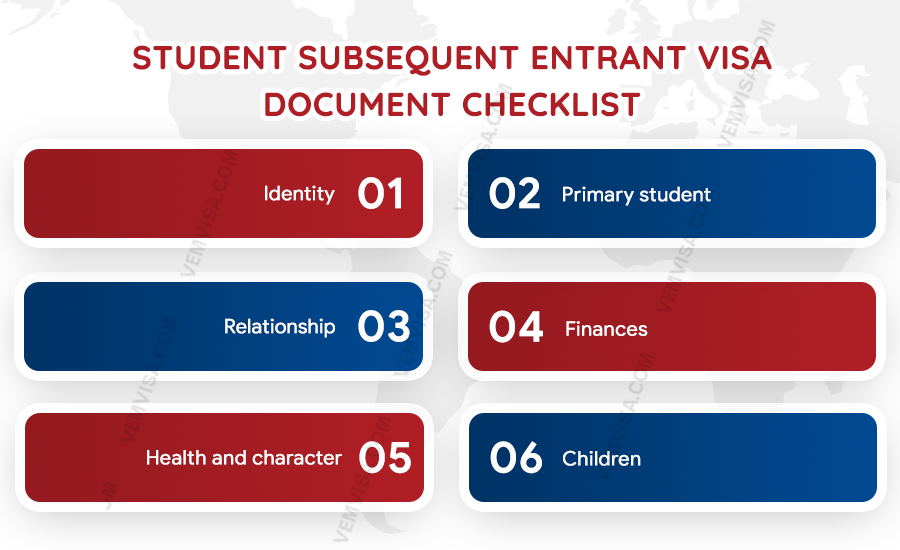
Student subsequent entrant visa document checklist
Use this as a planning list only. The online checklist and ImmiAccount request for the specific applicant take priority.
Identity
Passport bio page, national identity documents, birth certificate, name-change documents and compliant photographs where requested.
Primary student
Visa grant letter, passport, CoE, enrolment confirmation, academic progress and evidence of the student’s Australian address and circumstances.
Relationship
Marriage or birth records plus joint finances, household evidence, communication, visits, photographs and clear statements where relevant.
Finances
Bank records, income evidence, scholarship or sponsor documents, education expenses and an explanation of large or recent deposits.
Health and character
OSHC certificate, health-examination results when requested, police checks and military or service records if applicable.
Children
Custody and consent documents, Form 1229 where required, school planning and evidence addressing the child’s best interests and family arrangements.
Translate non-English documents into English using an acceptable translator and include the original. File names should be clear and evidence should be readable, complete and internally consistent.
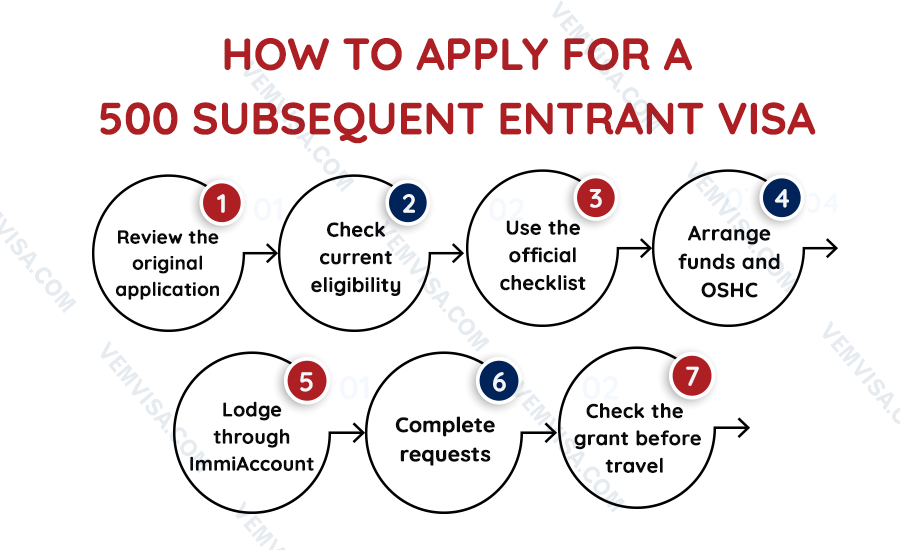
How to apply for a 500 subsequent entrant visa
Step 1. Review the original application
Confirm whether the family member was declared and retain a copy of the relevant answers. If the relationship began later, establish the timeline with dated evidence.
Step 2. Check current eligibility
Verify the primary student’s visa, CoE and course status, and the family member’s age, relationship and location. Onshore applicants must also confirm that their current visa permits a valid application.
Step 3. Use the official checklist
Run the Home Affairs Document Checklist Tool using the requested passport and education-provider details, then compare the result with the attachment list in ImmiAccount.
Step 4. Arrange funds and OSHC
Calculate the family budget, prepare source-of-funds evidence and obtain health cover for the required dates. Do not submit a certificate that excludes the applicant.
Step 5. Lodge through ImmiAccount
Choose the Student visa subsequent entrant application, enter the primary student’s identifying and visa details accurately, upload evidence and pay the charge shown at lodgement.
Step 6. Complete post-lodgement requests
Monitor messages for biometrics, health examinations, character documents or further information. Respond by the specified deadline and update material changes.
Step 7. Check the grant before travel
Read the visa period, travel details and every condition. A grant does not mean the family member has the same unrestricted rights as the primary student.
VEM’s ImmiAccount and VEVO guide explains the difference between tracking a pending application and checking an in-effect visa after grant.
Cost and processing time
When a dependent family member submits a separate Student Visa (Subclass 500) subsequent entrant application, they are treated as the main applicant for that application. The relevant charges are:
AUD 2,500 for the subsequent entrant lodging the separate application
AUD 1,530 for each additional applicant aged 18 or over
AUD 500 for each additional applicant under 18
An additional AUD 700 per eligible person may apply under the Subsequent Temporary Application Charge (STAC) when the application is lodged in Australia
Processing time is not fixed. Completeness, health and character checks, document verification, demand and processing priorities can affect the outcome. Use VEM’s current Student visa processing-time guide as a planning reference, then check the live Home Affairs tool.
Do not book travel around an estimate: Lodging a complete application does not guarantee a decision by a requested date. Wait for the written grant and check its conditions before committing to travel.
Work, study and travel rights after grant
Rights arise from the granted visa and its conditions. Family members commonly have limited work rights, while different settings may apply where the primary student is undertaking a master’s degree by research or doctoral degree. Course commencement can also matter.
Work
Check condition 8104 and any other attached condition in VEVO before accepting shifts. Do not rely only on the primary student’s work settings.
Study
A dependent’s study may be limited. Someone planning a longer course should check whether they need their own Student visa as a primary student.
Travel and stay
Review the visa expiry and travel facility. Changes to the primary student’s enrolment or visa can have consequences for accompanying family.
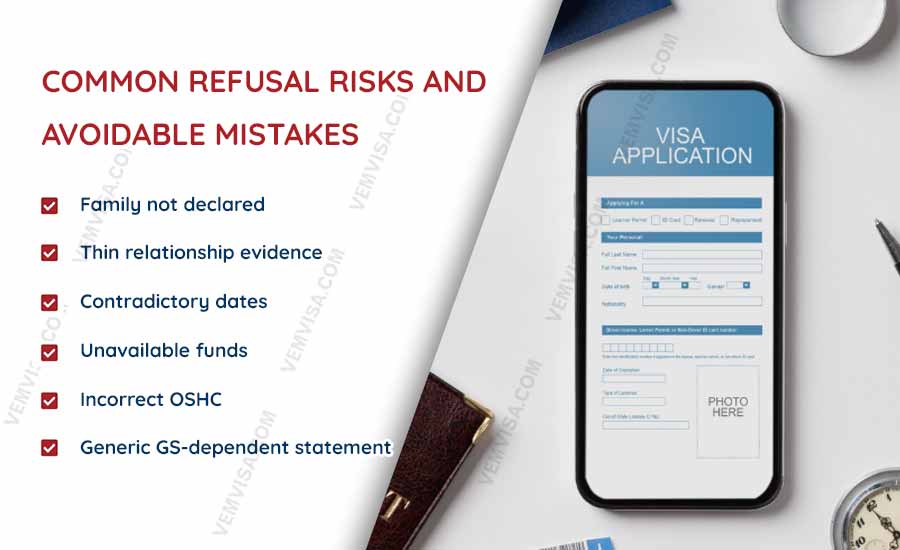
Common refusal risks and avoidable mistakes
Family not declared: the relationship existed earlier but the original application did not disclose it.
Thin relationship evidence: relying only on a recent marriage certificate or a small selection of messages.
Contradictory dates: relationship, address, travel or employment timelines do not match across documents.
Unavailable funds: unexplained deposits or money that cannot genuinely support the proposed stay.
Incorrect OSHC: the policy dates or insured names do not cover the subsequent entrant properly.
Generic GS-dependent statement: the explanation does not address the applicant’s actual family and temporary-stay circumstances.
Assuming work rights: planning income based on unlimited work without checking the family member’s grant conditions.
A strong application connects the original family declaration, current relationship evidence, the primary student’s active course, finances, OSHC and temporary family plan. Each document should support the same chronology.
Who can apply as a Student visa subsequent entrant?
An eligible member of the primary Student visa holder’s family unit may apply, commonly a spouse, de facto partner or dependent child. The person must satisfy the relationship, dependency and other subclass 500 requirements that apply.
Must my family have been declared in my original Student visa application?
Home Affairs tells visa holders to check that family members were previously declared. If the relationship began or a child was born later, provide evidence of the timing. An undeclared pre-existing family member can face an eligibility problem.
Can a spouse apply after the primary Student visa is granted?
Potentially, yes. The spouse must meet the subsequent-entrant criteria and provide evidence of the genuine relationship, finances, OSHC, health, character and GS-dependent requirement.
Can I apply inside Australia?
Location rules and the applicant’s current visa affect whether an onshore application is valid. Check for conditions preventing an onshore application and whether the visa class currently held is affected by Student visa application restrictions.
How much does a 500 subsequent entrant visa cost?
The amount can change and depends on age, location, application date and visa history. Use the official Home Affairs Visa Pricing Estimator and allow for OSHC, medicals, police checks, biometrics, translation and school costs where relevant.
Can a subsequent entrant work in Australia?
Many family members have limited work rights, with different settings potentially applying when the primary student undertakes a master’s by research or doctorate. Check the family member’s grant letter and VEVO before working.
Does the visa last as long as the primary student’s visa?
The subsequent entrant’s stay is connected to the primary student’s study and visa, but rely on the dates in the actual grant notification. Do not assume an expiry date before the Department issues the decision.
Mr. Phong Cao is a licensed migration agent by MARA (MARN: 1577877). He is also a member of the Migration Institute of Australia (MIA: 12648), one of the most reputable organizations in the field of immigration in Australia. In addition, Mr. Phong Cao holds a QEAC certification in study abroad consulting (QEAC: K580) and Australian real estate investment (RA85931). With over 12 years of experience in Australian immigration, he provides comprehensive solutions for studying and settling in Australia.

 VN
VN

 Người
đăng
Người
đăng Ngày
cập nhật:
Ngày
cập nhật: