Updated 7 September 2026 · Student Visa Refusal Review
Current ART review rules, paper-based procedure, fees, evidence and lawful-status planning after a subclass 500 refusal.
If an Australian Student visa is refused, the first step is not automatically to “appeal”. Read the refusal notification and record the exact reason, review right, eligible review applicant, and deadline. Some decisions can be reviewed by the Administrative Review Tribunal (ART); others cannot.
From 1 June 2026, most ART reviews of Student visa refusals must be decided without an oral hearing, except in very limited circumstances. Effective student visa appeal help therefore begins with a precise written case: identify the legal criterion, answer the decision-maker’s findings, and support every important claim with organised evidence.
Act now: ART migration deadlines are strict, and the Tribunal cannot extend the statutory time limit. The current migration-review fee is AUD 3,727, with a possible 50% financial-hardship reduction. Use the deadline in the refusal letter, not a generic number found online.
Student visa refused
A refusal letter normally identifies the criterion not satisfied and explains whether the decision is reviewable. Download the decision record and every attachment from ImmiAccount, keep the original email, and do not wait for an education provider or agent to forward the notice.
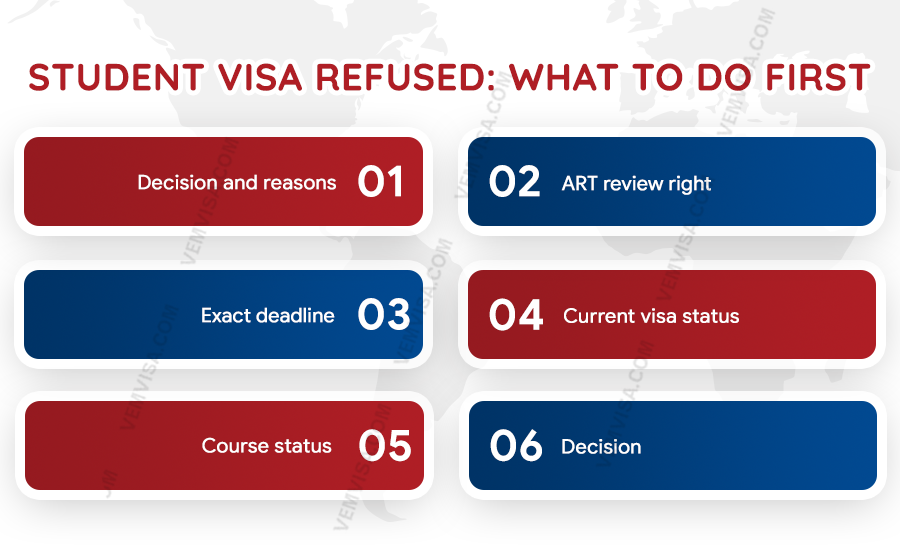
| Immediate check |
Why it matters |
Documents to secure |
| Decision and reasons |
Defines the legal and factual findings the review must answer. |
Refusal letter, decision record and Department correspondence. |
| ART review right |
Not every offshore or onshore refusal is reviewable by the applicant. |
Review-rights attachment and applicant/location details. |
| Exact deadline |
A late application may be outside jurisdiction; ART cannot grant a general extension. |
Notification date, delivery method and stated final day. |
| Current visa status |
Refusal, review and withdrawal can affect bridging status and departure timing. |
VEVO result, grant notices and visa history. |
| Course status |
A current CoE and coherent study plan may be central to merits review. |
CoE, transcripts, attendance, progress and provider letters. |
VEM’s Australian visa refusal guide explains how to read a decision and compare review, reapplication and judicial review without treating them as interchangeable.
Can you appeal a Student visa refusal in Australia?
A student visa appeal Australia pathway may be available where the Migration Act makes the refusal reviewable and the correct person applies on time. Review rights often turn on where the applicant was when the application or decision was made, their visa status and whether another person in Australia has standing. The refusal letter is the starting authority for the individual case.
ART replaced the AAT
The Administrative Review Tribunal replaced the Administrative Appeals Tribunal on 14 October 2024. Searches such as “AAT Student visa refusal” or “Student visa refusal AAT” now refer to the historical body. New review applications are made to the ART; describing it as a court is also incorrect.
Deadline and fee
The current fee for review of a reviewable migration decision is AUD 3,727. A 50% reduction may be granted where financial hardship is established. For Part 5 migration reviews, the applicable fee must be paid before the review deadline. A fee-reduction request does not make a late review valid.
Do not assume “21 days” or “28 days”
The prescribed period depends on the decision and notification framework. Calculate it from the refusal notice and current law. Lodging one day late can remove the Tribunal’s power to review, even where the underlying Student visa case is strong.
Australia Student visa rejection reasons in 2026
A strong appeal for Student visa refusal addresses the criterion actually failed. It does not simply resubmit the original application with a longer personal statement.
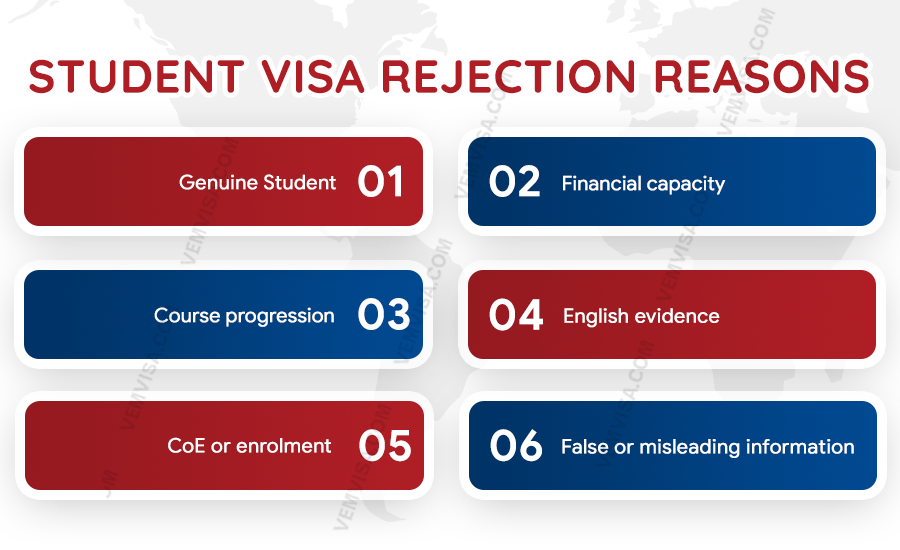
| Common refusal issue |
What the ART may need to assess |
Potential written response |
| Genuine Student |
Study rationale, course value, immigration history, circumstances and credibility. |
Structured submission tied to objective academic, employment and career evidence. |
| Financial capacity |
Whether sufficient funds exist and are genuinely available. |
Bank history, source of funds, sponsor relationship, income, loan and tuition evidence. |
| Course progression |
Whether the new course is coherent with prior study and intended outcomes. |
Transcripts, provider material, skills gap analysis and credible career plan. |
| English evidence |
Whether the accepted test, score, date or exemption met the visa criterion. |
Official score report and exact rule applying to the application date. |
| CoE or enrolment |
Whether required enrolment evidence exists and remains relevant. |
Current CoE, provider confirmation, deferral or cancellation explanation. |
| Health or character |
Whether statutory health, disclosure and character criteria are satisfied. |
Requested examinations, police/court records, disclosure and specialist evidence. |
| False or misleading information |
Accuracy, knowledge, materiality and any PIC 4020 consequences. |
Source documents, forensic chronology and legal submission; do not “explain away” inconsistencies casually. |
The underlying criteria are summarised in VEM’s Student visa Australia requirements guide. An appeal case should use the rules applying to the original decision and the Tribunal’s review, not an outdated GTE template where the Genuine Student framework applies.
Can new evidence be provided?
ART merits review can consider relevant evidence beyond the material originally given to Home Affairs, subject to the law and procedural directions. New evidence must answer the criterion and be credible. A newly created bank balance, course plan or employment letter can raise more questions if its source, timing and relationship to the original facts are unexplained.
Student visa reviews without an oral hearing
From 1 June 2026, except in very limited circumstances, the ART must decide a Student visa refusal review without an oral hearing where the review was not assigned to a Tribunal member before that date, or where the review application was lodged on or after that date. A previously issued hearing listing may still proceed as notified.
What paper-based review changes
The applicant should no longer plan to repair gaps through oral testimony at a later hearing. Written submissions need to identify the reviewable decision, set out the legal tests, respond to each adverse finding and direct the member to evidence by page, date and issue. Witness material should be in a usable written form where relevant.
Follow every ART direction
The Tribunal may write about the review process, request information or set a deadline. Monitor the ART portal, email and postal address. Do not assume that silence means no evidence is required, or that documents can be uploaded indefinitely until a hearing date that will never occur.
How long does review take?
For Student refusal reviews finalised between 1 February and 31 July 2026, the ART reported 50% finalised within 1 year and 6 months and 95% within 2 years and 1 month from lodgement. These are historical outcomes, not a promise. Paper-review reforms, caseload and case complexity may change future figures.

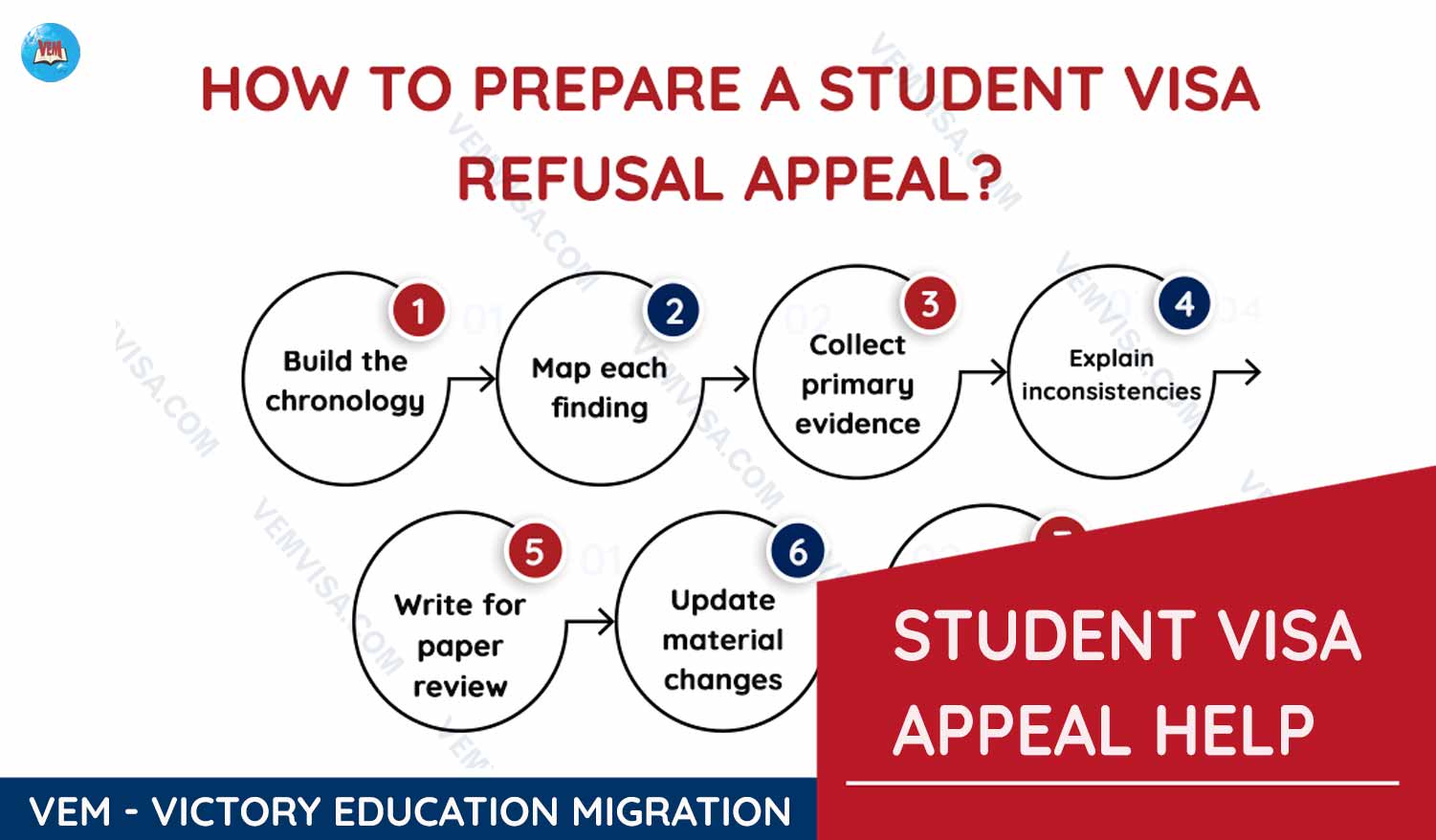
How to prepare a Student visa refusal appeal
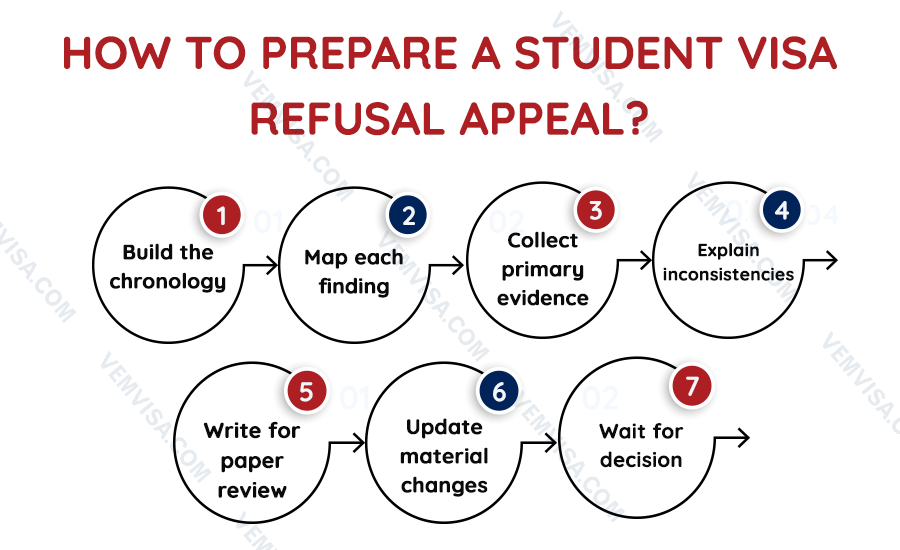
1. Build the chronology
Record study, employment, visas, travel, CoEs, finances, applications and refusal events.
2. Map each finding
Turn the decision reasons into an issue list; do not ignore an adverse credibility finding.
3. Collect primary evidence
Prefer verifiable records over generic letters written only for the appeal.
4. Explain inconsistencies
Reconcile dates, course choices, bank movements and different statements directly.
5. Write for paper review
Use headings, cross-references and a document index so the evidence is easy to verify.
6. Update material changes
Notify the Tribunal of new passport, address, family, enrolment or other relevant facts.
Genuine Student submission
A persuasive submission connects prior education, the Australian provider and course, knowledge of study and living arrangements, funding, career value and post-study plans. It should address the refusal reasoning rather than merely state that the applicant loves Australia or promises to follow visa conditions.
Financial evidence
Show both amount and genuine access. Identify the source of large deposits, sponsor relationship, income and commitments; reconcile tuition already paid; and use the financial-capacity settings relevant to the review. Documents in another language should be accompanied by an appropriate English translation.
Bridging Visa, study and travel during review
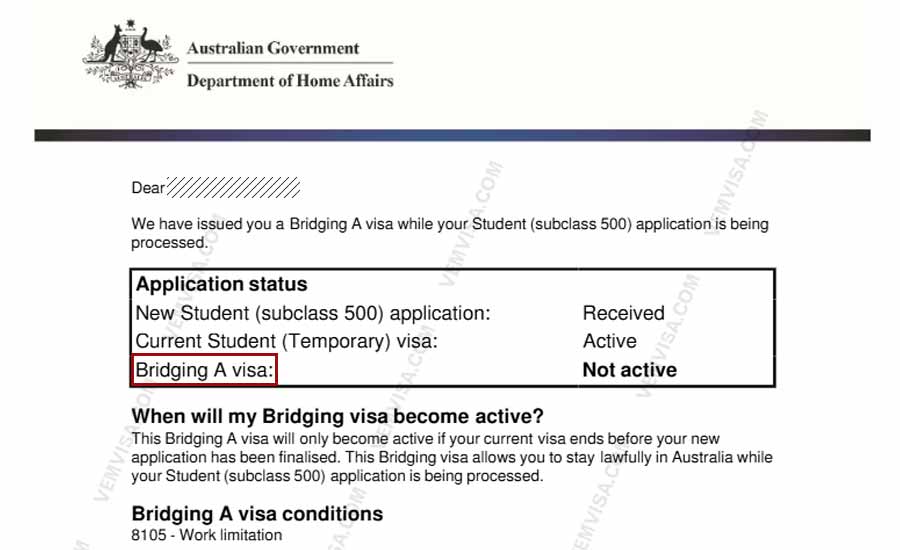
Applying for ART review does not itself answer which visa is in effect or what conditions apply. Check VEVO, the original Bridging Visa grant and correspondence after review lodgement. Study and work rights may continue, change or be restricted depending on the visa and conditions.
Travel can end a review strategy
A Bridging Visa A does not permit return to Australia after departure. A Bridging Visa B may be required before travel, but eligibility and the effect of departure on the review and any future application must be checked first. VEM’s Bridging Visa A guide and Bridging Visa B guide explain the distinction.
Section 48 after refusal
An onshore applicant who no longer holds a substantive visa may be affected by section 48 after a relevant refusal. A pending ART review does not automatically remove that restriction, and a Student visa is not simply available onshore because a new CoE exists. Review VEM’s Section 48 bar guide before trying to reapply in Australia.
ART review vs reapply vs Federal Court
| Option |
What it is for |
Main limitation or risk |
| ART merits review |
Reconsiders an eligible refusal on facts, evidence and applicable law. |
Strict jurisdiction/deadline; fee; most Student reviews now have no oral hearing. |
| New Student visa |
A fresh application where valid and strategically appropriate. |
Section 48, onshore application restrictions, new fee and repeating the same weakness. |
| Another visa pathway |
Used only where the person independently meets another visa’s criteria. |
A refusal does not create eligibility; conditions and statutory bars may prevent onshore lodgement. |
| Judicial review |
Challenges jurisdictional legal error in a court. |
Not a merits rehearing; strict time, filing/legal costs and adverse-cost exposure. |
| Departure |
May be necessary to comply with visa status or pursue an offshore strategy. |
Can affect review standing, bridging visa and future plans; obtain advice before travelling. |
Is reapplying faster than appealing?
Sometimes, but only if a valid new application can be made and the refusal problem is genuinely fixed. A new fee and a different processing queue apply. Reapplying can be a poor strategy where section 48 operates, a No Further Stay condition applies, the course choice remains unconvincing or false-information findings create wider consequences.
If continued study requires a new subclass 500 rather than a review, VEM’s Student visa extension Australia guide explains CoE, OSHC and valid-lodgement planning.
Possible ART outcomes
| Outcome |
What it generally means |
What happens next |
| Affirm |
ART agrees with the refusal decision. |
Read the reasons and any court/departure information immediately. |
| Set aside/substitute |
ART replaces the reviewed decision with another decision where empowered. |
Follow the formal outcome; do not assume the visa is granted until confirmed. |
| Remit |
The matter returns to Home Affairs for reconsideration with directions or findings. |
Department processing resumes; outstanding health, character or other criteria may remain. |
| No jurisdiction/dismissal |
The Tribunal cannot or will not determine merits—for example, because of standing, time, fee or procedural issues. |
Urgently check status and any remaining legal option. |
| Withdrawal |
The applicant ends the review before decision. |
Check Bridging Visa, departure and future application consequences first. |
A successful remittal is not always an immediate visa grant. Home Affairs may still assess criteria not resolved by the Tribunal. Continue monitoring ImmiAccount and keep contact, passport, CoE and personal circumstances current. VEM’s Australian visa status guide explains the difference between ImmiAccount and VEVO.
Need help after a Student visa refusal?
VEM can review the decision, ART eligibility and deadline, current visa status, refusal issues, written evidence and whether review or another valid strategy should be considered.
Discuss your Student visa case with VEM
FAQs
Can I appeal an Australian Student visa refusal?
Only if the refusal is reviewable and the correct person applies to the ART within the strict deadline. The refusal notification states the available review right and timing.
How long do I have to lodge a Student visa appeal?
There is no safe universal answer. Use the exact deadline in the refusal letter and calculate it under the current notification rules. ART cannot extend a statutory migration-review deadline.
How much is a Student visa refusal appeal?
From 1 July 2026, the fee for a reviewable migration decision is AUD 3,727. A 50% reduction may be granted for financial hardship. Professional, translation and evidence costs are separate.
Will I have an ART hearing?
For most Student visa refusal reviews affected by the law from 1 June 2026, no oral hearing is held except in very limited circumstances. Follow the ART’s written directions for your case.
How long does an ART Student refusal review take?
Recent ART data showed 50% of Student refusal reviews finalised within 1 year and 6 months and 95% within 2 years and 1 month. Historical figures are not a guarantee.
Can I submit new evidence to the ART?
Relevant new evidence can generally be considered in merits review, subject to the law and ART directions. It should directly address the refusal reasons and any inconsistencies.
Can I remain in Australia during the review?
That depends on the visa currently in effect and bridging arrangements. Check VEVO and grant notices. A review application does not itself prove work, study or travel rights.
Should I appeal or submit a new Student visa application?
Compare review rights, deadline, refusal issue, current status, section 48, onshore restrictions, new evidence, cost and study plan. Reapplication is useful only where it is valid and the original weakness is genuinely resolved.

 VN
VN
 Người
đăng
Người
đăng Ngày
cập nhật:
Ngày
cập nhật:



