downloadNgười đăngPeter Phong D Cao
calendarNgày cập nhật:23/07/2026

189 vs 190 Visa: Key Differences, Requirements and Which Is Right for You

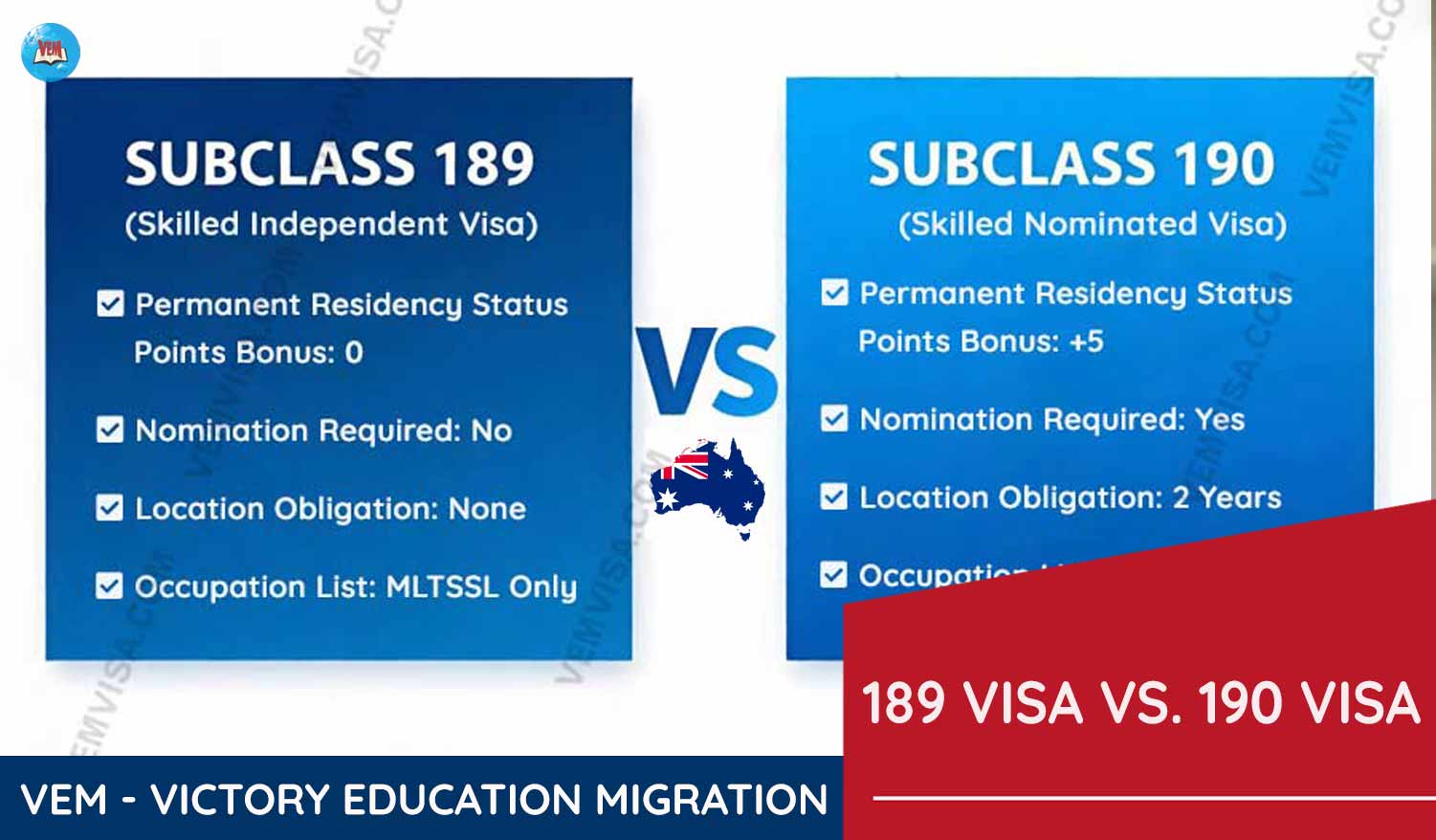
avt 189 190 visa comparision
Australian skilled migration comparison

Both the Skilled Independent visa (subclass 189) and the Skilled Nominated visa (subclass 190) are points-tested permanent residence pathways. The decisive difference is nomination: 189 is an independent federal invitation pathway, while 190 requires selection by an Australian state or territory and adds 5 nomination points. 

Current check, 23 July 2026: A total score of 65 is the minimum threshold, not a guaranteed invitation. 190 state nomination adds 5 points, but each state or territory applies its own occupation, residence, work, ROI and allocation settings. Do not rely on an old state list, a generic two-year rule or a past invitation round.

Difference between 190 and 189 visa: quick answer

Subclass 189

A direct permanent visa for invited skilled workers. There is no employer, family or state nomination requirement in the Points-tested stream.

Best fit: applicants with an eligible occupation and a competitive independent profile who want maximum location flexibility.

Subclass 190

A direct permanent visa for invited skilled workers who are nominated by a state or territory government.

Best fit: applicants whose occupation and profile match a current state program and who are prepared to support that state’s settlement objectives.

190 vs 189 visa comparison table

Feature Subclass 189 Subclass 190
Visa outcome Permanent residence Permanent residence
Nomination No state or territory nomination required State or territory nomination required before visa invitation
Points At least 65 points, based on claims in the EOI At least 65 points total, including 5 points for valid state or territory nomination
Occupation pathway Must be eligible for the 189 Points-tested stream under the current skilled occupation instrument Must be eligible for 190 and meet the nominating jurisdiction’s current occupation and program criteria
EOI SkillSelect EOI required SkillSelect EOI required, plus the state’s own nomination process where required
Invitation pathway Commonwealth SkillSelect invitation round State/territory selection, nomination, then visa invitation
Where you live after grant No state nomination commitment The permanent visa is federal, but you should honour the settlement commitment in the nominating jurisdiction’s policy. The duration and wording vary by state.
Costs Visa application charge plus evidence costs Visa application charge plus evidence costs; a state nomination fee may apply, depending on the jurisdiction
Best strategic use Higher independent competitiveness and strong preference for national flexibility A profile that aligns with a state program and can benefit from 5 nomination points

Minimum eligibility is not an invitation benchmark. Invitation numbers, program settings, and selection priorities change.

Requirements both 189 and 190 share

Both visas are points-tested and begin with a truthful, evidence-backed Expression of Interest. The shared baseline generally includes:

Invitation firstNeither pathway is a direct application route. Submit an EOI and apply only after invitation.
AgeYou must be under 45 when invited. Turning 45 after invitation does not itself prevent the visa application.
Skills assessmentYou need a suitable skills assessment for your nominated occupation before submitting the EOI.
EnglishAt least Competent English is required. Higher English can add points, subject to current approved-test rules.
Points thresholdYou need at least 65 points to be eligible for an invitation, but 65 does not guarantee selection.
Health and characterAll applicants and family members must meet the applicable health and character requirements.
Critical EOI rule: Claims made in SkillSelect must be supported by documents. Update an EOI before invitation when your qualifications, English, work history, family details or assessment change. Once invited, the EOI cannot be updated.

How 190 state nomination changes the strategy

The 190 visa is not simply a 189 visa with five free points. A state or territory chooses whether to nominate you based on its current migration program, allocation, occupation priorities and additional eligibility settings.

1. Occupation fitCheck that your nominated occupation is eligible under Home Affairs rules and currently supported by the particular state or territory program.
2. State processA state may require an ROI, direct nomination application, evidence of work or residence, annual earnings information, or another state-specific step.
3. Selection remains competitiveSubmitting an EOI or ROI does not create an entitlement to a nomination. Allocation limits and targeted priorities affect selection.
4. Settlement commitmentMany state programs ask successful nominees to commit to living and working in that jurisdiction, often for two years, but the exact policy is set by the jurisdiction and can change.

For example, South Australia and Western Australia currently state a two-year living and working commitment in their nomination policies, while Victoria describes a commitment to live in Victoria for at least two years. Treat this as a state nomination commitment, not a universal federal visa-condition sentence copied into every 190 article.

189 and 190 occupation eligibility: do not oversimplify it

A common simplification is that 189 uses only the MLTSSL and 190 uses a state list. That is directionally useful, but not enough to make a decision. Home Affairs maintains combined skilled occupation lists and the relevant legislative instrument, while states apply their own current program criteria and selection priorities.

  • For 189: confirm that the nominated occupation is eligible for the Points-tested stream at the time of EOI and invitation.
  • For 190: confirm both federal eligibility and the chosen state’s current list, sector or program pathway.
  • For both: match your skills assessment, ANZSCO code, qualifications and claimed employment duties to the occupation you select.

Start with the Australian Skilled Occupation List, then verify the official state program page immediately before lodging or changing your EOI.

189 vs 190 visa differences in nomination points and settlement strategy

Occupation eligibility and state program settings should be verified at the time you act.

Application process: 189 vs 190

189 visa process

  1. Choose an eligible occupation and obtain the required skills assessment.
  2. Calculate points and obtain English evidence where required.
  3. Submit a SkillSelect EOI for subclass 189.
  4. Wait for a Commonwealth invitation round. An EOI remains active for two years unless circumstances change or you withdraw it.
  5. If invited, lodge the online visa application within 60 days and provide evidence for every claim.

190 visa process

  1. Complete the same federal eligibility and evidence preparation.
  2. Choose a state or territory based on current program fit, not just extra points.
  3. Submit or update the SkillSelect EOI and complete any ROI or state step required by that jurisdiction.
  4. If selected, lodge the state nomination application and satisfy its evidence requirements.
  5. After a valid nomination and visa invitation, lodge the online visa application within 60 days.
Processing time: Do not compare the visas by a fixed number of months. A 190 pathway has a separate state-selection and nomination stage before federal visa processing. For either visa, Home Affairs invitation and processing tools are indicative only and do not guarantee a grant date.

189 visa vs 190: which one should you choose?

189 may suit you when

  • Your points profile is independently competitive.
  • Your occupation is eligible for the 189 Points-tested stream.
  • You do not want to plan your settlement around one state program.
  • You want to pursue the federal invitation route without an extra state stage.

190 may suit you when

  • You can meet the federal visa baseline and a real state nomination pathway.
  • The additional 5 points make a material difference to your total score.
  • Your occupation, sector, experience or location aligns with a state’s current priority settings.
  • You are genuinely ready to live and work in the nominating state under its program commitment.
Avoid this mistake: do not choose 190 solely because it adds five points. A state nomination is not automatic, and a higher point total does not override occupation eligibility, nomination settings or selection competition.

difference between 189 and 190 visa pathways for skilled migration Australia

Choose the pathway that matches your evidence, invitation prospects and real settlement plans.

189 vs 190 visa FAQs

Which visa is easier: 189 or 190?

Neither is universally easier. The 190 visa adds five nomination points, but you must also meet a state or territory’s separate criteria and be selected. The 189 route removes the state stage but can be highly competitive in federal invitation rounds.

Does 190 give 5 points?

Yes. A valid state or territory nomination for subclass 190 contributes 5 points to the points test. The minimum threshold is still 65 points total, and an invitation is not guaranteed.

Do I have to live in the nominating state for exactly two years on a 190 visa?

Do not treat two years as a blanket federal visa condition. State nomination programs can require a settlement commitment and some currently describe two years, but the exact wording and duration are determined by the jurisdiction’s current policy.

Can I submit EOI for both 189 and 190?

You can indicate interest in eligible visa options in SkillSelect, but a 190 pathway also needs the relevant state or territory process. Keep all claims consistent, current and capable of being evidenced.

Are 189 and 190 direct PR visas?

Yes. Both are permanent residence visas when granted. They are different from provisional regional pathways such as the 491 visa, which has a separate pathway to subclass 191.

How much do 189 and 190 visas cost?

Visa application charges are updated periodically. Check the official Visa Pricing Estimator immediately before lodging. For 190, also check whether the nominating state charges a nomination fee.

Plan the visa around your actual invitation pathway

The useful comparison is not “which visa is better?” It is whether your occupation, skills assessment, points, English and settlement plan are genuinely aligned with an independent federal invitation route or a specific state nomination program.

Contact VEM

Continue reading:
189 Visa Australia · 190 Visa Australia · Skills Assessment · Skilled Occupation List · 491 Visa Australia
4.4/5 - (12 votes)

Các câu hỏi thường gặp

Can you apply for both 189 and 190 simultaneously?

Yes, you can lodge one EOI and indicate interest in both Subclass 189 and Subclass 190 visas at the same time. By selecting state nomination options, you may be considered by states and territories for the 190 visa, while still remaining eligible for a 189 invitation. If you receive both, you can then decide which visa pathway best suits you.

Is the 189 visa harder than the 190?

In many cases, yes. The 189 visa is usually more competitive, especially for popular occupations that require a high points score. The 190 visa may be easier to obtain if your occupation is on a state occupation list and you meet the state’s requirements, as state nomination gives you extra points and an additional invitation pathway.

Which visa is processed quicker, 189 visa or 190 visa?

The 190 visa may be quicker to receive an invitation because state nomination gives you 5 extra points. However, overall processing times for 189 and 190 are often similar, with the Department currently showing a median of around 9 months for skilled permanent visas.

ceo cong ty vem
CEO and Founder of VEM

Mr. Phong Cao is a licensed migration agent by MARA (MARN: 1577877). He is also a member of the Migration Institute of Australia (MIA: 12648), one of the most reputable organizations in the field of immigration in Australia. In addition, Mr. Phong Cao holds a QEAC certification in study abroad consulting (QEAC: K580) and Australian real estate investment (RA85931). With over 12 years of experience in Australian immigration, he provides comprehensive solutions for studying and settling in Australia.


Chia sẻ bài viết

Leave a Reply

Your email address will not be published. Required fields are marked *