Updated August 2026 processing guide
Current subclass 491 decision times by stream, the full pre-lodgement timeline and how occupation and onshore/offshore priority affect the queue.
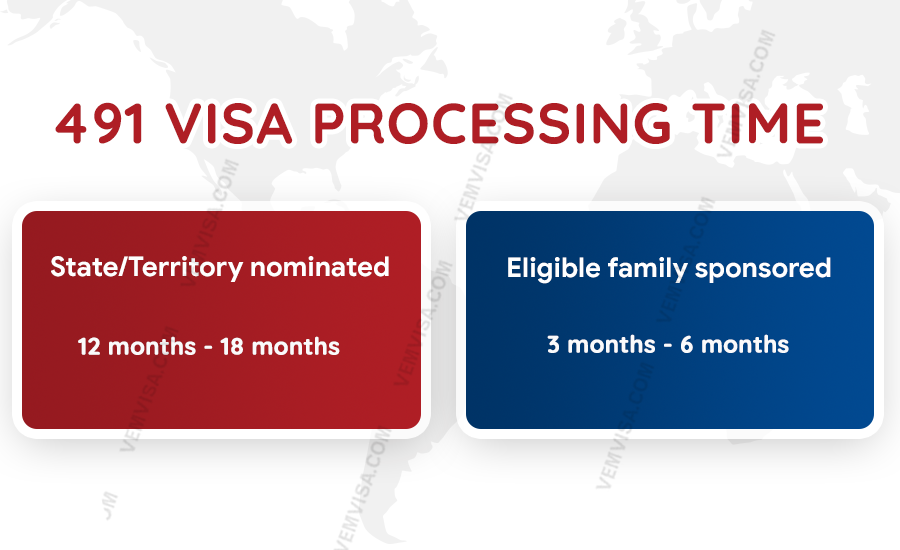
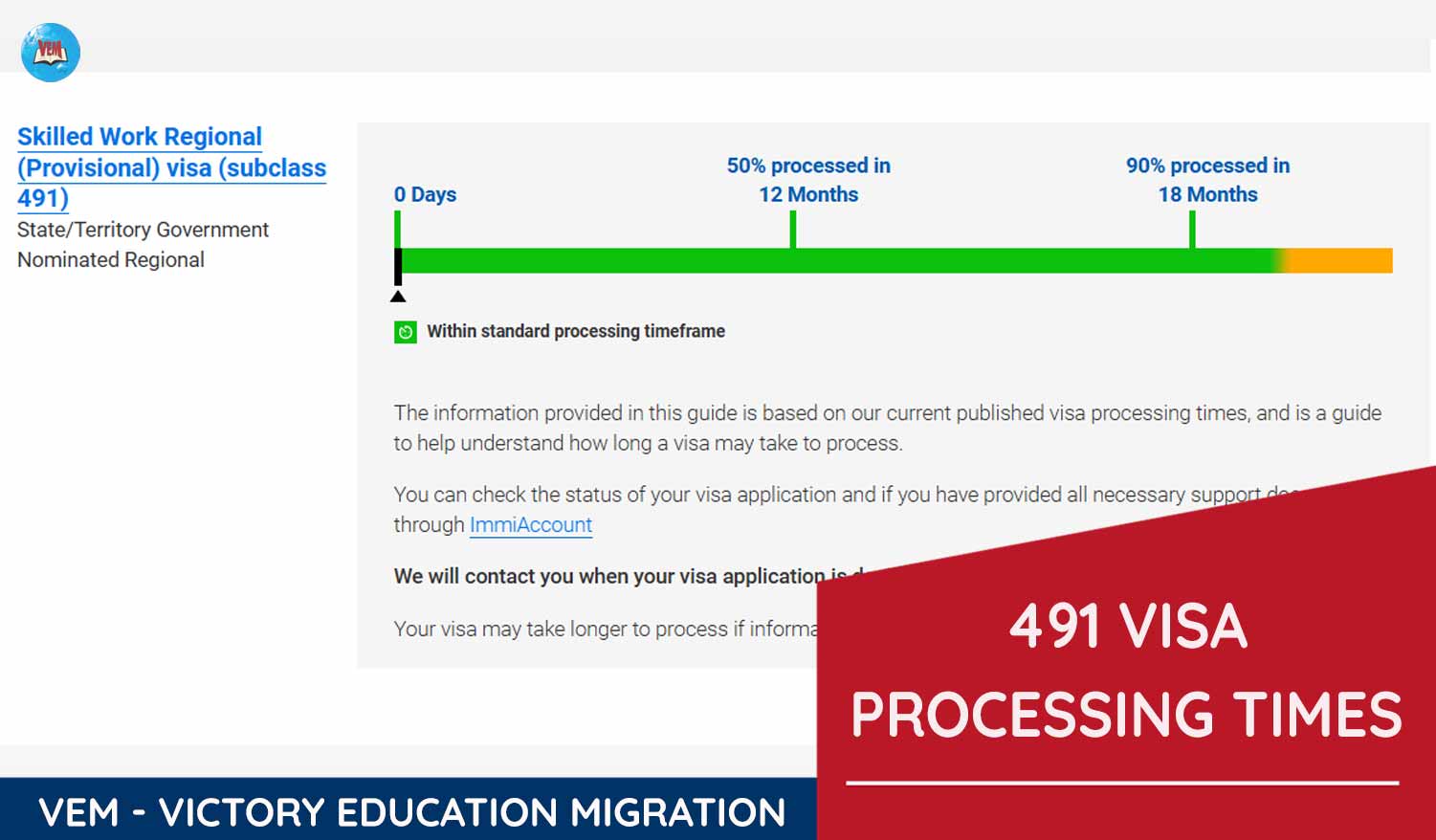
The latest 491 visa processing times differ substantially by pathway. Home Affairs figures recorded on 4 August 2026 showed that 50% of Family Sponsored Regional applications were finalised within 3 months and 90% within 6 months. For State or Territory Nominated Regional applications, the corresponding figures were 12 months and 18 months.
491 visa processing time in 2026
Home Affairs publishes historical percentiles based on recently finalised applications. The 50% figure is the median for that decision sample; the 90% figure means one in ten finalised cases took longer.
| Subclass 491 pathway |
25% finalised |
50% finalised |
75% finalised |
90% finalised |
| Family Sponsored Regional |
70 days |
3 months |
5 months |
6 months |
| State/Territory Nominated Regional |
5 months |
12 months |
14 months |
18 months |
A percentile is not a deadline
The guide looks backwards at recent decisions and changes as old or complex files are finalised. It does not promise that a newly lodged application will match the displayed range.
Why are the two 491 processing times different?
Both pathways lead to the same five-year provisional subclass 491 visa, but their invitation routes and recently decided caseloads are different.
State or Territory nominated
A state or territory government nominates the candidate under its own occupation, residence, employment and invitation settings. Nomination adds 15 points.
Visa stage: 12 months for 50%; 18 months for 90% in the cited snapshot.
Eligible family sponsored
An eligible relative in designated regional Australia sponsors the candidate, who must receive an invitation through relevant SkillSelect rounds.
Visa stage: 3 months for 50%; 6 months for 90% in the cited snapshot.
The shorter Family Sponsored visa decision time does not mean it is automatically the faster route overall. Invitation rounds, occupation coverage and ranking can create a long or uncertain wait before the visa application exists.
The complete 491 visa process time
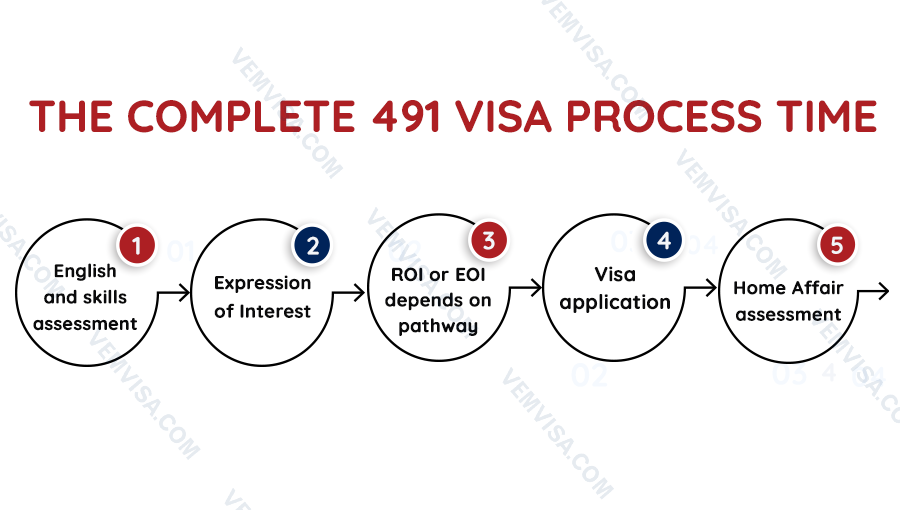
A realistic timeline begins before ImmiAccount lodgement. Each stage has its own decision-maker and evidence:
1. English and skills assessment: timing depends on the testing body, assessing authority, occupation, evidence and any review.
2. Expression of Interest: the EOI can remain active without an invitation. Reaching 65 points only meets the minimum threshold; it does not guarantee selection.
3A. State nomination: candidates may need a Registration of Interest and must wait for the state’s program, quota and selection process.
3B. Family-sponsored invitation: eligible EOIs wait for Department invitation rounds and ranking within the covered occupations.
4. Visa application: after invitation, the applicant normally has 60 days to lodge and prove every points claim and criterion as required.
5. Home Affairs assessment: the public 3–6 or 12–18-month figures relate to this lodged visa stage only.
Do not add a generic “state nomination takes X weeks” to the visa range. Each jurisdiction opens, closes and prioritises its program differently, and nomination allocations can be exhausted.
491 visa processing time: onshore vs offshore
Home Affairs does not publish a separate public 50%/90% table for 491 visa processing time onshore and 491 visa processing time offshore. The displayed figures are divided by nomination pathway.
However, location now affects queue priority. Under Ministerial Direction 119, which commenced on 25 July 2026, applicants who were in Australia at the time of application receive higher priority than comparable applicants outside Australia, subject to the occupation priorities above them.
Onshore priority does not create a guaranteed shorter timeframe
It affects processing order, not eligibility or a promised decision date. Offshore applications continue to be processed, and a decision-ready offshore file can still finish before a complex onshore case.
Do not move onshore merely to influence priority without a lawful visa strategy. Location for the Direction is assessed at the relevant application time, and other onshore validity or bridging rules apply.
How Ministerial Direction 119 prioritises subclass 491
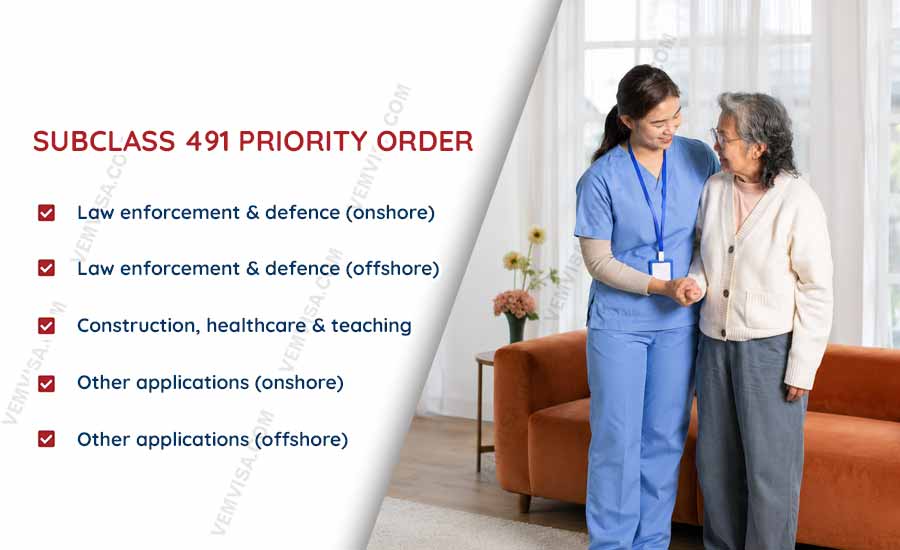
Direction 119 applies to on-hand and new subclass 491 applications. The processing order is:
- Law enforcement or defence-interest occupations where the applicant was in Australia.
- The same occupation group where the applicant was outside Australia.
- Construction, healthcare or teaching occupations where the applicant was in Australia.
- All other covered applications where the applicant was in Australia.
- All other covered applications where the applicant was outside Australia.
Applicants do not lodge a separate form to be placed in the correct group. Priority does not excuse missing evidence, an expired skills assessment or an incorrect points claim.
What can delay a 491 visa application?
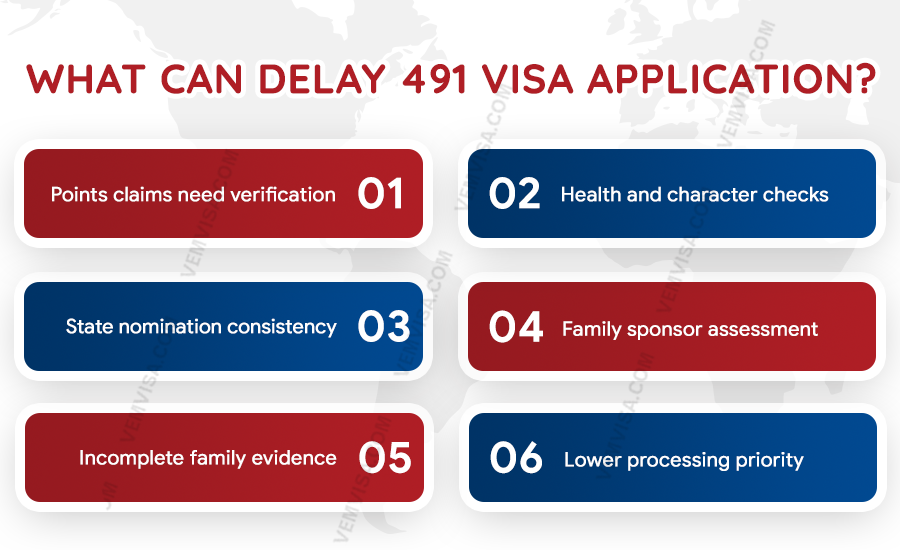
Points claims need verification
Employment, partner skills, English, study or regional points not fully supported can trigger enquiries or refusal.
Health and character checks
Specialist medical review, police certificates from several countries, military service or namesakes can take longer.
State nomination consistency
Changes to employment, residence, marital status or nominated occupation can affect evidence and notification duties.
Family sponsor assessment
Relationship, sponsor eligibility and proof of residence in designated regional Australia must be established.
Incomplete family evidence
Non-migrating family can still require health, character or identity assessment in some circumstances.
Lower processing priority
Occupation and application location determine position under Direction 119.
Can you speed up 491 processing?
There is no general paid fast-track. The practical goal is to keep the file decision-ready:
- Claim only points that can be proved at the required date.
- Upload clear skills, English, employment, civil, sponsor and nomination evidence.
- Arrange police certificates and medicals at an appropriate time so they do not expire unnecessarily.
- Respond completely and before every Home Affairs deadline.
- Notify changes to passport, address, relationship, newborn children and employment.
Repeated status requests do not move an in-range application forward. If the case passes the current 90% marker, recheck the latest stream-specific data, ImmiAccount messages and contact details before using official enquiry channels.
What to do while waiting for a 491 decision
Onshore applicants must follow the visa currently in effect. A Bridging Visa A may remain inactive until the substantive visa ends; once active, its work and travel conditions apply. A BVA does not support return travel, so obtain a Bridging Visa B before leaving Australia if required.
Offshore applicants should not make irreversible relocation plans from a percentile estimate. A grant can require entry by a specified date, and processing may extend beyond medical, police or employment-document validity.
The 491 is a provisional visa, not immediate permanent residence. After grant, holders must comply with regional conditions. Eligible holders may later pursue the Permanent Residence (Skilled Regional) subclass 191 pathway after meeting its separate requirements.
Planning or waiting for a subclass 491 visa?
Separate nomination and invitation timing from the lodged visa stage, then check priority and evidence.
Contact VEM Visa
FAQs
Does Family Sponsored processing include waiting for an invitation?
No. The 3-6 month range applies after visa lodgement. An EOI can wait much longer for an invitation, and no invitation is guaranteed.
Is an onshore 491 faster than an offshore application?
Direction 119 prioritises applicants in Australia over comparable offshore applicants, but Home Affairs does not publish separate location-based percentiles and does not guarantee a faster individual decision.
Why is Family Sponsored currently faster at the visa stage?
The figures reflect the composition and decisions in each recent caseload. They do not establish a permanent rule or mean Family Sponsored is easier to qualify for.
Does completing medicals mean a 491 grant is close?
Not necessarily. Health is one component. Points, skills, nomination or sponsorship, character, identity and security assessment may remain pending.
Can I contact Home Affairs after 18 months?
First check the current 90% time for the correct stream and all ImmiAccount requests. Official enquiry channels may be appropriate outside the range, but contact does not guarantee escalation.
Does a 491 visa lead to permanent residence?
It is a five-year provisional visa. Eligible holders may later apply for subclass 191 after meeting the separate regional and other requirements; PR is not automatic.

 VN
VN
 Người
đăng
Người
đăng Ngày
cập nhật:
Ngày
cập nhật:



