Form 80 Australian Visa: Complete Guide for Applicants
VEMVisa | Australian Visa Application Guidance
A practical guide to preparing Form 80, reconstructing personal-history timelines and submitting consistent character information through ImmiAccount.
Current check: 16 July 2026. The official Home Affairs Form 80 currently available is a 19-page PDF with design date 03/21. Forms and document requirements can change. Download the current version from Home Affairs and follow the checklist or request attached to your own visa application.
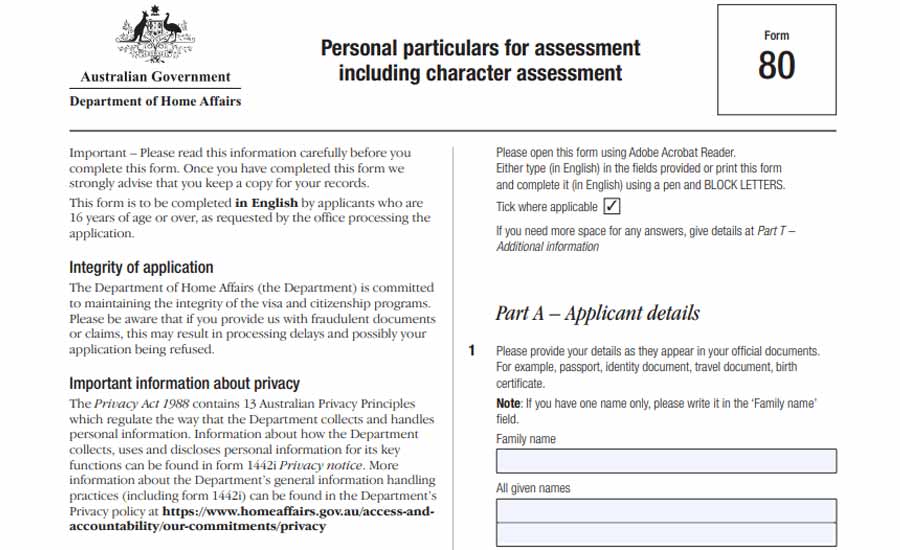
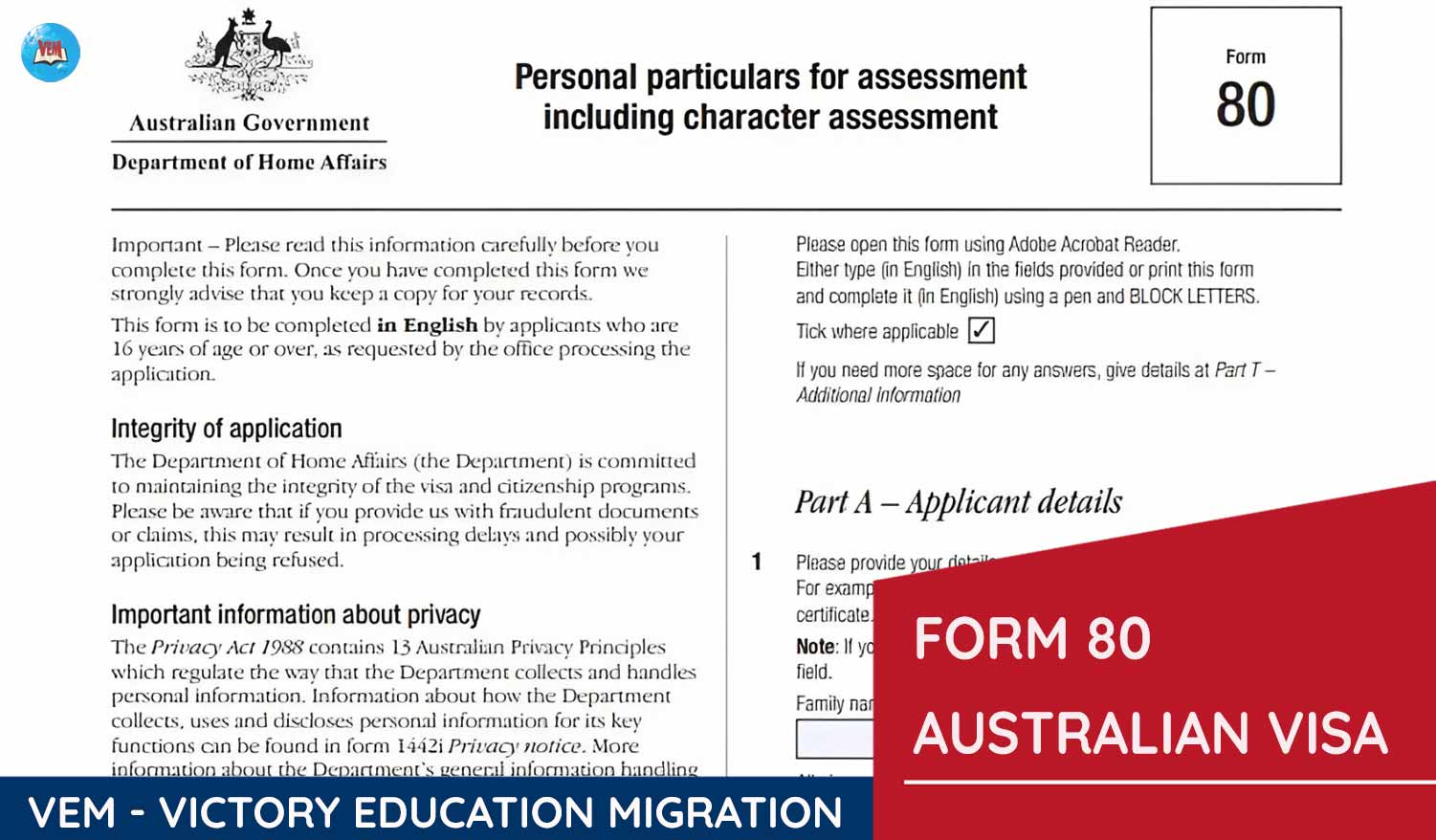
Form 80 Australian visa, officially titled Personal particulars for assessment including character assessment, is a detailed Department of Home Affairs form used to collect identity, residence, travel, employment, education, family, immigration and character information.
It is not automatically required from every visa applicant. The official form says that applicants aged 16 or over complete it when requested by the office processing the application. Some visa pages or ImmiAccount checklists may list it as a document to provide, while other applicants receive a specific request after lodgement. The correct approach is to follow the current instructions for your visa and your individual application.
The central rule is consistency.
Your Form 80 should align with your passport, CV, address records, police certificates, previous visa applications and information already entered in ImmiAccount. A long timeline is manageable. A timeline containing unexplained gaps or conflicting dates is much harder to assess.
Form 80 brings multiple parts of an applicant’s personal history into one detailed character-assessment record.
What is Form 80 for an Australian visa?
Form 80 is a Home Affairs questionnaire used to support personal, identity, security and character assessment. Its questions go well beyond basic passport details. The form asks applicants to account for significant parts of their life history, including addresses, international travel, employment, unemployment, education, family members and previous immigration events.
The Department’s character guidance states that visa applicants must answer questions truthfully, declare relevant criminal conduct and provide requested information. After an application is lodged, Home Affairs may ask for a police certificate, Form 80, a statement of character, military records or other evidence.
Current form
19 pages
Design date 03/21
Applicant age
16 years or over
When requested or listed for the application
Government form fee
No separate fee
It supports the visa application
Download the current PDF directly from the Department of Home Affairs Form 80 page. Avoid relying on a saved copy from an old application without first checking the design date and official source.
Is Form 80 mandatory?
Form 80 is not universally mandatory for every Australian visa application. The wording on the form is important: it is for applicants aged 16 or over, as requested by the office processing the application.
However, “not universally mandatory” does not mean “optional whenever you prefer.” It becomes required when the relevant visa instructions, the ImmiAccount document checklist or a Department request tells you to provide it. Home Affairs pages for several skilled, employer-sponsored, temporary graduate and child pathways currently refer to Form 80, although the exact instruction can differ between subclasses and applicant circumstances.
Situation
What to do
Do not assume
Your visa page or ImmiAccount checklist lists Form 80
Complete the current form and attach it in the requested category.
That an older form from a previous visa is still current.
Home Affairs sends a request after lodgement
Follow the request, deadline, upload location and any applicant-specific instructions.
That providing a different character document automatically replaces Form 80.
The form is not listed and no request has been made
Follow the current visa checklist. Obtain advice before uploading unnecessary or conflicting material.
That every applicant in every subclass must submit it proactively.
Partner visa applicants: check the live document list in ImmiAccount and the current subclass page. Requirements can be updated, and the documents requested may depend on the applicant’s age, history and processing office. For pathway guidance, see VEM’s Partner Visa Australia overview.
Whether Form 80 must be provided depends on the visa instructions, ImmiAccount checklist and any direct Department request.
Who needs to complete Form 80?
The person named as the applicant completes and signs their own Form 80. Where a secondary applicant is 16 or older and the checklist or processing office requires the form, that person generally completes a separate Form 80 using their own personal history.
Main applicant
Completes a form when it is required for the visa or requested by Home Affairs. The answers must describe that applicant’s own history.
Family members aged 16+
May need separate forms depending on the subclass, checklist and Department instructions. Do not combine two people’s histories in one form.
Sponsor or employer
Does not complete the applicant’s declaration. The form may still ask the applicant for sponsor, Australian contact or sponsoring-employer details.
Applicants with previous charges, convictions, military or police service, visa refusals, cancellations, deportation history, complex citizenship records or extensive travel may receive additional requests. A “yes” answer is not automatically a refusal, but an incomplete or misleading answer can create serious issues.
What information does Form 80 request?
The current form is organised into Parts A to T. The table below is a planning summary, not a replacement for reading every question and note in the official PDF.
Form section
Main subject
Preparation focus
Parts A–C
Applicant details, names, citizenships, passports and identity documents
Include former names, alternative spellings, previous citizenships and expired, lost or stolen travel documents where asked.
Parts D–E
Contact details, 10-year address history and 10-year international travel
Build chronological timelines and account for temporary accommodation, study addresses and qualifying trips.
Part F
Employment and unemployment
Include paid work, self-employment, internships, volunteer work, unemployment and periods before first employment.
Parts G–J
Education, proposed travel, Australian addresses and Australian visa history
Check qualifications, institution details, previous visas, applications and stays in Australia.
Parts K–P
Character, security, military, immigration and related matters
Read each question literally. Provide explanations and evidence for relevant “yes” answers.
Part Q
Partner, children, parents, siblings, accompanying family and Australian contacts
Collect legal names, dates and places of birth, citizenships and countries of residence.
Part R
Sponsoring employer or Australian organisation
Complete where relevant to the application and provide accurate business contact details.
Parts S–T
Declaration and additional information
Sign and date the declaration. Reference each question number when continuing an answer in Part T or an attachment.
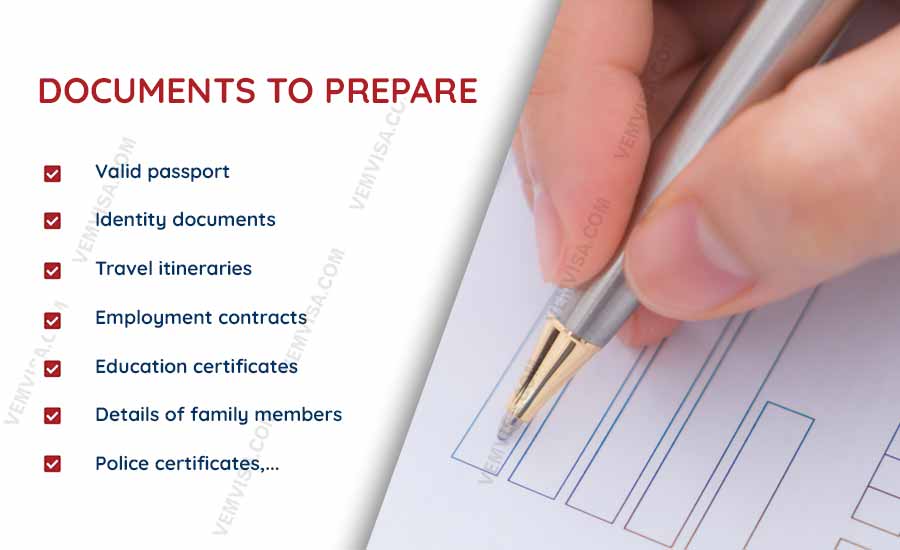
Documents to prepare before completing Form 80
Do not begin by trying to remember ten years of dates directly inside the PDF. First create a working timeline and gather source records. This reduces omissions and makes it easier to cross-check the final form.
Identity and travel records
Current and expired passports
Lost or stolen passport records
National identity documents
Passport stamps and visa labels
Flight, hotel and booking histories
Old calendars, emails and photographs
Address, work and education records
Leases, utility bills and official mail
CV, contracts, references and payslips
Tax or social-insurance records
Business registration for self-employment
Certificates, transcripts and institution details
Evidence explaining unemployment or retirement
Family and immigration records
Birth, marriage, divorce and name-change records
Details of parents, siblings, partners and children
Copies of previous visa applications
Refusal, cancellation or removal notices
Police certificates and court documents
Military, police or government-service records
Consistency documents
Current ImmiAccount application answers
Partner or family relationship statements
Skills-assessment and employment evidence
Sponsorship or nomination material
Previously submitted Form 80 or Form 1221
A master chronology used for final checking
A master chronology built from source records is more reliable than completing Form 80 from memory alone.
How to complete Form 80 correctly
Open the official form using Adobe Acrobat Reader, as instructed on the PDF. Type in English in the available fields or print it and complete it in English using a pen and block letters. Read the notes attached to each question because the required time period and level of detail are not identical throughout the form.
Use a three-document method
Document 1: a master timeline. Document 2: the completed Form 80. Document 3: a consistency checklist comparing the form with ImmiAccount and supporting evidence. This separates research, data entry and quality control.
1. Identity, names and passports
Enter names exactly as shown on official documents. Disclose former names, married names, aliases, cultural or tribal names, preferred names and alternative spellings where the question requires them. Record current and previous passports, including expired, lost or stolen documents. If a document number or date is no longer available, give as much accurate information as possible rather than inventing a value.
2. Address history
The current form requests a ten-year address history for most applicants. It specifically includes addresses inside and outside Australia, places used for work or study, share houses, university residences and temporary accommodation. List entries chronologically and make sure one address ends when the next begins. Explain genuine gaps in Part T.
3. International travel
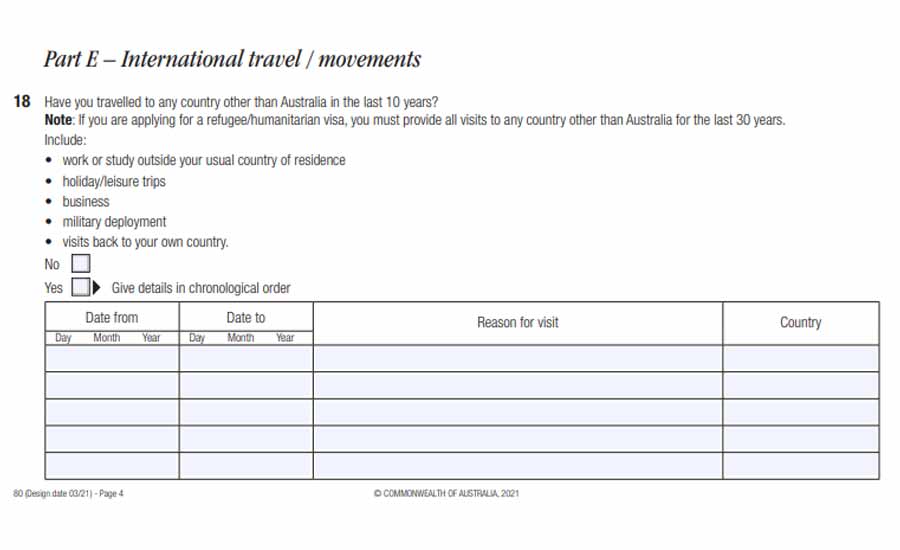
The form asks about travel to countries other than Australia during the stated period. Include holidays, business travel, study, employment, military deployment and visits to your country of citizenship where required by the question. Use passport stamps, travel accounts, emails and photos to reconstruct dates.
When an exact date cannot be recovered: use the most accurate information available and explain the basis and uncertainty. Do not present a guessed date as a confirmed fact. Keep the explanation concise and reference the relevant question number.
Travel history should be chronological, evidence-based and consistent with passport and immigration records.
4. Employment and unemployment
Part F includes paid work, self-employment, family business, internships, work experience and volunteer work. It also asks applicants to account for unemployment, gaps between employment and gaps between education. Describe how you occupied your time and supported yourself during non-working periods. Use full business names rather than unexplained abbreviations.
5. Education, Australian visa history and proposed stay
Check institution names, course dates, qualifications and locations against certificates and transcripts. Review every previous Australian visa, refusal, cancellation and period of stay before answering the immigration-history questions. The dates should match previous applications and Department correspondence.
6. Character, security and service questions
Read each question carefully and answer truthfully. Disclose relevant criminal charges and convictions even when they occurred outside Australia or seem minor. Where military, police, intelligence, government or security service is relevant, provide the requested information and supporting records. Obtain professional advice before submitting a complex explanation rather than minimising or concealing the issue.
A “yes” answer does not itself decide the visa outcome. The Department assesses the facts, documents and applicable law. In contrast, false, incomplete or misleading information can affect credibility and may have consequences beyond the original issue.
7. Family members and Australian contacts
Collect the legal names, dates and places of birth, citizenships and countries of residence of the family members requested. Do not omit a relative merely because they are not migrating. For Australian contacts, provide information that is accurate and current.
8. Declaration and Part T
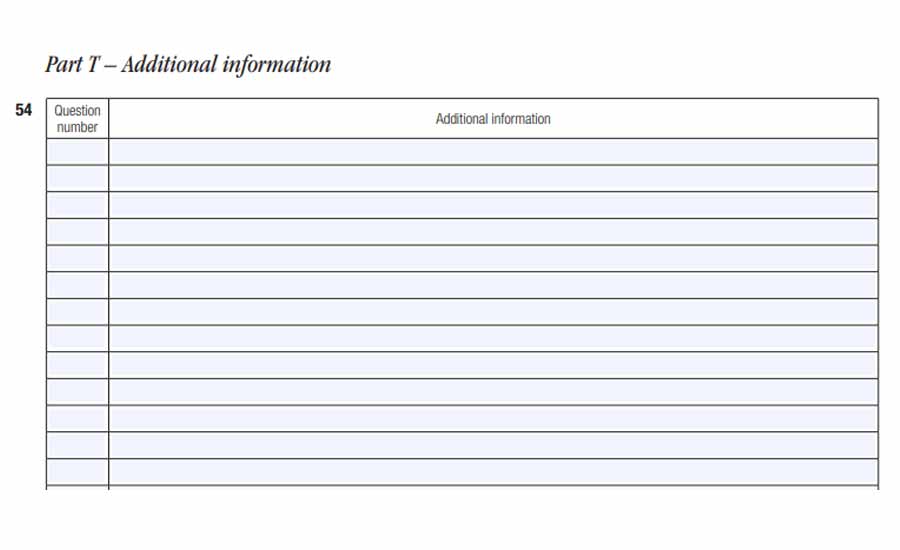
Read the declaration, then sign and date the form in the manner required by the current PDF and your submission instructions. Part T is used when the form does not provide enough space. State the question number before every continuation. If Part T is insufficient, attach a separate statement with clear headings and page numbers.
Reference the exact Form 80 question number whenever an answer continues in Part T or a separate annexure.
How to submit Form 80 through ImmiAccount
For an online visa application, Form 80 and related explanations are generally attached through ImmiAccount under the document category shown for the applicant. Home Affairs states that the application form tells applicants what to attach and whether documents should be attached before or after submission.
Step 1
Review every page and annexure.
Step 2
Sign and date as required.
Step 3
Create a clear, complete PDF.
Step 4
Upload under the correct applicant.
Use a clear filename such as Form-80-Family-Name-Given-Names.pdf.
Upload annexures and supporting evidence in logical categories with meaningful descriptions.
Follow any deadline or specific document naming instructions in the Department’s request.
Do not email documents unless Home Affairs specifically instructs you to do so.
Keep your own complete copy. Home Affairs warns that supporting documents may not remain accessible from ImmiAccount after upload.
After submission: Home Affairs may review Form 80 with the visa application, police certificates and other records. It may request travel clarification, employment evidence, military records, court documents or a further character statement. Providing Form 80 does not guarantee a faster decision or visa grant.
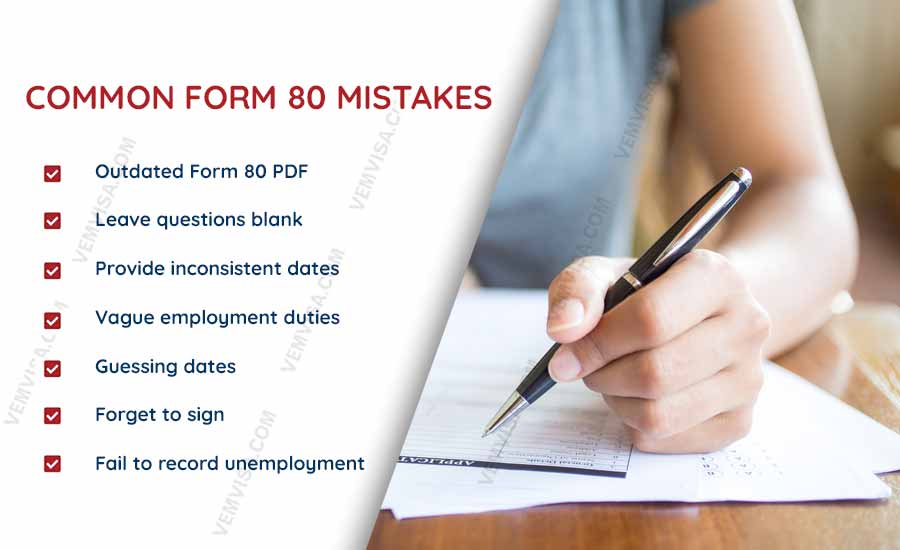
Common Form 80 mistakes
Common mistake
Why it matters
Better approach
Using an old PDF
Questions and instructions may change.
Download the current official version before starting.
Leaving timeline gaps
It can make address or employment history unclear.
Account for study, unemployment, travel, retirement and temporary addresses.
Copying CV dates without checking
CVs often omit short jobs and unemployment.
Use employment records and build a complete chronology.
Guessing exact dates
A guess may conflict with objective records.
Use the most accurate estimate and explain genuine uncertainty.
Omitting minor offences or refusals
The omission may become more serious than the underlying event.
Read the wording carefully and disclose relevant matters with evidence.
Inconsistent names or passports
Identity checks rely on complete name and document history.
Include aliases, former names, alternative spellings and previous documents.
Forgetting the declaration
An unsigned or undated form may be incomplete.
Perform a final page-by-page review before upload.
Most preventable Form 80 problems come from outdated forms, timeline gaps, unsupported guesses and inconsistencies with other documents.
Form 80 final review checklist
✓I downloaded the current Form 80 from Home Affairs.
✓Names, birth details, citizenships and passport history match official records.
✓Address, travel, employment and unemployment timelines contain no unexplained gaps.
✓Education and Australian visa history match prior applications and supporting evidence.
✓All character and immigration questions have been read carefully and answered truthfully.
✓Every continuation identifies the relevant question number.
✓The form is consistent with ImmiAccount, police certificates, CV and relationship or sponsorship documents.
✓The declaration is signed and dated as required.
✓I saved a complete copy of the form, annexures and uploaded evidence.
Complete the form only after building the timeline, then conduct a separate consistency review before upload.
When should you seek professional help?
A straightforward timeline can often be prepared by the applicant. Professional review may be valuable when the form raises legal, character or credibility risks rather than simple data-entry questions.
Criminal charges, convictions, court orders or pending proceedings
Previous visa refusal, cancellation, removal, deportation or unlawful stay
Military, police, intelligence, security or sensitive government service
Different names, birth dates or citizenship details across documents
Missing historical records or major gaps that cannot be reconstructed
Conflicting dates in earlier visa applications
A Home Affairs request with a short deadline or complex annexure requirements
A registered Australian migration professional can review Form 80 against the broader application and help structure factual explanations. The purpose is not to make difficult history disappear. It is to disclose it accurately, coherently and with the appropriate evidence.
Form 80 Australian visa FAQ
Is Form 80 required for every Australian visa?
No. The official form states that applicants aged 16 or over complete it when requested. It is required when the relevant visa instructions, ImmiAccount checklist or processing office tells you to provide it.
Where can I download Form 80?
Download it from the official Home Affairs website. At the time of this review, the available PDF is 19 pages and shows design date 03/21.
Does every family member need a separate Form 80?
Each person who is required to provide Form 80 completes a separate form about their own history. Check the age rules and document instructions for every applicant included in the visa application.
What should I write when I cannot remember an exact date?
Search reliable records first. When the exact date genuinely cannot be recovered, provide the most accurate information available and explain the uncertainty. Do not invent a precise date merely to fill the field.
Can I reuse Form 80 from an earlier visa application?
Use the current official form and review every answer. Your address, travel, employment, family details and immigration history may have changed, and the earlier PDF may be outdated.
Should I email Form 80 to Home Affairs?
For online applications, attach documents through ImmiAccount unless the Department gives different instructions. Home Affairs generally tells applicants not to email supporting documents.
Will submitting Form 80 make my visa faster?
Not necessarily. A complete and consistent form may reduce avoidable clarification requests, but it does not guarantee faster processing or approval.
Form 80 review support
Check the timeline before Home Affairs has to question it
VEM can review Form 80 against your visa application, identify inconsistent dates and help organise annexures for complex personal or character history.
Check all available records, provide the closest accurate information and explain the uncertainty in Part T. Do not invent a date merely to complete the field.
Mr. Phong Cao is a licensed migration agent by MARA (MARN: 1577877). He is also a member of the Migration Institute of Australia (MIA: 12648), one of the most reputable organizations in the field of immigration in Australia. In addition, Mr. Phong Cao holds a QEAC certification in study abroad consulting (QEAC: K580) and Australian real estate investment (RA85931). With over 12 years of experience in Australian immigration, he provides comprehensive solutions for studying and settling in Australia.

 VN
VN
 Người
đăng
Người
đăng Ngày
cập nhật:
Ngày
cập nhật: