Updated 2026 Employer-Sponsored Visa Review Guide
What employers and sponsored workers should do after a sponsorship, nomination or visa refusal, including ART deadlines, fees, evidence and alternative pathways.
An employer visa nomination refusal appeal is usually an application for merits review by the Administrative Review Tribunal (ART). The ART can reconsider the facts, evidence and applicable law. However, the right person must apply, the application and fee must be lodged within the strict deadline, and a nomination review does not automatically review a separate visa refusal.
If you have an employment visa refused in Australia, first identify exactly which decision was made: sponsorship refusal, nomination refusal, visa refusal, or more than one. Each decision has different legal consequences, review rights and potential applicants.
Quick answer: Read every decision letter immediately. Confirm who has review rights and the exact deadline, lodge the correct ART application and pay the required fee on time, then build evidence addressing each refusal finding. The current Part 5 migration review fee is AUD 3,727; a 50% reduction may be requested on financial-hardship grounds.
What to do immediately after an employer visa refusal
A refusal is not the time to rely on a generic online statement that applicants have “21 days” or “28 days.” ART confirms that migration review time limits are strict, depend on the decision and cannot be extended. The Department’s decision letter is the authoritative starting point.
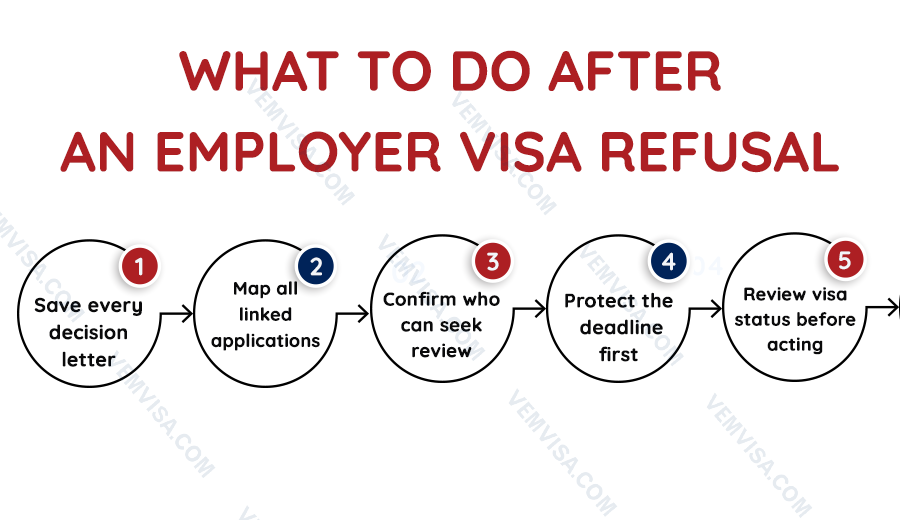
1. Save every decision letter
Download the sponsorship, nomination and visa correspondence from ImmiAccount. Note the notification method, date, reasons, review-rights section and deadline in each letter.
2. Map all linked applications
Identify the sponsor, nomination reference, visa subclass and stream, primary visa applicant, dependants, current visas and any Bridging Visas.
3. Confirm who can seek review
The business is commonly the eligible review applicant for a nomination refusal, while the worker may be the applicant for a reviewable visa refusal. Follow the wording in each letter.
4. Protect the deadline first
Lodge the correct review application and pay the required amount by the deadline. Evidence can usually be developed after lodgement, but a missed jurisdictional deadline generally cannot be repaired.
5. Review visa status before acting
Check VEVO and all Bridging Visa notices before withdrawing an application, changing employer, stopping work or leaving Australia.
Do not withdraw the linked visa application automatically
Withdrawal can end an associated Bridging Visa pathway and may affect onshore options. Compare ART review, a new nomination and a fresh visa application before taking an irreversible step.
Nomination refusal vs sponsorship refusal vs visa refusal
Employer-sponsored migration is not assessed as one single application. Subclasses such as 482 Skills in Demand, 186 Employer Nomination Scheme and 494 Skilled Employer Sponsored Regional involve linked but legally distinct stages.
| Decision |
Who made the original application? |
Immediate consequence |
Who commonly seeks review? |
| Sponsorship refusal or cancellation |
The business or organisation. |
The business may be unable to sponsor or continue sponsoring workers under the relevant program. |
The sponsor, if the decision is reviewable and the letter identifies it as eligible. |
| Nomination refusal |
The sponsoring employer. |
The nominated position or worker is not approved. A linked visa cannot be granted on that refused nomination. |
Usually the nominator/employer, subject to the statutory criteria and decision letter. |
| Visa refusal |
The sponsored worker and included family members. |
The applicant does not receive the requested visa; current status depends on existing and bridging visas. |
The visa applicant or another person specified by law and the refusal letter. |
| Multiple linked refusals |
The employer and worker made separate applications. |
Both the nomination and visa pathways may need to be preserved. |
Separate eligible applicants may need separate ART applications, deadlines and fees. |
A nomination refusal does not automatically cancel a visa the worker already holds. It does, however, prevent Home Affairs from granting a visa that requires approval of that nomination. The linked visa may later be refused or may be withdrawn after advice, depending on the circumstances.
Likewise, an approved nomination does not guarantee the worker’s visa. Home Affairs separately assesses personal criteria such as skills, work experience, English, age where applicable, health, character and whether information is genuine.
Can an employer nomination refusal be appealed?
ART can review certain decisions under the Migration Act to refuse approval of a nominated occupation, activity or position. Review is not automatic in every case. The decision letter states whether the decision is reviewable, who may apply and the deadline.
“Appeal” is commonly used in searches, but the ART process is technically a merits review. The Tribunal stands in the shoes of the original decision-maker and reassesses the matter. It is different from judicial review in a court, which focuses on legal or jurisdictional error rather than simply reaching a preferable factual outcome.

One refusal can create two review files
If Home Affairs refuses the employer’s nomination and later refuses the worker’s visa, do not assume the employer’s ART application protects the visa applicant. Review rights, applicants, deadlines and fees must be checked separately for each decision.
For offshore matters, review rights may depend on the visa subclass, where the applicant was located, the sponsor or nominator’s status and other statutory conditions. A business or worker should not lodge in the wrong name merely to meet a deadline; an invalid review application can be dismissed for lack of jurisdiction.
Common reasons employer nominations and visas are refused
A successful strategy begins with the actual findings in the refusal letter. Common nomination issues include:
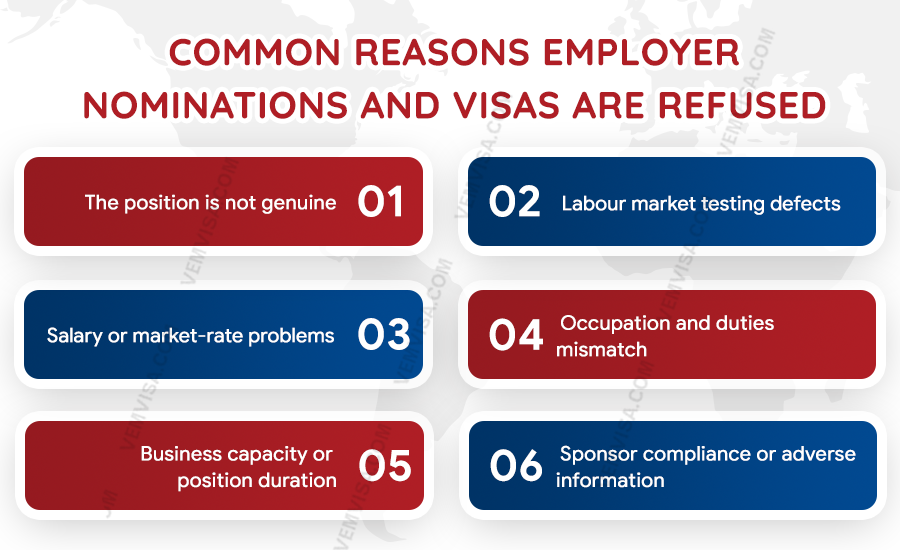
The position is not genuine
Business structure, workflow, staffing, contracts or financial records may not demonstrate a real need for the nominated role.
Labour market testing defects
Advertisements may have used the wrong dates, channels, duration, role details or evidence, or an exemption may have been claimed incorrectly.
Salary or market-rate problems
The salary may not meet the applicable threshold, annual market salary rate or employment-law requirements, or the supporting comparison may be too generic.
Occupation and duties mismatch
The proposed duties may not align with the nominated occupation, or the evidence may describe a lower-skilled or substantially different role.
Business capacity or position duration
Financial statements, payroll, contracts or forecasts may not support the salary, ongoing need or required employment period.
Sponsor compliance or adverse information
Previous breaches, unpaid obligations, inaccurate information or unresolved compliance concerns may undermine sponsorship or nomination approval.
A visa refusal may instead concern the worker’s qualifications, skills assessment, employment experience, English, age, health, character, identity, genuine intention or the absence of an approved nomination. A response aimed only at the employer will not resolve a separate personal visa criterion.
Employer nomination refusal appeal process at the ART
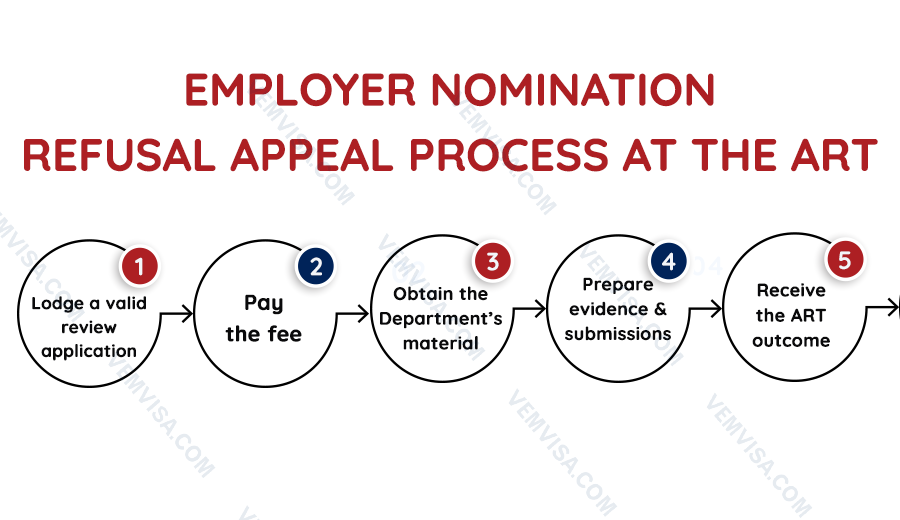
1. Lodge a valid review application
Use ART Online Services or another accepted method, identify the decision accurately, provide the required information and submit before the statutory deadline.
2. Pay the fee
The Part 5 migration review fee is AUD 3,727. If paying the full fee causes financial hardship, the applicant may request a 50% reduction with supporting evidence.
3. Obtain the Department’s material
Review the decision record, documents supplied at lodgement, requests for information, responses and adverse findings. Identify what was missing, misunderstood or legally disputed.
4. Prepare evidence and submissions
Organise evidence against each criterion and explain the connection between the documents and the factual or legal issue. Avoid simply uploading an unstructured business archive.
5. Attend any hearing or case event
The Tribunal may ask the employer, worker or witnesses questions. Answers should be consistent with the records and demonstrate how the business and role operate in practice.
6. Receive the ART outcome
The Tribunal may affirm, vary, set aside or remit the decision, depending on its powers and findings. A favourable remittal commonly sends the matter back to Home Affairs for reconsideration under directions.
ART fee and processing time
50% hardship amount
$1,863.50
The processing figures apply to Nomination/Sponsor approval reviews finalised between 1 February and 31 July 2026. They are historical statistics, not a timetable for one case. Complexity, hearing readiness, linked matters, evidence and Tribunal workload can affect timing.
ART’s expedited-decision form states that requests for expedited processing are not available for a decision about nomination or sponsorship of an activity, occupation, position or person. Do not build a strategy around an assumed fast-track.
Evidence for a nomination refusal review
New material may be provided during merits review, but new documents do not automatically cure the refusal. Some criteria must have been satisfied at a particular historical time. The evidence should prove the required facts and address the Department’s reasoning directly.
| Refusal issue |
Potential evidence |
Core question to answer |
| Genuine position |
Organisation chart, duty allocation, contracts, workflow, staffing records, business plan and explanation from operational managers. |
Why does this business genuinely need this specific position at the nominated skill level? |
| Financial capacity |
Financial statements, BAS, payroll, bank records, forecasts, contracts, invoices and accountant evidence. |
Can the employer sustain the position and pay the nominated salary for the required period? |
| Market salary |
Comparable employee records, tailored job-market data, enterprise agreement or award analysis and remuneration methodology. |
Is the proposed remuneration lawful, supported and equivalent to the relevant Australian market rate? |
| Labour market testing |
Advertisements, invoices, screenshots, publication dates, applications received, recruitment report and any valid exemption evidence. |
Were the legislative advertising requirements satisfied at the required time? |
| Occupation alignment |
Detailed position description, duty percentages, reporting lines, work samples, client contracts and expert industry explanation where useful. |
Do the actual duties correspond to the nominated occupation rather than merely sharing its title? |
| Adverse information |
Compliance records, corrective action, policies, payroll audit, regulator correspondence and a precise response to each allegation. |
Is the information accurate, relevant and sufficiently serious, and are there reasons it should be disregarded? |
Witness evidence should match the documentary record. For example, a director who says the role is essential should be able to explain daily duties, reporting lines, existing staff, revenue source and why the work cannot simply be absorbed by another position.
What happens to the worker’s visa and work rights?
A nomination refusal does not by itself tell the worker whether they can remain or work in Australia. Visa status depends on the substantive visa, any linked visa decision, Bridging Visa grant, review application and conditions recorded in VEVO.
- Existing substantive visa: it generally remains in effect until its own expiry or cancellation; the nomination refusal does not rewrite its expiry date.
- Pending linked visa: Home Affairs cannot grant a visa that requires an approved nomination while the relevant nomination remains refused.
- Bridging Visa: a timely, valid review of a reviewable visa refusal may affect how long a bridging visa remains in effect, but the actual grant notice and conditions control.
- Work rights: check the current visa and conditions. A review application does not create unrestricted work rights.
- Travel: Bridging Visa A does not permit re-entry. A Bridging Visa B must be obtained before departure where eligible.
- Onshore reapplication: a visa refusal while the person lacks a substantive visa may engage section 48 restrictions, limiting visas that can be applied for in Australia.

Check both the employer’s and worker’s timelines
An employer may preserve nomination review rights while the worker misses the deadline for the linked visa refusal. Coordinated case management is essential because one valid review does not necessarily preserve the other matter.
ART review vs a new nomination or court appeal
There is no universal answer to whether a refused visa or nomination should be reviewed or replaced with a new application. The correct strategy depends on whether the historical defect can be answered, whether current criteria can be met, lawful status and how the nomination links to the visa subclass.
| Option |
Best suited to |
Main benefit |
Main risk or limitation |
| ART merits review |
A reviewable decision where the refusal findings can be contested or answered with evidence. |
Fresh consideration of facts, evidence and applicable law. |
Strict jurisdiction and deadline; substantial fee and potentially long wait. |
| New nomination/application |
A curable defect where current rules, status and timing permit a valid fresh pathway. |
May allow a cleaner, decision-ready application without waiting for ART. |
New fees; no automatic refund; may not link to an existing visa application. Home Affairs expressly states a new 186 nomination cannot be linked to an existing 186 visa application. |
| Review and reapply |
Cases where preserving rights and pursuing a separate valid pathway are both strategically justified. |
Can preserve the challenged decision while progressing another option. |
Duplicated cost and complexity; inconsistent evidence can damage both cases. |
| Judicial review |
A decision affected by an arguable legal or jurisdictional error. |
A court can address legal invalidity. |
The court does not simply remake the merits; strict deadlines, costs and litigation risk apply. |
A fresh nomination is not automatically better because the business can now produce more documents. If labour market testing had to be completed before lodgement, or another time-specific criterion was not met, the defect and the linked visa strategy require close analysis.
Possible ART outcomes
Affirm
The original refusal remains in place. Any further court option depends on an arguable legal error and the applicable deadline.
Set aside or substitute
The Tribunal replaces the original decision where its powers and findings permit that outcome.
Remit
The matter returns to Home Affairs for reconsideration, often with findings or directions that bind the further assessment.
Dismissal or no jurisdiction
The review may end without merits success if it was late, lodged by the wrong person, not reviewable, withdrawn or dismissed under applicable procedures.
A favourable nomination outcome is not necessarily an immediate visa grant. Home Affairs may still need to finalise nomination processing and assess every remaining visa criterion.

Received an employer nomination or visa refusal?
VEM can review the decision letters, identify the eligible review applicant and deadline, coordinate the employer and worker matters, and prepare an evidence plan for ART review or a lawful new application strategy.
Discuss the refusal with VEM
FAQs
Can an employer appeal a nomination refusal in Australia?
ART can review certain decisions to refuse approval of a nomination. The refusal letter confirms whether review is available, who can apply and the exact deadline. The employer or nominator is commonly the eligible applicant.
What is the deadline for an employer nomination refusal appeal?
Use the deadline in the Home Affairs decision letter. Time limits vary, and ART has no power to extend the statutory period for lodging a migration review. Do not rely on a generic number of days found online.
How much does an ART employer nomination review cost?
The current fee for a Part 5 migration review is AUD 3,727. An applicant experiencing financial hardship may request a 50% reduction, but the required payment must still be handled by the application deadline.
Does appealing the nomination also appeal the worker’s refused visa?
No, not automatically. Nomination and visa decisions are legally distinct. If both are refused and reviewable, the employer and worker may need separate review applications, each lodged by the eligible person within its own deadline.
Can new evidence be given to the ART?
Merits review can generally consider further evidence. However, a new document cannot always fix a criterion that legally had to be satisfied at an earlier date. Evidence should be mapped to the legislation and refusal findings.
How long does a nomination refusal review take?
For Nomination/Sponsor approval reviews finalised from February to July 2026, ART reports 50% completed within 1 year 7 months and 95% within 2 years 5 months. These historical figures are not guarantees for a current case.
Can the employer lodge a new nomination instead of appealing?
Possibly, if a valid new nomination can meet current requirements. Review the linked visa carefully: for subclass 186, Home Affairs states that a new nomination cannot be linked to the existing visa application. A fresh visa application and new fees may be required.
Can the worker stay and work in Australia during the appeal?
That depends on the worker’s substantive visa, Bridging Visa, the review lodged and the conditions shown in VEVO. A nomination review alone does not automatically grant lawful status, work rights or permission to return after overseas travel.

 VN
VN

 Người
đăng
Người
đăng Ngày
cập nhật:
Ngày
cập nhật:



