Subclass 444 Visa Special Category: Requirements & Work Rights
Updated 2026 guide | New Zealand citizens in Australia
A practical guide to Special Category visa subclass 444, including eligibility, work rights, travel, Medicare, family members and the direct Australian citizenship pathway.
The visa 444, officially the Special Category visa subclass 444, is the temporary Australian visa available to eligible New Zealand citizens. Most travellers are considered for it when they enter Australia on a valid New Zealand passport, allowing them to live, work and study here without a fixed stay period while the visa remains in effect.
However, indefinite stay does not mean permanent residence. The subclass 444 visa ceases when its holder leaves Australia, and access to citizenship, Medicare, Centrelink, student loans and family sponsorship depends on separate legal requirements.
Quick answer: A 444 visa is a temporary visa for eligible New Zealand citizens. It generally costs AUD 0, permits work and study, and lasts while the holder remains in Australia. Since 1 July 2023, eligible SCV holders can apply directly for Australian citizenship without first obtaining a permanent visa, but residence, absence and character requirements still apply.
APPLICATION CHARGE
AUD 0
No standard visa application charge for the Special Category visa.
STAY PERIOD
No fixed limit
Valid while the holder remains in Australia and the visa stays in effect.
LEGAL STATUS
Temporary visa
Indefinite stay is not the same as holding a permanent Australian visa.
What is the Special Category visa subclass 444?
The Special Category visa is Australia’s visa arrangement for eligible New Zealand citizens entering on a valid New Zealand passport. It supports travel and residence under the Trans-Tasman relationship while remaining a temporary visa under Australian migration law.
Term
Meaning
Practical significance
Special Category visa
The official visa category for eligible New Zealand citizens.
Allows eligible holders to stay, work and study in Australia.
Subclass 444
The visa’s subclass number.
Used in VEVO, official records and eligibility checks.
TY 444
Visa class TY combined with subclass 444.
A classification label, not a different visa.
Protected or non-protected SCV
A distinction based mainly on historical Australian residence.
Can affect social-security and family-sponsorship outcomes.
The visa is temporary even when the stay is indefinite
An SCV holder may be treated as a permanent resident for a particular purpose, such as citizenship calculations, without actually holding a permanent visa. Migration status, tax residence, Medicare eligibility and Centrelink residence are separate questions.
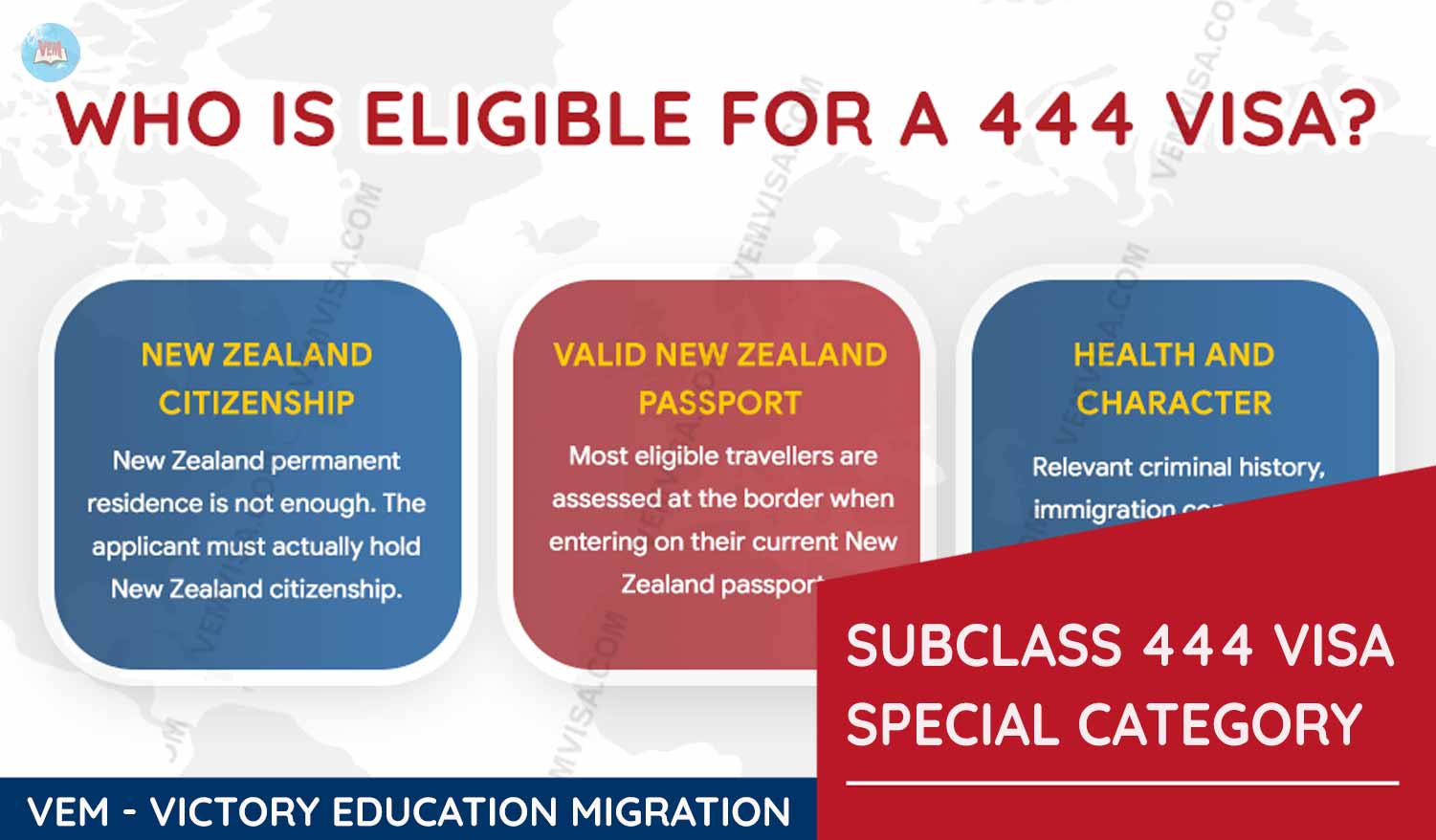
Who is eligible for a 444 visa in Australia?
A traveller is generally considered for a subclass 444 visa when they are a New Zealand citizen, present a valid New Zealand passport and satisfy the relevant entry, health and character requirements.
New Zealand citizenship
New Zealand permanent residence alone is not enough. The applicant must actually hold New Zealand citizenship.
Valid New Zealand passport
Most eligible travellers are assessed at the border when entering on their current New Zealand passport.
Health and character
Relevant criminal history, immigration concerns or health issues can affect whether the visa is granted.
Grant is not guaranteed merely because someone has entered Australia before. The decision is made against the criteria applying at the time of the relevant application or entry, and previous visa cancellation, removal or serious offending can change the outcome.
How is visa 444 granted
Most eligible New Zealand citizens do not submit a conventional pre-travel application. Home Affairs considers their Special Category visa application when they enter Australia and grants the visa if the requirements are met.
Applying from within Australia is also possible in specific circumstances. Home Affairs identifies an online SCV application route for people who:
Became a New Zealand citizen and passport holder after entering Australia.
Entered Australia using a passport other than a New Zealand passport.
Entered on another temporary Australian visa.
Have had a New Zealand citizen baby born in Australia who needs the appropriate visa assessment.
This distinction matters for dual citizens and people who acquire New Zealand citizenship after arrival. A New Zealand citizen entering on a different country’s passport should not assume a subclass 444 was granted; they should check VEVO and, if appropriate, use the official onshore application process.
How much does a subclass 444 visa cost?
The standard visa application charge for the Special Category visa is AUD 0. This should not be confused with charges for a New Zealand passport, travel, separate visas for non-New Zealand family members, citizenship applications or evidence-of-citizenship requests.
An agent is not required for an uncomplicated arrival assessment. However, professional advice can be appropriate where criminal convictions, previous visa cancellation, uncertain protected status, complicated citizenship residence or family sponsorship create legal risk.
What does the SCV 444 visa allow you to do?
A valid SCV 444 visa provides broad residence, employment and study flexibility. The major limitation is that access to government programs and long-term legal rights depends on separate rules.
Activity
General position
Important qualification
Live in Australia
No fixed maximum stay while the visa remains in effect.
The visa remains temporary and ceases on departure.
Work
Generally unrestricted employment and the ability to change employers.
Employers may still request a current VEVO check and professional registration.
Study
The visa allows study in Australia.
Commonwealth supported places and HELP loans have additional eligibility rules.
Medicare
Eligible New Zealand citizens living in Australia may enrol.
Residence and identity evidence must satisfy Services Australia.
Citizenship
Eligible SCV holders can apply directly by conferral.
Residence, absence, character and other statutory criteria still apply.
Family sponsorship
Some family members may have their own suitable visa pathway.
Holding an SCV alone does not automatically make every holder eligible to sponsor a permanent partner visa.
The visa does not itself give Australian citizenship, a right to vote in federal elections, guaranteed social security or automatic eligibility for every government-funded student loan.
Tax residence is separate from visa status
The Australian Taxation Office applies its own residence rules. A person can hold a temporary visa while being an Australian resident for tax purposes. Income tax, superannuation, foreign income and property-related tax outcomes should be checked against the individual’s actual circumstances.
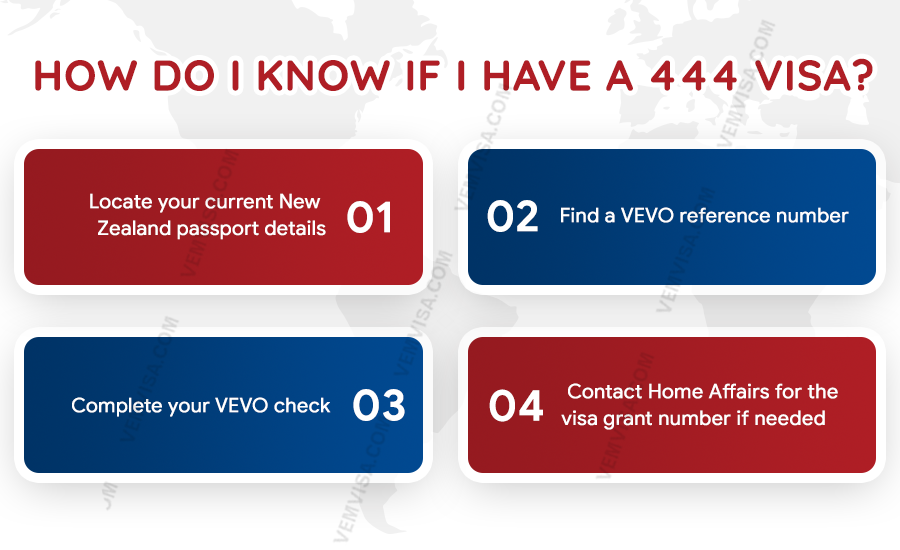
How do I know if I have a 444 visa?
The simplest way to confirm current status is the Department of Home Affairs’ Visa Entitlement Verification Online service. A VEVO result can identify the visa currently in effect, its subclass and relevant conditions.
1. Locate your current New Zealand passport details
Use the passport connected to your current visa record, and check whether replacement passport details need updating.
2. Find a VEVO reference number
If you cannot locate the necessary reference, Home Affairs provides an official VEVO reference-number request form.
3. Complete your VEVO check
Review the in-effect visa, work rights and other relevant details. Save or share the result where needed for employment or study.
4. Contact Home Affairs for the visa grant number if needed
Home Affairs advises New Zealand citizens that they can obtain their visa grant number by contacting the departmental service centre.
An SCV 444 visa grant number is not necessarily the same thing as the reference required to access VEVO. A current VEVO result is more useful than an old document when you need to demonstrate present immigration status.
Protected and non-protected SCV holders
“Protected SCV” and “non-protected SCV” describe different legal treatment associated with historical Australian residence. They are not different visa subclasses: both concern subclass 444.
Status
Typical historical basis
Why it matters
Protected SCV
Generally present in Australia on 26 February 2001, present for 12 months within the preceding two years, or assessed under applicable protected-status rules.
May be treated as an Australian resident for a broader range of social-security and family-sponsorship purposes.
Non-protected SCV
Commonly applies to New Zealand citizens who first arrived after 26 February 2001.
General income-support access is more limited, although particular payments, concessions and citizenship pathways may still be available.
Historical movement records, Centrelink assessments and precise residence dates can matter. A person should not infer protected status solely from having lived in Australia for a long time or from a relative’s protected status.
Visa 444 and Australian citizenship
Since 1 July 2023, eligible New Zealand citizens holding a Special Category visa can apply directly for Australian citizenship by conferral without first applying for and obtaining an Australian permanent visa.
This change did not make subclass 444 a permanent visa. Instead, eligible SCV holders are treated as permanent residents for relevant citizenship-law purposes when calculating the residence requirement.
4 years
Generally living in Australia on a valid visa immediately before application.
12 months
Generally holding a permanent visa or an SCV for the final 12 months.
12 months maximum
Generally no more than 12 months of absence across the previous four years.
90 days maximum
Generally no more than 90 days of absence during the final 12 months.
The applicant must also satisfy other relevant criteria, including good character where applicable. Travel history, previous visa status, date of first SCV grant and the actual application date can change the assessment.
Four years in Australia is not automatically enough
Citizenship requires the correct lawful residence, qualifying SCV or permanent-visa period, acceptable absences and the other statutory criteria. A person who exceeded the final-year absence limit may need to wait before applying.
Can subclass 444 holders study or access HECS-HELP?
A 444 visa allows the holder to study in Australia, but permission to study is different from eligibility for a Commonwealth supported place or a HELP loan.
Study Assist states that an eligible New Zealand Special Category visa holder may access a HELP loan when the individual satisfies all relevant long-term residence conditions:
First became usually resident in Australia at least 10 years ago.
Was under 18 and had no spouse or de facto partner when first becoming usually resident.
Has been physically in Australia for at least eight of the past 10 years.
Has been physically in Australia for at least 18 months of the past two years.
Satisfies the remaining course, residency and loan-specific requirements.
Do not confuse a subsidised place with a government student loan
A New Zealand citizen may be eligible for a Commonwealth supported place without being eligible for a HELP loan. Eligible current or former SCV holders must meet the separate long-term residence rules before relying on HECS-HELP or FEE-HELP.
Can partners and children be included on a 444 visa?
No. The special category visa subclass 444 is granted to an eligible New Zealand citizen individually. Family members do not receive the visa simply because they travel together or are related to the SCV holder.
Family situation
Possible immigration outcome
What must be checked
Partner or child is a New Zealand citizen
May qualify for their own subclass 444.
Valid New Zealand passport and the person’s individual eligibility.
Family member is not an Australian or New Zealand citizen
Subclass 461 or another suitable visa may be relevant.
The New Zealand citizen’s status, family relationship and the specific visa criteria.
Child born in Australia
May already be an Australian citizen, depending on birth date and parental status.
Parent’s visa at birth, the child’s citizenship and evidence-of-citizenship requirements.
Permanent family sponsorship
May require Australian citizenship, permanent residence or eligible New Zealand citizen status.
The sponsor’s precise legal status and the family visa being considered.
Visa 444 versus subclass 461: what is the difference?
Subclass 444 is for eligible New Zealand citizens. Subclass 461 is a separate New Zealand Citizen Family Relationship visa for certain qualifying family members who are not New Zealand citizens.
Subclass 444
Granted to an eligible New Zealand citizen, commonly at border clearance, with no standard application charge and no fixed stay period while it remains in effect.
Subclass 461
A distinct temporary visa application for an eligible non-New Zealand family member, with its own relationship evidence, application charge, duration and eligibility rules.
The correct pathway depends on the family member’s nationality and the New Zealand citizen’s exact legal status. A partner should not attempt to enter Australia assuming that a spouse’s SCV automatically grants them work or residence rights.
Do 444 visa holders need permanent residence?
Not always. Since the direct citizenship pathway opened, many eligible New Zealand citizens can become Australian citizens without first obtaining a permanent visa. However, a permanent visa or citizenship may still be relevant where a person needs a particular legal status before a family sponsorship, government entitlement or long-term transaction.
Remain on subclass 444
May suit a person who wants flexible work and residence and does not currently need broader citizenship or sponsorship rights.
Apply directly for citizenship
May suit an eligible SCV holder who satisfies lawful residence, absence, character and other citizenship conditions.
Consider another visa
May be relevant where immediate permanent status, a non-New Zealand family member or a particular eligibility problem changes the strategy.
Whether another pathway is worthwhile depends on current visa availability and the person’s circumstances. Historical New Zealand-specific permanent visa arrangements should not be assumed to remain available to new applicants without checking Home Affairs.
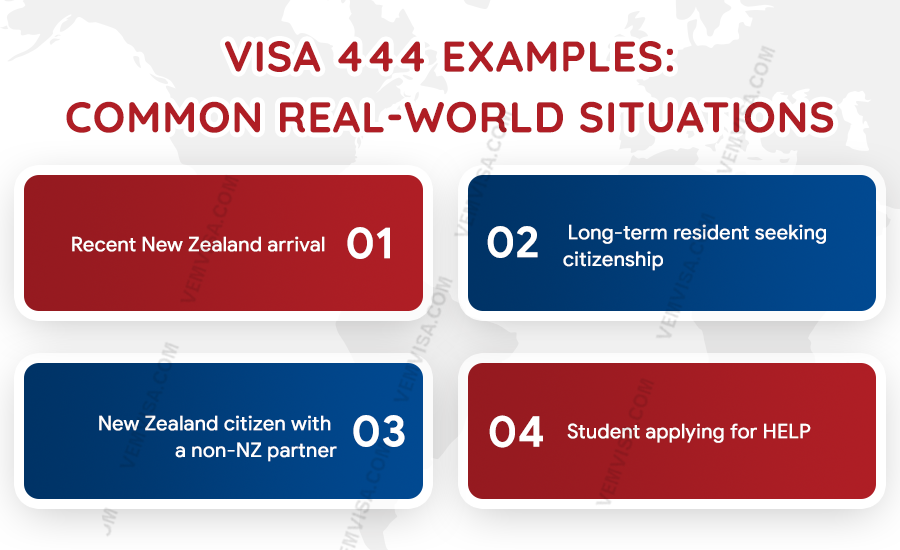
Visa 444 examples: common real-world situations
Recent New Zealand arrival
A New Zealand citizen enters on their New Zealand passport, receives an SCV and starts full-time employment. They may enrol in Medicare without waiting six months if they can show that they intend to live in Australia for at least six months.
Long-term resident seeking citizenship
An SCV holder has lived lawfully in Australia for more than four years but travelled frequently during the past year. Before applying, they must check both the overall 12-month absence limit and the final-year 90-day limit.
New Zealand citizen with a non-NZ partner
The New Zealand citizen may qualify for subclass 444, but the partner does not receive that visa through the relationship. Subclass 461 or another family pathway must be assessed against the couple’s exact circumstances.
Student applying for HELP
An SCV holder may qualify for a Commonwealth supported place, but a HELP loan also requires the long-term residence rules, including arriving as an eligible minor and meeting the 10-year, eight-year and 18-month conditions.
Common 444 visa mistakes
Calling the SCV permanent: an indefinite stay period does not turn subclass 444 into a permanent visa.
Assuming the same visa survives travel: the current SCV ceases when its holder departs Australia.
Entering on the wrong passport: a dual citizen using another passport may not receive subclass 444.
Ignoring citizenship absence limits: four years of residence alone does not satisfy every citizenship requirement.
Waiting unnecessarily for Medicare: some new arrivals can enrol earlier by proving an intended stay of at least six months.
Assuming all student finance is available: HELP loans require additional long-term residence conditions.
Treating every Centrelink payment identically: protected status and payment-specific rules can produce different outcomes.
Including family members automatically: non-New Zealand partners and children need their own appropriate visa or citizenship status.
Travelling with unresolved character issues: a previous grant does not ensure another grant after departure.
Using an old grant notice as current evidence: VEVO is the better source for checking a visa currently in effect.
If you need further assistance, please contact VEM. Our consultant, Mr. Peter Cao, aregistered migration agent(MARN: 1577877), with more than 10 years of experience in the migration field, will help you.
Unsure what your 444 visa means for citizenship or your family?
Review your VEVO record, travel history, protected status, citizenship timing, and any partner or child visa needs before relying on a migration pathway.
Do I need to apply for visa 444 before travelling?
Most eligible New Zealand citizens entering on a valid New Zealand passport are considered at the Australian border without a conventional advance application. People with character, health or immigration-history issues should check their position before travel.
Are children of 444 visa holders Australian citizens?
Children born in Australia on or after 1 July 2022 to an eligible New Zealand citizen holding an SCV may automatically become Australian citizens at birth. Different rules apply to children born earlier. Eligibility depends on the child’s birth date and the parent’s visa status at that time.
Can a 444 visa holder work full-time?
Yes. A valid SCV generally allows unrestricted work, including full-time employment and changing employers, subject to normal workplace and professional-licensing requirements.
Can a 444 visa holder buy property in Australia?
New Zealand citizens may be able to buy residential property in Australia, but the correct answer depends on the purchaser’s citizenship, relevant foreign-investment rules, ownership structure, lender requirements and state or territory taxes.
Do not assume that “temporary visa holder” automatically means a New Zealand citizen is treated the same as every other foreign purchaser. Equally, do not assume exemption from approval requirements, foreign-purchaser surcharges, land tax or lending restrictions without checking the exact transaction and current rules.
Can I get Medicare on a subclass 444 visa?
Yes, an eligible New Zealand citizen living in Australia can enrol in Medicare when the residence and identity requirements are satisfied. Services Australia says a New Zealand citizen can qualify by showing one of the following:
Evidence that they will live in Australia for at least six months.
Evidence that they have lived in Australia for at least six months during the previous 12 months.
Evidence that they live in Australia and have applied for permanent residence.
Are children born in Australia to SCV holders Australian citizens?
A child born in Australia on or after 1 July 2022 to a parent holding an SCV at birth may have acquired Australian citizenship automatically, subject to the applicable legal conditions. Older birth dates require separate historical analysis.
Can my non-New Zealand partner come to Australia on my 444 visa?
No. A non-New Zealand partner needs their own appropriate visa. The subclass 461 New Zealand Citizen Family Relationship visa or another family pathway may be relevant depending on both partners’ circumstances.
Mr. Phong Cao is a licensed migration agent by MARA (MARN: 1577877). He is also a member of the Migration Institute of Australia (MIA: 12648), one of the most reputable organizations in the field of immigration in Australia. In addition, Mr. Phong Cao holds a QEAC certification in study abroad consulting (QEAC: K580) and Australian real estate investment (RA85931). With over 12 years of experience in Australian immigration, he provides comprehensive solutions for studying and settling in Australia.

 VN
VN
 Người
đăng
Người
đăng Ngày
cập nhật:
Ngày
cập nhật: