Becoming an Australian citizen marks a major milestone for thousands of migrants each year. One of the key steps in this process is completing the Australian Citizenship Test. Below is a complete guide to help you understand how the test works, what to expect, and how to set yourself up for success.
What is Australian Citizenship Test?
The Australian Citizenship Test checks whether applicants have a solid understanding of:
- Australia’s values
- The nation’s history and democratic system
- The responsibilities and privileges of citizenship
The test follows a standard format that all applicants must meet:
- 20 multiple-choice questions
- You must score at least 75% (15 correct answers)
- You must correctly answer all 5 Australian values questions (100% accuracy)
- Test based entirely on the Australian Citizenship: Our Common Bond booklet
- Conducted in English at a Department of Home Affairs office

Passing the test shows you are ready to participate fully in Australian civic life, including the ability to vote, apply for an Australian passport, and enjoy the full legal rights of an Australian citizen.
What’s New for 2026 Australia Citizenship Test?
Although the structure of the test has not changed, several topics continue to trend among applicants:
- How to prepare efficiently for the test
- Where to find the latest practice questions
- What to expect after passing the test
- Whether rescheduling can be done online
- Understanding processing times leading into 2026
- How to strengthen English skills before the test day
For further information about the Australian citizenship requirements, you can refer to our article.
How to Prepare for the 2026 Citizenship Test?
Success comes from consistent preparation rather than cramming. Here are the most effective strategies:
1. Study the official resource booklet
All test questions come directly from the ‘Our Common Bond’ booklet, with focus especially on:
- Australia’s democratic beliefs
- Rights and responsibilities
- Local and federal government roles
- Australian symbols and national history
2. Complete practice tests
Practice tests will help you:
- Understand question styles
- Improve speed and confidence
- Identify gaps in your knowledge
3. Learn the Australian values
This is the only section you must get 100% right. You need to pay close attention to real-life examples of values, such as:
- Freedom of speech
- Equality under the law
- Respect for diversity
- Responsibility to obey the law

4. Join study groups & forums
Discussing questions with others can make learning easier and help you stay motivated. You can find a study group at:
- Community centres and local libraries
- Migrant support organisations
- Facebook groups for citizenship applicants
- Online forums like Reddit or dedicated citizenship test communities
- WhatsApp/Telegram study circles created by other applicants
5. Create notes and review
Short notes and flashcards can make revision simpler and more effective. Some smart ways to create notes include:
- Flashcards: Great for memorising facts such as national symbols, historical dates, or government functions.
- Mind maps: Useful for visual learners, helping connect topics like democracy, responsibilities, and rights.
- Highlighting key sections: Focus on the most important content from the official booklet.
- Daily revision: Even 10–15 minutes of review keeps information fresh.
Sample Practice Questions for 2026
Below are example questions similar to what you may encounter in the test:
- What is the capital city of Australia?
- a) Sydney
- b) Melbourne
- c) Canberra
- d) Brisbane
- Which option is a responsibility of Australian citizens?
- a) Serving on a jury if called
- b) Buying property
- c) Applying for a passport
- d) Voting in local council elections
- Which colours appear on the Australian national flag?
- a) Red, white, and blue
- b) Green and gold
- c) Blue and gold
- d) Red and green
- Which of the following statements about violence in Australia is correct?
- a) Verbal violence is acceptable if you are insulted.
- b) Physical violence is acceptable in self-defence only.
- c) Violence of any kind, physical or verbal, is illegal.
- d) Violence is a private matter and not enforced by the law.
- Which arm of government has the power to interpret and apply laws?
- a) Legislative
- b) Executive
- c) Judicial
- d) Constitutional

How to Apply for Australian Citizenship in 2026?
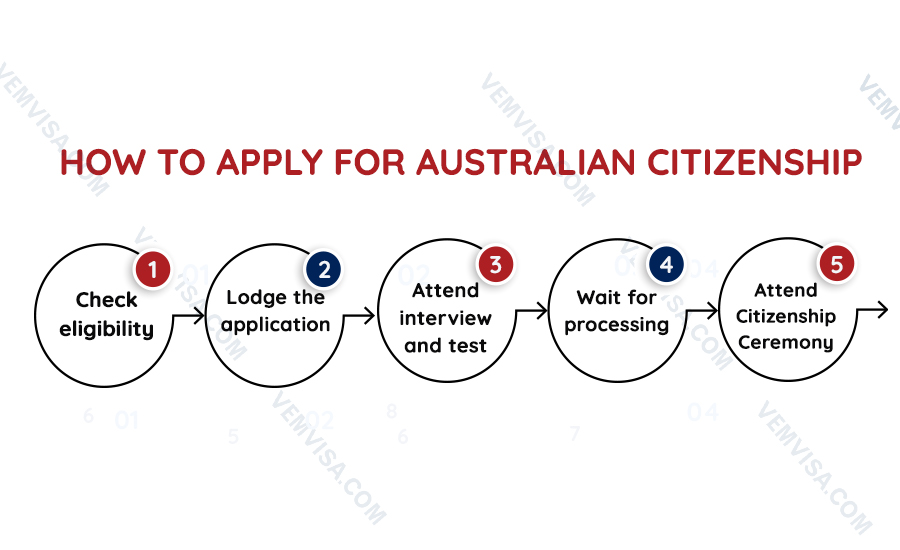
The citizenship process involves several steps:
Step 1. Check eligibility
Most applicants must:
- Be a permanent resident
- Meet the residency requirement
- Be of good character
Step 2. Lodge the application
Like Australian permanent visas, you need to submit the form online and upload the required documents when applying for Australian citizenship, such as:
- Identity documents
- Residency proof
- Character clearances
Step 3. Attend your interview and test
You’ll be invited to verify your identity and complete the test at a Home Affairs office.
Step 4. Wait for application processing
Processing times vary, so check for updates regularly.
Step 5. Attend a Citizenship Ceremony
Once approved, the final step is making the Citizenship Pledge. This is when you officially become an Australian citizen.
Common Mistakes to Avoid
There are some common mistakes you should avoid when taking the test:
- Leaving preparation too late
- Ignoring the values section
- Not reading the official booklet
- Assuming “common sense” knowledge is enough
How Migration Professionals Can Help
While the test itself is straightforward, the citizenship application process can be complex. A registered migration agent can assist by:
- Checking your eligibility
- Preparing your documents
- Guiding you through the interview and test requirements
- Managing communication with Home Affairs
- Helping resolve complex residency or character issues
Our migration consultant (MARN: 1577877) will provide personalised support throughout every stage of your citizenship journey, ensuring your application is accurate, complete, and processed as smoothly as possible.
By: Peter Phong D Cao – Registered migration agent
(MARN: 1577877, MIA: 12648)
CEO and Founder of VEM
Mr. Phong Cao is a licensed migration agent by MARA (MARN: 1577877). He is also a member of the Migration Institute of Australia (MIA: 12648), one of the most reputable organizations in the field of immigration in Australia. In addition, Mr. Phong Cao holds a QEAC certification in study abroad consulting (QEAC: K580) and Australian real estate investment (RA85931). With over 12 years of experience in Australian immigration, he provides comprehensive solutions for studying and settling in Australia.

 VN
VN

 Người
đăng
Người
đăng Ngày
cập nhật:
Ngày
cập nhật: